




Low-Silica Quartz Explained: Composition, Testing and Market Limits
Low-silica quartz is a commercial name for engineered stone formulated to contain less crystalline silica than conventional quartz slabs. It is not the same as silica-free, and a lower content does not make a slab risk-free or automatically lawful in every market. The percentage, the test method, the report date, and the destination country’s rules all have to be checked before a buyer relies on the name.
What is crystalline silica, and how does it differ from “silica” in general?
Silica is silicon dioxide (SiO2). That chemical formula covers more than one structure. Crystalline silica has an ordered crystal lattice. OSHA and NIOSH identify the forms most often discussed in workplace health as quartz, cristobalite, and tridymite. Safe Work Australia’s guidance on the model WHS Regulations also includes tripoli among the crystalline polymorphs of silica.
Amorphous silica is also silicon dioxide, but it lacks that ordered crystal structure. Recycled glass, for example, can contain amorphous silica. A laboratory result for “total silica” or “total SiO2” is therefore not the same as a result for crystalline silica. Occupational exposure limits used in fabrication shops are written for respirable crystalline silica (RCS)—very small airborne particles that can reach the lungs.
Marketing language sometimes treats “silica,” “quartz,” “low-silica,” and “silica-free” as if they were interchangeable. They are not. A buyer who needs to manage fabrication risk, or to decide whether a slab is permitted in a given country, should ask for crystalline silica as a weight/weight percentage, named as quartz, cristobalite, and tridymite where the method identifies them, together with the method and detection limit.
| Term | What it usually means | Why buyers should not treat it as a substitute for the others |
|---|---|---|
| Crystalline silica | Silicon dioxide in crystalline form, commonly quartz, cristobalite, or tridymite | This is the family of substances addressed by respirable-crystalline-silica exposure rules |
| Amorphous silica | Silicon dioxide without a crystalline lattice | It is not RCS, but dust from products that contain it can still require controls; it does not prove a product is harmless |
| Total silica / total SiO2 | A broader chemical measure that may include crystalline and non-crystalline forms | A total-silica figure can overstate or obscure the crystalline fraction, depending on the method |
| Mineral quartz | The most common crystalline form of silica, and a typical aggregate in conventional engineered quartz | A “quartz surface” brand name does not, by itself, disclose the crystalline-silica percentage of that slab |
What can “low-silica” mean, and why do the percentage and test method matter?
“Low-silica” is not a single legal grade with one accepted number. In the stone trade it usually means that the manufacturer has reduced the crystalline-silica content compared with conventional engineered quartz. Conventional products can be very high in crystalline silica. A joint OSHA/NIOSH hazard alert on countertop work states that crystalline silica can comprise up to 95% of the material in engineered stone, and its summary table gives a typical range of less than 0.2% to 95%. The same document notes that some polymer-resin engineered stones contain less than 50% crystalline silica, and that some recycled-glass products in a portland cement matrix have less than 0.2%. Exact content, it says, can be determined by petrographic analysis and X-ray diffraction on each stone.
Because that range is so wide, the word “low” has little meaning until it is attached to a number, a method, and a sample. A slab that contains 40% crystalline silica is “lower” than a 90% slab, but it is not low in any regulatory sense that treats 1% as a threshold, and it is not silica-free. A slab at 0.8% may fall on one side of a legal definition in one country and still require strict dust controls in another. Results can also differ if laboratories use different methods, sample preparations, or detection limits.
Formulation approaches vary. Some manufacturers reduce quartz or cristobalite aggregate and introduce other mineral fillers or glass; some products are closer to a different material category, such as a cement- or glass-based composite. This article does not attribute a recipe to Aspire Stone, because the company has not published a crystalline-silica percentage or a raw-material formula for the models in this range.
Aspire Stone does offer a low-silica and silica-free quartz surfaces series. The series page, checked on 23 November 2026, says these slabs are engineered quartz surfaces “made with a lower crystalline-silica content, or with a silica-free formulation, compared with conventional quartz,” and lists them for kitchen countertops, vanity tops, and commercial interiors, “including projects where fabricators want a lower-silica slab option.” Current designs named there include Calacatta Athens, Bianca Gloria, Onda White, and Galaxy White, among others. The listings are not split into a verified “low-silica” group and a verified “silica-free” group, and they do not publish crystalline-silica percentages. Until a current accredited report is provided for a named model, a catalogue name should not be used as a substitute for a test result.
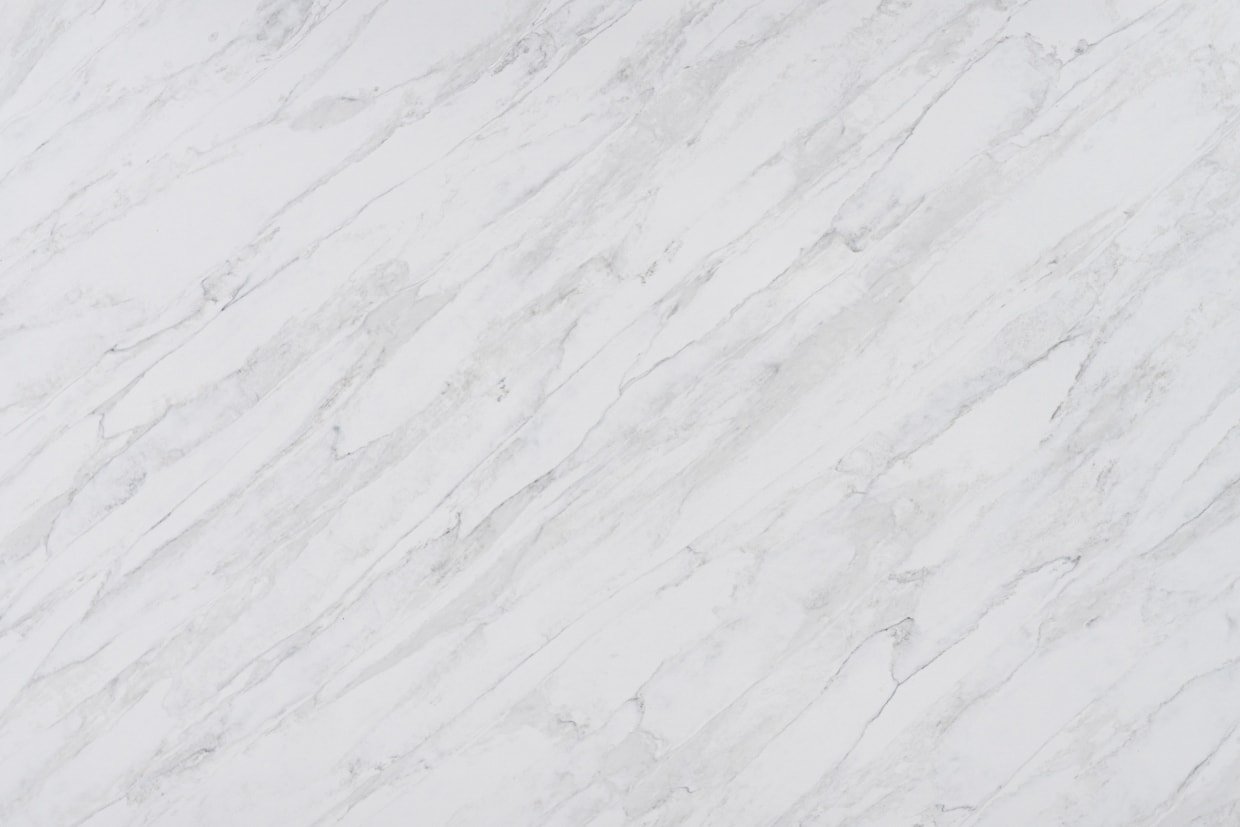
Bianca Gloria, a named model from Aspire Stone’s live series pages. This photograph is not a silica-content claim.
Does a lower crystalline-silica content remove fabrication risk?
No. The health concern in fabrication is inhalation of respirable crystalline silica generated when slabs are cut, ground, drilled, or polished, especially with dry methods and poor dust control. OSHA and NIOSH describe silicosis as an incurable, progressively disabling, and potentially fatal lung disease, and they associate RCS exposure with increased risk of lung cancer, COPD, tuberculosis, and kidney disease.
Reducing the crystalline-silica content of a slab can reduce the amount of RCS available to become airborne, but it does not automatically bring exposure below a legal limit, and it does not make uncontrolled cutting acceptable. Even a “low” residual percentage can generate RCS if enough material is worked without suitable controls. Dust from resin, pigments, and non-crystalline fillers can also be generated.
Jurisdictions regulate this in different ways, and those rules should not be mixed.
- In the United States, OSHA’s general-industry standard, 29 CFR 1910.1053, requires the employer to keep employee exposure at or below 50 μg/m3 as an 8-hour time-weighted average. The action level is 25 μg/m3. Construction work is covered by 29 CFR 1926.1153. These are exposure limits and control duties, not a product ban.
- In Great Britain, the Health and Safety Executive states that the workplace exposure limit for RCS is 0.1 mg/m3 (100 μg/m3) as an 8-hour TWA, under COSHH. That limit is not the same as OSHA’s, and lawful handling under one regime does not approve a product under the other.
- Australia has gone further for a defined product category. Safe Work Australia states that, from 1 July 2024, the manufacture, supply, processing, and installation of engineered stone benchtops, panels, and slabs is banned under the model WHS Regulations as implemented by the Commonwealth and the states and territories. From 1 January 2025, those products are also prohibited imports under regulation 5M of the Customs (Prohibited Imports) Regulations 1956. Details can vary by jurisdiction.
Safe Work Australia defines engineered stone, for those model regulations, as an artificial product that contains at least 1% crystalline silica as a weight/weight concentration, is created by combining natural stone materials with other chemical constituents such as water, resins, or pigments, and becomes hardened, with listed exclusions such as concrete, ceramic tiles, and resin-free porcelain or sintered stone. An artificial stone benchtop, panel, or slab that contains less than 1% crystalline silica is, SWA states, not subject to that ban, because the definition requires at least 1%.
That 1% line is a legal definition in that Australian context. It is not a health guarantee, and it is not a global standard. Safe Work Australia’s July 2025 review recorded a common misconception “that if a product is not prohibited, it must be safe to work with.” The same review found that there is no nationally recognised, standard approach in Australia to test whether a product is engineered stone, and recommended urgent work to develop testing criteria. A “low-silica” label, without a current report that matches the destination country’s definition and method, is not evidence of compliance.
This article does not claim that any Aspire Stone product is below 1% crystalline silica, is excluded from the Australian ban, or meets any other country’s rules. No such product test was verified for this article.
What documents should buyers request?
| Document | What it should show |
|---|---|
| Composition statement for the named model | The model name and code, the production period or batch if available, and the crystalline-silica content the manufacturer is prepared to stand behind |
| Accredited laboratory report | The laboratory’s name, accreditation, the sample identity, the date, and the result for crystalline silica as weight/weight, ideally broken down by quartz, cristobalite, and tridymite |
| Test method and detection limit | The analytical method (often X-ray diffraction for crystalline forms) and the limit of detection or quantification. A “not detected” result is not the same as a proven zero |
| Sample description | Whether the test was run on the finished slab, a reserved production sample, or a substitute colour. Results should not be transferred casually from one model to another |
| Safety data sheet or equivalent | Declared hazardous constituents and any fabrication or dust-control advice the supplier issues |
| Market-specific advice, kept separate from the test | If a supplier comments on a country’s rules, that comment is not a substitute for the report, or for legal advice in that jurisdiction |
X-ray diffraction is widely used to identify and quantify crystalline silica in stone, and OSHA and NIOSH point to XRD and petrographic analysis for determining exact content in countertop materials. Methods written for airborne filter samples, such as NIOSH Method 7500, are not automatically the same protocol as a bulk analysis of a slab. Buyers should record the method actually used on the product sample. A related guide, what buyers should verify for low-silica and silica-free surfaces, is intended to go further on document checks. The health context for RCS is covered in silica health risks. For silica-free claims, see silica-free surfaces, testing, and market requirements.
How should buyers treat “low-silica” in different markets?
Treat the destination country’s current official text as the starting point, then match the product file to that text. Do not borrow a definition from another country, and do not rely on a brochure that names no method or date. In Australia, the questions include whether the product is a benchtop, panel, or slab, whether it meets the engineered-stone definition (including the 1% threshold and the presence of a binder such as resin), and whether import rules administered by the Australian Border Force apply. In the United States or Great Britain, a countertop material may still be sold while fabrication remains subject to RCS exposure limits; a marketing name does not remove those duties. In any other market, obtain the current official rule before using words such as “compliant,” “approved,” or “ban-exempt.”
Kitchen, vanity, and commercial applications for these slabs are the same kinds of work surfaces used for other engineered quartz, and Aspire Stone’s series page lists those uses. Suitability still depends on size, thickness, finish, and appearance, and, separately, on whether the composition file meets the buyer’s market requirements. A design decision and a compliance decision should not be collapsed into one sentence. For the wider choice of a kitchen slab, see how to choose a kitchen slab.
For a wider view of how materials, printing, and market rules are changing, see materials, technology, and market forces shaping engineered stone.
FAQ
What is low-silica engineered stone?
It is a trade description for engineered stone made with less crystalline silica than conventional quartz slabs, which can contain very high crystalline-silica levels. The term has no single worldwide numerical definition. The buyer should ask for a percentage, a method, and a current report for the named model.
How is silica content measured?
Crystalline silica in stone is commonly determined by X-ray diffraction, sometimes with petrographic analysis. The report should state the method, the date, the sample, and the detection limit. A figure for total silica or SiO2 is not a substitute for a crystalline-silica result. In Australia, Safe Work Australia has noted that identifying engineered stone can require more than one type of analysis and that there is not yet a nationally recognised standard test approach.
Does low silica mean silica-free?
No. Low-silica means a reduced crystalline-silica content, not the absence of crystalline silica. Silica-free is a separate, and often stricter, commercial claim that also requires testing. The two should not be used interchangeably.
Is low-silica quartz safe to fabricate?
Not automatically. A lower crystalline-silica content may reduce, but does not necessarily eliminate, respirable crystalline silica in dust, and it does not remove the need for dust controls required by local law. “Safe,” “risk-free,” and “ban-compliant” are not conclusions this article draws for any unnamed or untested slab.
Does Aspire Stone publish the crystalline-silica percentage for these products?
Not on the series or product pages checked on 23 November 2026. Those pages group low-silica and silica-free surfaces together and do not state a percentage or a test method. Buyers should request a current accredited report for the specific model.
Ask for the report before you rely on the name
If you are considering a lower-crystalline-silica slab, treat the live low-silica and silica-free series as a catalogue of designs, not as a compliance certificate. Request a composition statement and an accredited laboratory report for the named model, then compare that file with the official rules of the destination market.


 WhatsApp
 EMAIL