




Health Risks of Silica in Engineered Stone, and How Shops Limit Exposure
Crystalline silica is silicon dioxide in crystal form, present in many stones, including conventional engineered quartz. Cutting, grinding, drilling, or polishing those materials can release respirable crystalline silica—particles small enough to reach the lungs. Official occupational-health sources associate that exposure with serious disease. This article explains the science and the limits of workplace controls. It is not medical advice and not legal advice.
What is silica, and which form matters in stone shops?
Silica is silicon dioxide (SiO2). That formula covers more than one structure. Crystalline silica has an ordered crystal lattice. OSHA and NIOSH identify the forms most often discussed in workplace health as quartz, cristobalite, and tridymite. Safe Work Australia’s model work health and safety framework also includes tripoli among the crystalline polymorphs of silica.
Amorphous silica is also silicon dioxide, but it lacks that ordered lattice. Recycled glass, for example, can contain amorphous silica. A laboratory result for “total silica” or “total SiO2” is therefore not the same as a result for crystalline silica. Occupational exposure rules used in fabrication shops are written for respirable crystalline silica (RCS): very small airborne particles that can reach deep into the lungs.
These terms are often mixed in marketing. They should be kept apart.
| Term | What it usually means | Why it should not be treated as a substitute for the others |
|---|---|---|
| Crystalline silica | Silicon dioxide in crystalline form, commonly quartz, cristobalite, or tridymite | This is the family of substances addressed by respirable-crystalline-silica exposure rules |
| Amorphous silica | Silicon dioxide without a crystalline lattice | It is not RCS, but dust from products that contain it can still require controls; it does not prove a product is harmless |
| Mineral quartz | The most common crystalline form of silica, and a typical aggregate in conventional engineered quartz | A “quartz surface” brand name does not, by itself, disclose the crystalline-silica percentage of that slab |
| Engineered stone | A manufactured slab or similar product; legal definitions differ by country | In Australia the term is defined in work health and safety law; it is not a global product grade |
| Low-silica / silica-free | Commercial claims about reduced or undetected crystalline silica | Neither name, on its own, is a test result, a risk assessment, or proof of legal status |
For how those commercial claims should be read, see what low-silica quartz is, and how the term should be used and how silica-free surface claims are explained and limited.
How does stone cutting create respirable crystalline silica dust?
Respirable particles are much smaller than the grit that settles on a workbench. OSHA and NIOSH describe RCS as typically around 100 times smaller than ordinary sand, small enough to become trapped in lung tissue. Those particles become airborne when a tool cuts, grinds, drills, edges, contours, or polishes stone that contains crystalline silica, and when settled dust is disturbed by dry sweeping or compressed air.
The 2026 OSHA/NIOSH Hazard Alert (OSHA 3768 / NIOSH 2026-101) identifies high-exposure tasks in countertop manufacturing, finishing, and installation. Workers using powered hand tools—saws, grinders, and high-speed polishers—can have some of the highest exposures, in the shop and on the job site. Nearby workers and people who do maintenance or housekeeping can also be exposed. In plants that manufacture engineered stone, the same alert notes exposure when silica powder and bulk raw materials are handled and when dust collectors are maintained.
Finished-product composition and workplace exposure are related, but they are not the same issue. A slab’s crystalline-silica percentage describes the material. Exposure describes the air a person breathes, which also depends on the task, the duration, the tools, the controls in use, and housekeeping. A lower content can reduce the amount of crystalline silica available to become dust, but it does not automatically make a task safe, and a high content does not, by itself, tell you the airborne concentration on a given day.
OSHA and NIOSH report typical crystalline-silica ranges that vary widely. In the 2026 Hazard Alert, engineered stone is described as ranging from less than 0.2% to 95% crystalline silica, granite at 10–50%, and marble or limestone at less than 5%. Those figures are typical ranges, not a specification for any named product. The exact content of a given slab has to be determined by analysis of that material.
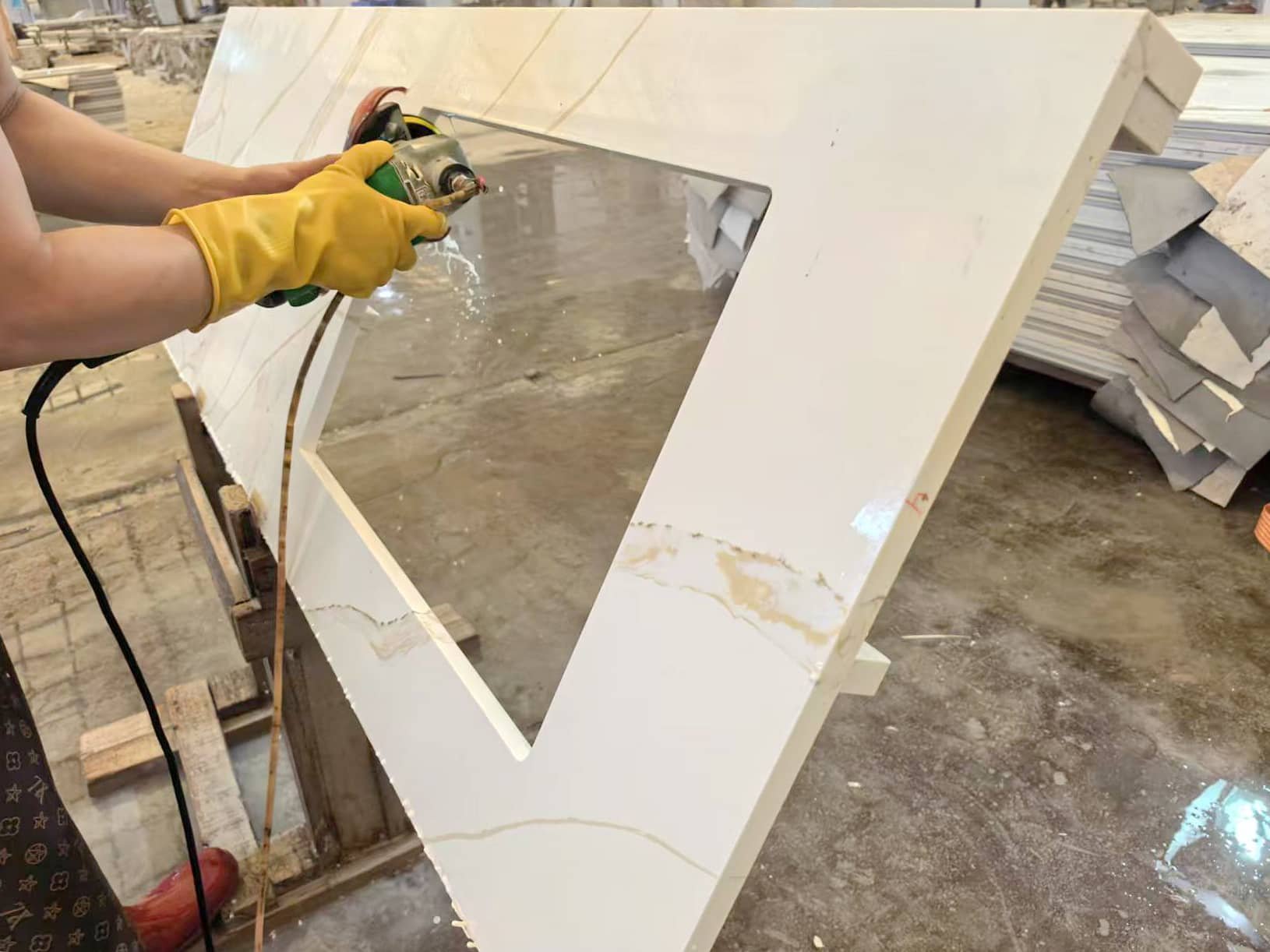
Wet polishing at a sink cut-out in the Aspire Stone workshop. This photograph is not evidence that wet work eliminates silica-dust risk.
What health risks are associated with silica exposure?
OSHA and NIOSH state that workers who inhale very small dust particles containing RCS are at risk for silicosis, which they describe as an incurable, progressively disabling, and potentially fatal lung disease. RCS can become trapped in lung tissue, causing inflammation and scarring and reducing the lungs’ ability to take in oxygen. Symptoms can include shortness of breath, cough, and fatigue. The timeline depends on the duration and intensity of exposure.
The same official sources state that RCS exposure also puts workers at increased risk for lung cancer, chronic obstructive pulmonary disease (COPD), tuberculosis, and kidney disease, and is associated with autoimmune disorders and cardiovascular damage. The UK Health and Safety Executive (HSE) likewise describes silicosis as causing irreversible loss of lung function, notes that the effect can continue after exposure stops, and states that silica may also be linked to lung cancer and that workers with silicosis are at increased risk of tuberculosis, kidney disease, and arthritis. HSE also states that exposure to RCS may cause COPD. NIOSH’s 2026 silica overview adds that silicosis is not reversible but is preventable. Damage can occur before symptoms are obvious. None of these statements is a diagnosis.
This summary is drawn from those official publications. It is not a complete medical review, and it does not rank products or workplaces.
How can fabricators reduce exposure—without treating controls as a guarantee?
Official guidance uses a hierarchy of controls: elimination or substitution, then engineering controls, then administrative controls, then personal protective equipment. OSHA and NIOSH present that order because earlier steps reduce the hazard at source; later steps depend more on consistent use. A workplace programme that follows this hierarchy can reduce exposure. It does not guarantee that risk is eliminated, and no single measure should be described as sufficient on its own.
Engineering and work-practice examples in the 2026 Hazard Alert include isolating high-exposure tasks with booths or enclosures and local exhaust ventilation (LEV); avoiding dry cutting, grinding, sweeping, and compressed air; preferring wet methods and, where practical, remote-controlled tools with water-spraying systems; capturing dust near its origin with LEV; and, where needed, combining water and LEV. The alert also stresses equipment maintenance and warns that dry sweeping or compressed air can put settled dust back into the air.
Wet cutting is an important control. It is not a complete solution. HSE’s guidance on working engineered stone notes that the mist generated by water suppression itself contains crystalline silica and has to be controlled. Ordinary disposable masks are not a respiratory-protection programme. Where respirators are required, official rules generally call for proper selection, training, and, for tight-fitting types, fit testing, under the law that applies at the workplace. This article does not recommend a single respirator as universally sufficient; that decision belongs to local rules and competent advice.
A more detailed workshop discussion, including housekeeping and training, is in silica dust safety in stone fabrication.
What should a workplace programme include?
Rules differ by country, but official sources repeatedly point to the same building blocks. Employers should identify tasks that can generate RCS, assess exposures where the law requires it, and use engineering and work-practice controls as the first line of protection. They should train workers, in a language they understand, about the hazard and the controls in use. Housekeeping should avoid methods that redisperse dust. Medical surveillance, where required, is a legal and occupational-health duty, not a substitute for dust control.
In the United States, OSHA’s general industry standard, 29 CFR 1910.1053, still sets a permissible exposure limit (PEL) of 50 µg/m3 as an 8-hour time-weighted average and an action level of 25 µg/m3 as an 8-hour TWA (verified 23 November 2026). It also addresses exposure assessment, a written exposure control plan, housekeeping, respirators where required, training, and medical surveillance. Construction work is covered separately under 29 CFR 1926.1153. Those figures are US law. They are not a worldwide limit and they are not a product ban.
In Great Britain, HSE states that the workplace exposure limit for RCS is 0.1 mg/m3 as an 8-hour TWA, and that exposure is also subject to the Control of Substances Hazardous to Health Regulations 2002 (COSHH). Health surveillance is required where workers are regularly exposed to RCS dust and there is a reasonable likelihood that silicosis may develop. Those are GB rules, not a global standard.
Composition files, safety data sheets, and marketing names help a shop understand what is being processed. They do not replace air monitoring, local legal duties, or a functioning control programme. Country rules for the product itself are a separate question, discussed in the engineered-stone regulations overview for importers and fabricators.
Where can employers find official resources?
The following official starting points were fetched on 23 November 2026 (Asia/Shanghai, UTC+8). Always open the current page or instrument before relying on a figure or duty.
| Jurisdiction | Official starting point | What it addresses |
|---|---|---|
| United States | OSHA 29 CFR 1910.1053 and 1926.1153; OSHA/NIOSH Hazard Alert OSHA 3768 (NIOSH 2026-101); NIOSH silica pages | Workplace exposure limits, assessment, controls, medical surveillance, and countertop-industry recommendations. Not a federal product ban. |
| Great Britain | HSE silicosis page; COSHH; EH40 workplace exposure limits; HSE “Working engineered stone” guidance and COSHH essentials ST3A | WEL, employer duties, health surveillance, and task guidance. Not a product ban. |
| Australia | Safe Work Australia engineered stone ban page and model WHS materials; jurisdictional WHS regulators | A product prohibition on certain engineered-stone benchtops, panels, and slabs, plus broader crystalline-silica workplace duties. Check the local regulator, because implementation can vary. |
| Canada | CCOHS engineered-stone fact sheet, plus the occupational health and safety law of the relevant province or territory | CCOHS states that each jurisdiction has legislated exposure limits, and that some provinces and territories also have control-programme requirements. No national product ban is stated in that fact sheet. |
If you are comparing materials, ask for a current crystalline-silica report on the named product and batch, then read it against the destination country’s official text. Aspire Stone can discuss composition statements, laboratory reports, and related paperwork with buyers through its contact page. Those files, if provided, still have to be checked; this article has not verified any Aspire Stone test report, and a document is not proof that a workplace or destination market is satisfied.
For shops that want a practical control checklist, continue to silica dust safety in stone fabrication. For how countries treat the product itself, start with engineered stone regulations.
FAQ
What is respirable crystalline silica?
Respirable crystalline silica is quartz, cristobalite, and/or tridymite in airborne particles small enough to reach deep into the lungs. OSHA defines it by reference to respirable-particle-size-selective sampling (ISO 7708:1995). It is not the same as visible grit, total silica, or amorphous silica, and it is not the same thing as a slab’s bulk composition percentage.
How does stone cutting create silica dust?
Powered cutting, grinding, drilling, edging, contouring, and polishing of stone that contains crystalline silica can release very fine particles into the air. OSHA and NIOSH also identify exposure from dry cleanup, compressed air, and, in manufacturing plants, from handling silica powder and maintaining dust collectors. Nearby workers can be exposed even if they are not operating the tool.
What health risks are associated with silica exposure?
Official OSHA, NIOSH, and HSE publications associate RCS exposure with silicosis, lung cancer, and COPD, and they discuss increased risks that include tuberculosis and kidney disease. Silicosis is described as incurable and potentially fatal. This is occupational-health information, not a personal diagnosis or a prediction for any one worker.
How can fabricators reduce exposure?
Use the hierarchy of controls required or recommended by the regulator that covers the workplace: consider lower-silica or non-crystalline-silica materials where they are lawful and genuinely lower risk, then engineering controls such as wet methods and local exhaust ventilation, then work practices, training, housekeeping, and, where required, a proper respiratory-protection programme and medical surveillance. Wet cutting, ventilation, and ordinary masks do not fully eliminate risk, and a written programme does not guarantee safety.
Does a low-silica or silica-free slab remove the need for dust controls?
No. A lower or undetected crystalline-silica content may change the amount of RCS available from that material, but other dusts can still be generated, and residual crystalline silica, if present, can still become airborne. Official Australian review material has also recorded concern that some products marketed as “silica free” contain amorphous silica, which can lead workers to assume the dust is not hazardous. Controls should be set by a risk assessment and by local law, not by a brochure.
Is this the same as a product ban?
No. Most of the rules summarised here are workplace exposure rules. A product prohibition, such as Australia’s restrictions on certain engineered-stone benchtops, panels, and slabs, is a separate legal question and must be read in that country’s current official text.


 WhatsApp
 EMAIL