




Full-Body vs Printed Quartz: How Cut Edges and Miters Differ
Full-body, or through-body, quartz means the colour or pattern is present through the thickness of the slab, so a cut edge resembles the face. Printed quartz generally means the visible design is applied by a printing or heat-transfer process, which may be concentrated at or near the surface. The terms are not standardised, and a “full-body printed” option should be judged on a cut edge, not on the name alone.
What does full-body quartz mean?
In surfaces, “full-body,” “through-body,” and “full-depth pattern” are used to say that the look is not only a skin. On a true through-body slab, a saw cut, a sink cut-out, or a profiled edge still shows a colour or vein related to the face, because the decorative material was distributed through the mix, or otherwise carried through the thickness, during manufacture.
That definition is a practical one for fabricators. It is not a single certified term. Different factories use “full-body” for slightly different constructions. Some conventional veined quartz is mixed through the slab and shows movement on the edge. Some decorative veins are richer on the face than in the core. The only reliable check is to look at a cut and polished edge from the same model and process that will be supplied.
Conventional engineered quartz is formed by combining mineral aggregate, resin, and pigments, then pressing and curing the slab. ISFA 3-01 (2013) describes that general construction. How the vein or colour is introduced—throughout the mix, in layers, or mainly on the face—is a process choice, and it is the process choice that decides what an edge will look like. For the forming sequence itself, see how quartz slabs are made.
What is printed or decorated quartz in this comparison?
Printed quartz, in the sense used on Aspire Stone’s site, is engineered quartz whose design is applied by thermal-transfer or heat-transfer printing. The printed quartz stone slabs page, checked on 23 November 2026, says the company uses high-resolution thermal-transfer printing on an engineered quartz surface, that designs can be consistent from slab to slab, and that full-body printed options are available. The About page refers to “heat-transfer ink full-body designs.” A fuller account of that product type is in what printed quartz stone is, and how the pattern is applied.
Two points follow from that published wording. First, a printed face can look highly detailed and repeatable, including Calacatta-style looks discussed in what Calacatta quartz is. Second, “printed on an engineered quartz surface” and “full-body printed” are not automatically the same construction. The first phrase describes a surface decoration. The second is a supplier option that must be defined and inspected. This article does not treat a surface print as through-body, and it does not assume that every printed model is full-body.
Industry equipment literature is a useful caution, not a description of Aspire Stone’s line. Breton’s published Chromia process, for example, states that colour can diffuse into the resin matrix to a depth of up to 300 microns (0.3 mm). That is deeper than a purely superficial ink film, and it can survive polishing, but 0.3 mm is still a near-surface zone on a 20 mm or 30 mm slab. A mitered edge, which exposes the thickness of the sheet, would not automatically show the face pattern after a decoration of that depth. If a factory uses the words “full-body printed,” the buyer should ask whether the pattern occupies the full thickness or only a decorated zone, and should verify the answer on a sample.
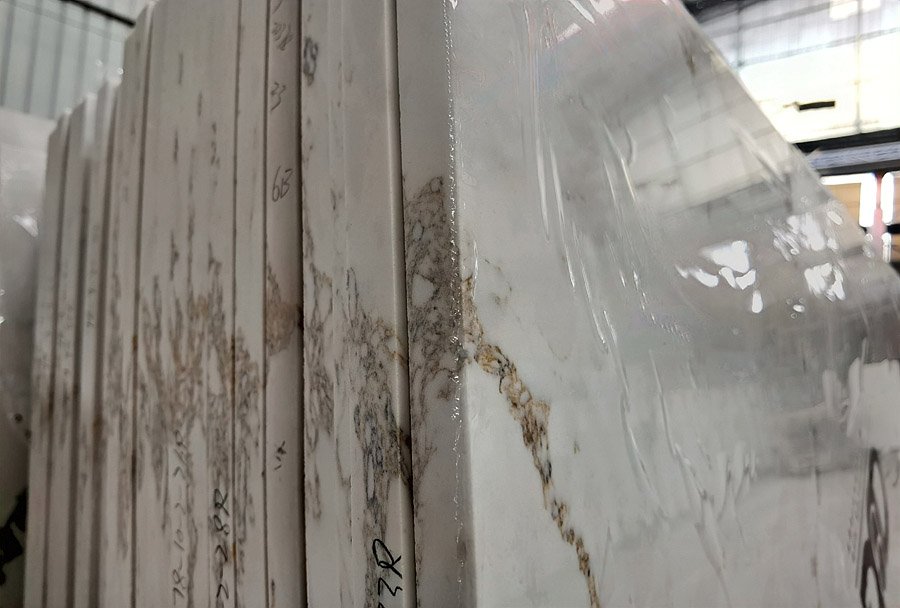
Stacked slabs at the factory, showing cut edges beside the finished faces. The photograph does not by itself identify through-body or surface-only construction.
How do pattern depth, edges, consistency, and design flexibility compare?
| Factor | Full-body / through-body patterned quartz | Printed or heat-transfer decorated quartz |
|---|---|---|
| Where the pattern sits | Colour or veining is intended to be present through the thickness, subject to verification on a cut edge | The visible design is applied by printing or heat-transfer and may be limited to the face or a near-surface zone, unless a verified full-body printed construction is supplied |
| Face appearance | Can be very convincing, though fine “photographic” detail is usually harder to mix than to print | Can carry fine graphic detail and stone-inspired looks with a consistent design from slab to slab, as Aspire Stone states for its printed series |
| Cut-edge appearance | A genuine through-body slab should still show related colour or movement on the edge | A surface or near-surface print may reveal a plainer body colour on the edge, at a sink cut-out, or on a miter return |
| Visual consistency | Depends on the veining method and the production lot; still review full slabs | Often stronger on face pattern repeatability; still review the lot and the edge, not only a chip |
| Design flexibility | Limited by what can be created in the mix | Broader graphic range is possible, including special or bookmatched artwork where the factory agrees to supply it |
| Best checked by | Face, cut edge, and finished profile on the same model | Face, cut edge, and finished profile, plus a clear statement of whether the order is surface-printed or full-body printed |
Cost and production complexity are sometimes assumed to favour one method. This article does not rank price, because no verified cost comparison for Aspire Stone’s constructions was available. Buyers should request a quotation for the named model, thickness, finish, and construction rather than assuming that printed is cheaper, or that full-body is automatically more expensive.
What happens after cutting, edge profiling, and mitering?
A straight polished edge is the first place a construction difference appears. On a through-body colour or a well-distributed vein, the edge still belongs to the same design. On a face-only decoration, the edge can look like a different, usually simpler, material. That contrast is not a defect if the project only shows the face and a thin eased edge. It becomes a design problem on a visible thick edge, a waterfall, or an open shelf.
Edge profiles increase the visible thickness of that cut face. A bullnose, ogee, or laminated build-up turns more of the core toward the viewer. If the pattern does not continue, the profile will frame the worktop with a band of body colour.
Mitered edges are the most demanding case. A miter folds a second face into view, as if the slab were thicker, or it creates a waterfall panel. If only the original face is patterned, the return can fail to continue the vein. For mitered islands and waterfall ends, a verified through-body or verified full-body printed construction is usually the safer specification. “Usually” is deliberate: the sample edge, not the marketing name, should decide.
Undermount sink cut-outs and hob holes show the same issue in a smaller area. The inside of the cut is often visible at close range. A fabricator should polish that edge and agree with the client, before cutting, whether a different core colour is acceptable.
Aspire Stone states that printed quartz can be cut and edge-polished like other engineered quartz. That statement is about workability, not about edge pattern. Standard quartz fabrication practice still applies: support the sheet, use appropriate tooling, and control dust in line with the applicable silica rules for the actual composition of the slab.
How should fabricators and buyers inspect the difference?
- Look at the face of a full slab or a large sample in the intended finish, not only a 10 cm chip.
- Ask the supplier to state the construction in writing: conventional through-body, surface printed, or full-body printed, using the supplier’s own definition.
- Inspect a cut edge from the same construction, preferably after it has been polished or profiled as it will be on the job.
- If miters or waterfalls are planned, look at a mitered corner or a photograph of a finished miter in that construction.
- Compare background colour in the core with the face. A close match may be acceptable even when veins do not continue; a strong contrast will read as a frame.
- Keep the approved sample, with its edge, as the reference for production.
This inspection is more useful than a debate about terminology. Two suppliers can use “full-body” and mean different things. A polished off-cut answers the question in seconds.
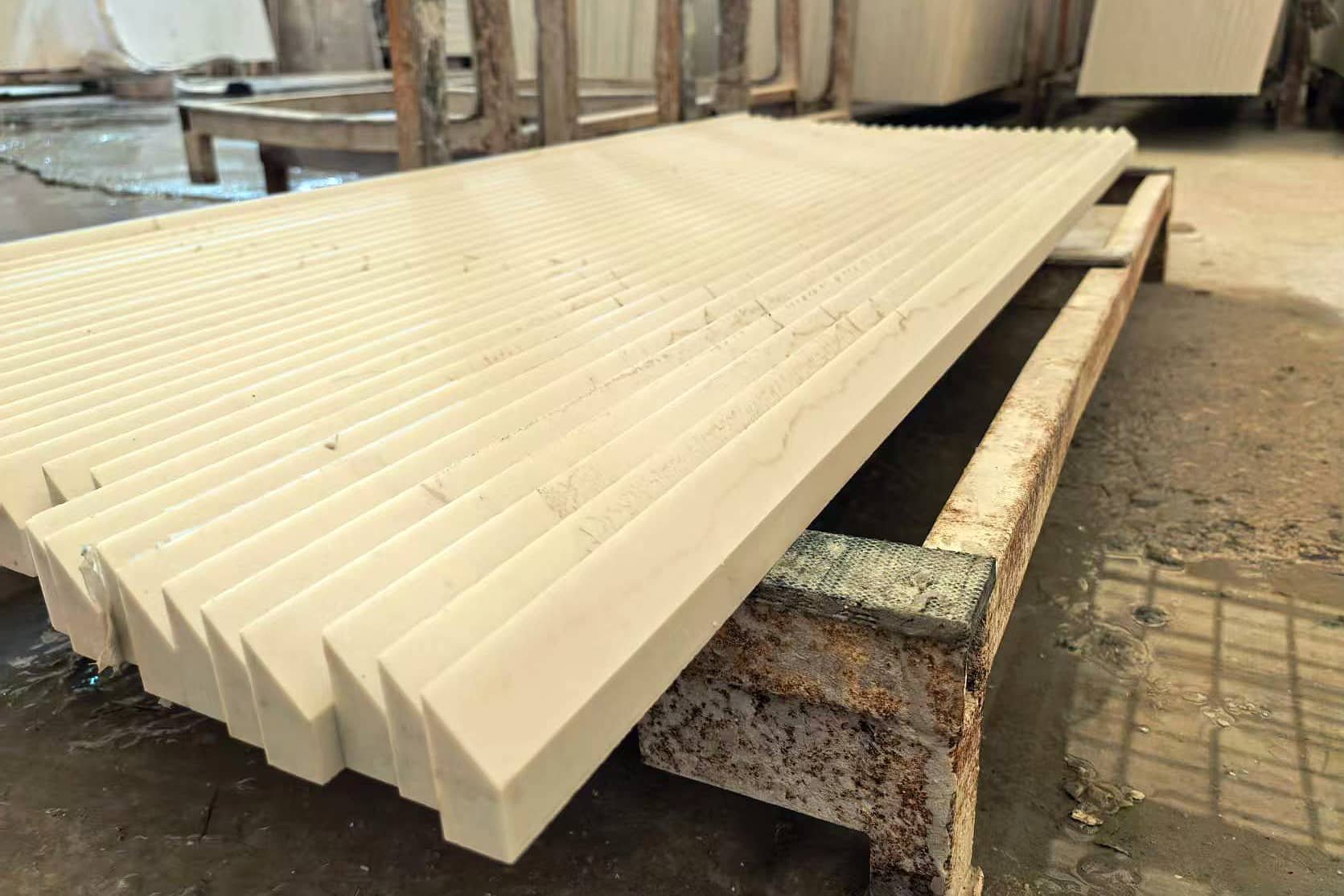
Profiled (fluted) edges on cut-to-size quartz pieces in the Aspire Stone workshop.
Which construction should be chosen for which application?
Choose a verified through-body or verified full-body construction when the edge will be seen: mitered islands, waterfall ends, thick laminated edges, open shelving, and some commercial reception desks. Choose a printed face when the priority is pattern detail, repeatability across many rooms, or a specific graphic, and when the edge will be thin, covered, or otherwise unimportant—or when a sample shows that the supplied printed construction already satisfies the edge.
Kitchens can use either construction. The deciding details are the island thickness, the sink type, and whether a waterfall is part of the design. Vanity tops with a simple eased edge are often less sensitive to core appearance. Feature walls and bookmatched panels depend more on face artwork than on edge pattern, unless the panels are thick or returned.
FAQ
What does full-body quartz mean?
In practical specification language, it means the colour or pattern is present through the thickness of the slab, so a cut edge resembles the face. The term is not standardised. Always confirm it by inspecting a cut edge of the actual product.
Is printed quartz only patterned on the surface?
Often the visible design is applied at or near the surface, but that is not a safe assumption for every product. Aspire Stone states that full-body printed options are available. Ask which construction is being supplied and inspect a sample edge rather than inferring the structure from the word “printed” alone.
Can you see the pattern on a cut edge?
You can on a genuine through-body slab, at least as related colour or movement. On a surface or near-surface print, the cut edge may show a plainer body. The only way to know for a named model is to look at a cut and polished edge.
Which is better for mitered edges?
A verified through-body or verified full-body construction is usually the better choice for miters and waterfalls, because those details expose the thickness of the slab. A printed face can still be used if a sample miter shows an acceptable result. Do not specify a mitered island on the basis of a face sample only.
Are full-body and printed quartz different materials?
They are different ways of creating the visible design on engineered quartz, not two unrelated materials. Both still need the usual checks for size, finish, care, and, where relevant, composition and silica documentation.
Inspect a cut edge before you choose
If you are deciding between a conventional veined slab and a printed design, compare a face sample and a cut edge for each option, then confirm the construction in the order. Aspire Stone’s printed quartz catalogue is the place to review current printed models; ask the factory which of those models, if any, can be supplied as full-body printed for visible-edge work.


 WhatsApp
 EMAIL