




A Practical Quartz Slab Inspection Checklist for Importers
A quartz slab quality inspection is a check against an approved sample and the written contract, not against a single global tolerance table. Inspect dimensions, thickness, flatness, surface condition, colour and pattern, labels, and documents before the container is sealed. Any numerical tolerance or sampling plan, including an AQL drawn from ISO 2859-1, is a contract item unless both parties have agreed on a named standard.
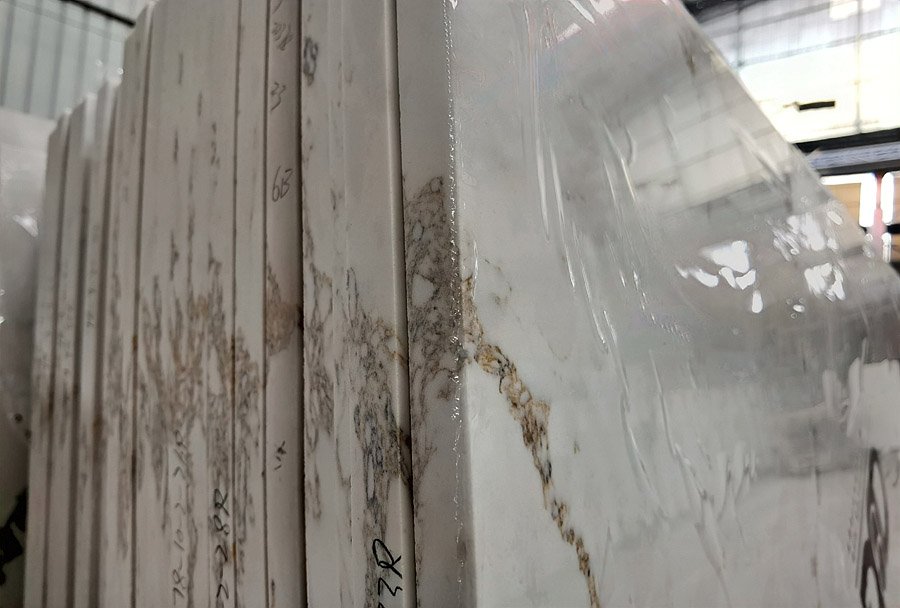
Close view of slab faces, cut edges, and handwritten marks at the factory. This is not evidence of an ISO-certified inspection procedure.
What should be approved before production starts?
Inspection begins with the sample, not with the container. Approve a physical slab, a cut sample, or a clearly identified production range, and keep a retained reference with photographs, the colour or batch code, the finish, and the nominal thickness. State in writing how later production will be compared with that reference, especially for veined designs, which can vary from slab to slab. Colour and batch control is discussed further in quality and colour consistency in quartz slab production. Questions to raise with the supplier before you place the order are in ten questions to ask before choosing a quartz stone supplier.
How should dimensions, thickness, flatness, and squareness be checked?
Measure the actual length, width, and thickness, and compare them with the nominal size and with the tolerances written in the contract. Record where each thickness reading was taken. Out-of-square or edge-chip allowances, if any, should also be contract terms. This article does not set universal tolerances for the trade.
Named manufacturer criteria can be used as examples of how one factory states its own limits, not as a global standard. Santa Margherita’s published “Criteria for slabs” for SM Quartz (document dated 2015-10-14, revision 02), checked on 23 November 2026, gives thickness bands of 18.5–20.5 mm for a 20 mm nominal slab and 28.5–30.5 mm for a 30 mm nominal slab, based on the average of three measurements taken at 50, 150 and 250 cm along the long edge. The same document says deviation from flatness shall not exceed 4 mm over the slab length or 2 mm over the slab width, measured in the middle of a horizontally laid slab, using the full length and width rather than the diagonals. If you use figures of that kind, say whose criteria they are, and write the agreed limits into your own contract.
What surface and appearance defects should buyers look for?
Inspect the finished face, the edges, and, if the contract requires it, the back, under agreed lighting. Typical items to record, if present, include cracks, chips, pits or pinholes, scratches, foreign material, dull patches on a polished face, residual marks from a previous colour run, and local colour spots that fall outside the approved sample range. Some designs that include glass or similar inclusions can show small irregularities that the manufacturer treats as a characteristic of the material; that is a specification point to agree in advance, not something to discover at the port.
Compare colour and pattern with the retained reference and with other slabs in the same batch. Slight variation can occur because the mineral aggregate is a natural input. Variation becomes a nonconformity when it falls outside the agreed range or when slabs that will be installed together were not selected as a group. Photograph any issue with a scale, a label, and a lighting note so the record is usable later.
How should test reports and product identification be reviewed?
A visual inspection does not replace laboratory testing, and a test report does not replace a visual check of the actual lot. Ask for reports that name the product, the method, the date, and the legal entity they were issued to. ISFA 3-01 (2013) is one industry classification and performance document for quartz surfacing. It cites methods including ASTM C97/C97M for density and water absorption and ASTM D790 for flexural properties, and it states, among other limits, a minimum density of 2,200 kg/m³ and a maximum water absorption of 0.12% under those methods. The EN 14617 series provides test methods for agglomerated stone. Those documents are method and classification references. They are not, by themselves, a certificate for your shipment. How tests are commonly arranged is discussed in how to test quartz slabs.
If you are buying a low-silica or silica-free surface, review whatever composition evidence the seller can provide, and do not treat a series name as a test result or as a market-access approval. Low-silica is not automatically silica-free, and neither description is risk-free. A buyer-focused list of what to verify is in what buyers should verify for low-silica and silica-free surfaces.
On the slab itself, check that labels, colour codes, thickness marks, batch or bundle numbers, and any vein-direction marks match the packing list. Aspire Stone’s cut-to-size page, checked on 23 November 2026, says that every countertop and vanity top is cleaned, sealed, labelled, and packed for delivery. That is a published statement about finished cut-to-size pieces, not a description of a whole-slab inspection procedure, and it is not presented here as an ISO method.
How do sampling plans and third-party inspections work?
The parties may agree to inspect every slab in a lot, or to inspect a sample. ISO 2859-1, Sampling procedures for inspection by attributes, is a named method that contracts sometimes adopt for lot-by-lot inspection. If you use it, the contract should state the edition, the inspection level, and the acceptance quality limit (AQL) that will apply to each class of defect. This article does not recommend a particular AQL, and it does not treat any AQL as a universal stone-industry standard.
A third-party inspector can be useful when you cannot be at the factory, but the inspector can only apply the written instructions, tolerances, and sample size you provide. Limitations are routine: a sample may miss a defect in an uninspected slab; factory lighting may differ from the destination showroom; and laboratory tests are performed only if they were booked. An inspection report is evidence of what was seen in the agreed sample, not a guarantee of the uninspected remainder or of performance in use.
A practical factory and pre-shipment checklist
The checklist below is an editorial buyer tool. It is not an Aspire Stone quality-manual extract and not a substitute for the contract.
| Item | What to do | What to record |
|---|---|---|
| Reference sample | Compare production slabs with the approved, retained reference. | Sample code, photographs, and any agreed range notes. |
| Identity | Check colour, thickness, finish, quantity, and labels against the order and packing list. | Mismatches, missing labels, and bundle numbers. |
| Dimensions and thickness | Measure length, width, and thickness at the agreed points, using the contract tolerances. | Readings, locations, and instruments used. |
| Flatness and squareness | Check flatness and square as the contract specifies. | Measured deviation and the method used. |
| Surface and edges | Inspect for cracks, chips, pits, scratches, foreign material, and finish defects. | Photographs with scale, slab identity, and location on the slab. |
| Colour and pattern | Compare within the batch and with the reference, especially for slabs that will be installed together. | Any slab that falls outside the agreed range. |
| Documents | Review specification, test reports, and any destination papers that should travel with the lot. | Document titles, dates, issuing entity, and gaps. |
| Packing and loading | Confirm packing method, protection, packed counts, and loading photographs before the seal is applied. | Frame or crate count, seal number, and photo file names. |
How should nonconformities be recorded and resolved?
Record each issue against a slab or bundle identity, with measurements and photographs, and classify it under the contract (for example, critical, major, or minor), if the parties have agreed those classes. Typical commercial outcomes are hold and replace, a written concession, or a price adjustment. Do not ship a disputed slab without a written agreement. Set a time limit for claims after arrival, and say what evidence is required, so a destination finding can still be connected to the pre-shipment record.
FAQ
How do you inspect quartz slabs?
Start from the approved sample and the contract. Check identity and labels, measure dimensions and thickness, review flatness and surface condition, compare colour and pattern, and confirm that the documents and the packed count match the lot. Photograph the findings before the container is sealed.
What defects should buyers look for?
Common items include cracks, chips, pits or pinholes, scratches, foreign material, dull areas on a polished face, thickness or flatness outside the agreed limits, and colour or pattern that falls outside the approved range. What is acceptable has to be written down; it is not the same for every design.
How do I check slab thickness?
Measure at the points agreed in the contract, with a suitable gauge, and compare the readings or an agreed average with the stated tolerance. One manufacturer example, Santa Margherita’s published slab criteria, uses three long-edge measurements and a stated band around the nominal thickness. Use your own contract figures for the order.
Should I hire a third-party inspector?
A third-party inspection is useful when you cannot attend and when you can give the inspector written tolerances, a sampling plan, and the approved sample. It is not a substitute for a clear contract, and the report covers only what was inspected.
Is there a universal AQL for quartz slabs?
No. ISO 2859-1 is a method that parties may name in a contract. The acceptance quality limit, inspection level, and edition have to be agreed. Publishing a single AQL as if it were an industry rule would be misleading.
Want to agree an inspection plan before production?
If you are placing an order with Aspire Stone, send the colour, size, thickness, and quantity, and say how you wish to approve the sample, what measurements should be recorded, and whether a third-party inspection is required. Use the Contact page or write to [email protected].


 WhatsApp
 EMAIL