




How to Verify a Reliable Quartz Slab Manufacturer in China
A reliable Chinese quartz slab manufacturer is identified by evidence, not by a ranking list. Confirm whether you are dealing with a factory, a trader, a distributor, or a fabrication shop; verify the registered identity and the production site; and test quality, communication, and packing on a pilot order before you scale. Published Aspire Stone facts are used only as an example, not as a score.
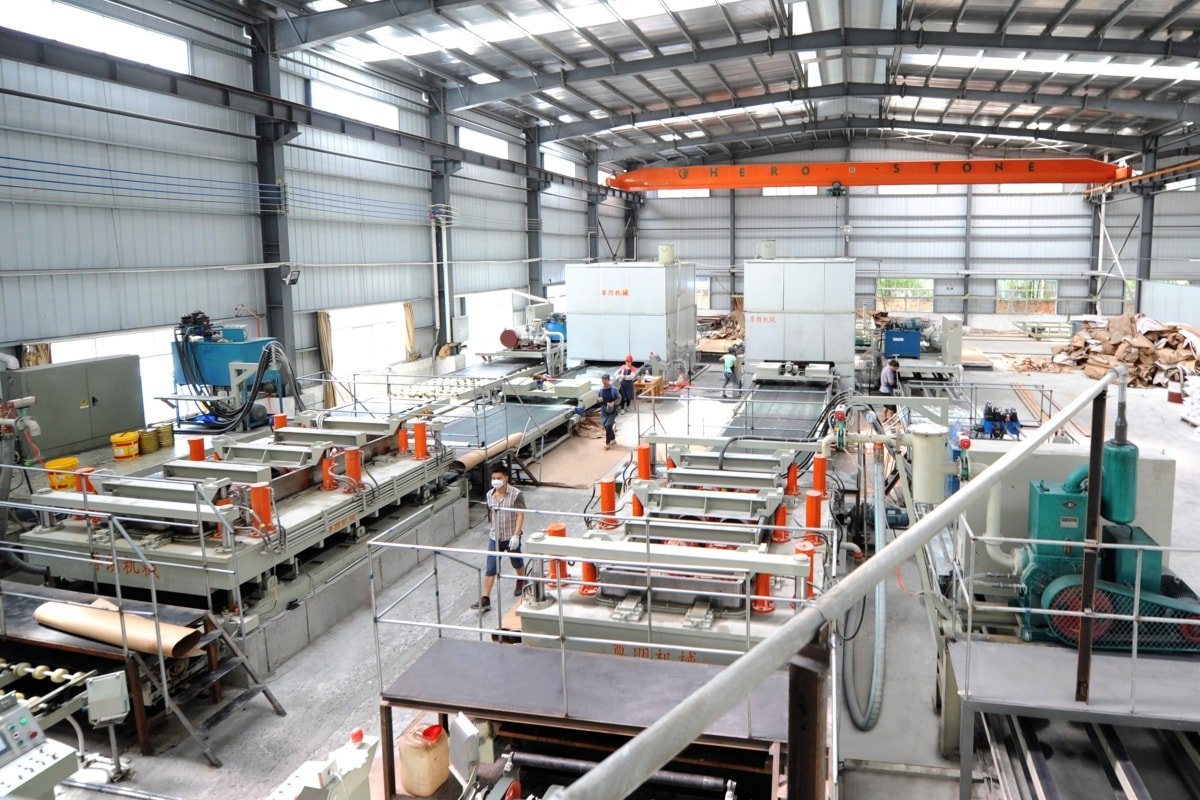
Pressing equipment from Aspire Stone’s live “Pressing Machine” photograph.
What is the difference between a factory, a trading company, a distributor, and a fabrication shop?
These four roles are often blurred in marketing language, but they are not the same in a contract.
| Role | What that party typically does | What a buyer should still confirm |
|---|---|---|
| Factory (manufacturer) | Presses or otherwise produces engineered-quartz slabs, and may also polish, finish, and pack them. | The registered company, the address of the production site, and that your order will be made there. |
| Trading company | Buys slabs from one or more factories and resells them, sometimes under its own brand. | Which factory will produce the goods, whether you may visit it, and who is liable for quality and claims. |
| Distributor | Stocks or represents products in a destination market, often after import. | Whether you are buying from stock or against a new production run, and who the importer of record is. |
| Fabrication shop | Cuts, edges, and finishes worktops from slabs. It may not manufacture the slabs at all. | The slab source, and whether you need a manufacturer, a fabricator, or both. |
A manufacturer may also run a cut-to-size shop, and a trader may have exclusive rights to a factory’s export brand. None of that is a problem if it is disclosed. The contract should name the legal seller and the place of manufacture. A related buying sequence, from specification through customs, is in how to import quartz slabs from China.
How can you verify a quartz slab manufacturer?
Start with identity. Ask for the Chinese company’s registered name, Unified Social Credit Code or equivalent registration number, and registered address. Compare that address with the factory gate, with tax or export documents, and with the name that will appear on the invoice and bill of lading. Do not invent or accept an English legal name that cannot be tied to the Chinese registration. Marketing brands and factory company names are often different; both should be stated clearly.
Then verify the site. A video call that shows only a showroom is not a production audit. If you cannot travel, consider a commissioned inspection that photographs the pressing lines, curing or finishing area, slab warehouse, and packing bay that would handle your order, together with nameplates on key equipment. Ask how slabs are identified by colour, thickness, and batch, and how a finished slab is traced back to a press run.
Aspire Stone’s About page, checked on 23 November 2026, describes a quartz stone manufacturer in Foshan, founded in 2008, with a factory covering more than 25,000 sq.m, three quartz pressing lines, and production in-house on Italian Simec equipment. The Our Equipment page, checked the same day, shows photographs labelled as a Simec polishing machine, a pressing machine, an air recycle system, and quartz raw material. Those are the company’s published statements and images, not an independent audit and not a complete equipment list. A broader look at why equipment matters in slab making is in why equipment matters in quartz slab production and in what happens inside a quartz slab factory.
The footer name on the live site is ASPIRESTONE CO., LTD. The published address is No.12, Mingxi Road, Mingcheng Town, Gaoming District, Foshan City, Guangdong, China. The official English legal name of the factory company is not confirmed in this article; it should be taken from current registration documents.
How should you assess range, custom work, and delivery reliability?
Ask the factory to show the colours and formats it can actually supply for your market, not a catalogue of every design it has ever displayed. Confirm thickness, finish, and whether jumbo or other oversized sheets are available in the colour you want. If you need cut-to-size pieces, ask which operations are done in house—cutting, sink openings, edge polishing, lamination, or packing of finished tops—and how drawings are received and confirmed.
Aspire Stone’s categories page, checked on 23 November 2026, says the company manufactures slabs in Calacatta, printed, low-silica and silica-free, Carrara and veined, solid color, sparkling, exotic, and super jumbo series, and also supplies cut-to-size. The cut-to-size page states that the cut-to-size centre covers 4,000 sq.m and is equipped with infrared cutting machines, water jets, and edge polishing machines, and that a team of 50 skilled workers handles cutting, polishing, sink-hole cutting, lamination, mitered edges, and more. Those figures are workshop figures published on that page, not a whole-factory headcount, and they are not a quoted capacity for a particular order.
Capacity and lead time should be discussed as commitments for your quantity and colour, supported by a production plan, not as a marketing claim. This article does not publish Aspire Stone capacity, shift patterns, minimum order quantities, or lead times, because those are order-specific and are not confirmed here. Ask the factory to state a window in the quotation and to explain how it handles overlapping orders.
What quality evidence is worth reviewing?
Ask for a specification sheet and for test reports that name the methods used, the laboratory or the in-house procedure, and the date. Industry references such as ISFA 3-01 (2013) and the ASTM methods it cites, including ASTM C97/C97M for density and water absorption and ASTM D790 for flexural properties, are examples of named methods; they are not a substitute for the reports that apply to the product you will buy. Certificates should name the legal entity, the product scope, and the validity dates. Do not treat a document issued to another company as the factory’s certificate, and do not assume that an expired certificate is current.
Also ask how colour and pattern are controlled between batches, how complaints are logged, and what the claims process is after shipment. A short list of questions you can put to any supplier is in ten questions to ask before choosing a quartz stone supplier. This article does not claim that Aspire Stone meets every quality-system or certificate item a buyer might ask for.
What else should you check in communication, sampling, contracts, and logistics?
Reliable supply also depends on ordinary commercial discipline. See whether questions about specification, packing, and documents are answered clearly and in writing. Agree a sample-approval process and keep a retained reference. Put the Incoterms® rule, inspection rights, packing method, and claims terms in the contract. Ask how slabs will be packed and how the factory will photograph loading. Payment terms are negotiated; a request for full prepayment with no inspection rights is a reason to slow down, not a standard that every buyer must accept.
What belongs on a supplier scorecard, and what are the red flags?
The scorecard below is an editorial tool for comparing candidates. It is not a ranking of named companies and not an Aspire Stone self-assessment. Score each line as evidence provided, partial, or missing, and keep the notes that support the score.
| Check | What “evidence provided” looks like |
|---|---|
| Legal identity | Registered name and address match the gate, the invoice, and the contract party. |
| Role | Factory, trader, distributor, or fabricator is disclosed, including any third-party production site. |
| Site and equipment | A visit or an independent audit shows the lines and packing area for your product. |
| Product range | The quoted colour, size, thickness, and finish are confirmed as available, not only displayed. |
| Quality evidence | Specification and dated test reports name methods and the legal entity; claims procedure is written. |
| Sampling | A retained, labelled reference sample can be compared with production. |
| Commercial terms | Incoterms rule, payment, inspection rights, and a realistic production window are in writing. |
| Packing and logistics | Packed weights, frame dimensions, and a loading-photo practice are offered for the shipment. |
| Communication | Technical questions receive timely, consistent written answers. |
Red flags include an inability or refusal to name the production address; documents that do not match the contracting party; certificates in another company’s name; pressure for full payment before any inspection; a sample that cannot be tied to a production batch; and a quotation that omits size, thickness, finish, quantity, or Incoterms, so it cannot be compared. None of those flags, by itself, proves fraud, but any one of them is a reason to pause.
Why run a pilot order before you scale?
A first container, or a smaller trial if the parties can agree one, is the practical test of colour match, packing, document quality, and claims handling. Inspect the pilot against the approved sample and the written tolerances. Photograph arrival condition. Only after that review should you increase quantity or add colours. Scaling on the basis of a showroom visit alone leaves the most important risks untested.
FAQ
How can I verify a quartz slab manufacturer?
Check the registered company against the factory address and the name on export documents, inspect the actual production and packing areas, and review specification and test documents that name methods and dates. A published website is a starting point, not the verification.
What questions should I ask a factory?
Ask who the contracting party is, where the slabs will be made, what documents and test methods will be supplied, how colour is controlled, what packing and inspection will be used, and what lead time applies to your quantity. A structured list is in the companion article on questions to ask a supplier.
How do I compare suppliers?
Compare like-for-like quotations and the evidence behind them: identity, site access, specification, packing, and contract terms. A scorecard helps you record that evidence. Do not compare on unit price alone when size, thickness, finish, or Incoterms differ.
Should I visit the factory before ordering?
A visit is the most direct way to confirm that the production site exists and can make your product. If you cannot travel, a commissioned inspection with photographs is the usual alternative. Skipping both, on a first order of any size, increases the chance that the seller and the factory are not the same party.
Is a long company history enough?
No. Years in business, a large listed floor area, or a named brand are useful context only when they can be tied to the site that will produce your order. Aspire Stone’s About page states that the company was founded in 2008; that published line does not, by itself, replace a site check or a pilot shipment.
Want to discuss a factory visit or a first enquiry?
Aspire Stone can be reached through its Contact page (Mr. Lin, +86 135 0025 4616, [email protected]). If you write, include the colour, size, thickness, and quantity you have in mind, and say whether you wish to schedule a visit or a video walk-through of the production and packing areas. The Our Workshop page shows workshop photographs labelled as cutting, water jet, edge polishing, and packing.


 WhatsApp
 EMAIL