




How to Judge Quartz Factory Equipment Without Trusting the Nameplate
Manufacturing equipment can influence a quartz slab’s dimensions, surface finish, throughput and repeatability, but a machine brand alone does not guarantee quality. Process control, maintenance, tooling and trained operators matter as much as the press or polisher. This article explains what different equipment categories do, how to judge evidence on a factory visit, and what Aspire Stone’s equipment page actually shows.
How can equipment affect dimensions, finish, throughput and repeatability?
A quartz slab is formed, compacted, cured and then ground to thickness and finish. Each of those steps depends on a machine doing a defined job, repeatedly. How quartz slabs are made sets out the process; the question here is what the equipment contributes — and what it cannot guarantee.
Dimensions. Length and width are first set by the mould or forming system and later by trimming. Thickness and flatness are largely a finishing issue: calibration equipment is what evens the slab after curing. Worn calibrating heads, poor slab support, or an inconsistent feed can leave thickness variation that shows up at the joint on a countertop.
Surface finish. Polishing and honing lines use a sequence of abrasive heads. The machine has to keep those heads in contact with the face in a controlled way, including near the edges. SIMEC, an Italian manufacturer of machines for natural stone, ceramics and agglomerated stone, describes polishing equipment for quartz-based agglomerated slabs and notes that conventional bridge movement can be a limit on irregular slabs. That is useful industry context about why polishing design matters. It is not a verdict on any one factory’s output.
Throughput. Cycle time at the press, kiln capacity, and the speed of the polishing line together set how many slabs a plant can finish. A bottleneck in polishing will cap output even if the press is fast. Color changes, jumbo formats and special finishes all reduce effective throughput. Buyers should not infer capacity from a photograph or from a machine count.
Repeatability. The same equipment, run with the same recipe and the same settings, is what makes a second batch comparable to the first. That only holds if weighing systems, press controls and polishing tools are kept in adjustment. Repeatability is therefore a system result, not a nameplate result.
Why does equipment alone not guarantee quality?
Two factories can install similar machines and ship very different slabs. The difference is usually process control, maintenance and people.
A press cannot correct an unstable recipe or a contaminated mixer. A polisher cannot hide a void that was formed in compaction, and it can create new marks if the heads are worn or the slab is poorly supported. A cutting machine in a workshop will not improve a slab that was already out of tolerance when it left the finishing line.
Operators and technicians matter at each of those points. Someone has to set the line for the product being run, change tooling at the right time, and stop the process when a result is out of range. A factory visit that only photographs equipment, and never asks who is responsible for calibration or what happens when a head is due for change, misses the larger part of the risk.
This is also why finding a reliable manufacturer is a broader task than collecting equipment names. Records, samples and the actual line for your product are stronger evidence than a brand list. Inside a quartz slab factory offers a zone-by-zone audit agenda that can be used with the questions below.
What equipment categories should buyers understand?
The categories below are industry types. They are not a claimed inventory for any one plant, except where a later section quotes a live Aspire Stone page.
| Equipment category | Typical function | What it can influence | What to ask on a visit |
|---|---|---|---|
| Storage and dosing | Hold and weigh aggregate, resin and pigments | Recipe repeatability and color stability | How are scales calibrated, and how are lots kept separate? |
| Mixers and distributors | Blend the batch and place it in the mould | Uniformity, veins, weak areas from poor distribution | How are mixers cleaned between colors? |
| Presses or compaction units | Densify the formed slab; some lines use vacuum and vibration | Density, voids, and the starting thickness for finishing | Which press will run this order, and how are settings recorded? |
| Curing kilns and cooling | Harden the resin binder and cool the slab for handling | Strength, distortion and readiness for calibration | How is the cycle controlled and checked? |
| Calibration and polishing lines | Even the thickness and produce the specified gloss or texture | Thickness tolerance, flatness, gloss, polish marks, edge quality | What tooling sequence is used, and when are heads changed? |
| Air, handling and packing equipment | Move slabs and manage process air or dust; protect finished pieces | Handling damage, cleanliness, shipment condition | How are faces and edges protected after inspection? |
| Cut-to-size machines, if used | Cut, waterjet and polish edges on finished slabs | Cut quality, edge finish and dimensional accuracy of pieces | Which operations are in-house, and on which machines? |
Breton, another Italian plant supplier, publishes complete Bretonstone lines based on vibro-compression under vacuum. That literature is an industry example of one process technology. It should not be read onto a factory floor unless that factory states that such a line is installed.
How should maintenance, calibration, tooling and training be judged?
The condition of the equipment is often more informative than its age. Newer machines can be poorly maintained. Older machines can be consistent if they are serviced, calibrated and correctly tooled.
Ask how often weighing systems are checked, how press or kiln instruments are verified, and how the factory records those checks. For polishing, ask about the abrasive sequence, the life of a head, and the rule for changing a worn tool. For cutting and edge polishing, ask about blade or tool condition and water or dust controls, which affect both quality and the workplace.
Training should be specific to the machine and the product. A technician who can run a solid color may still need a defined method for a wide vein or a jumbo slab. Buyers do not need a training-hour statistic invented for a brochure. They need to see that the people on the line can explain the checks they actually perform.
Spare tooling and basic maintenance access are practical signs. A polishing line with no spare heads, or a press that cannot be approached safely for inspection, is a risk to continuity as well as to quality.
What does Aspire Stone’s equipment page actually show?
Aspire Stone’s Our Equipment page was fetched on 23 November 2026 (Asia/Shanghai, UTC+8). The page still has no H1. Its title is “Our Equipment | Aspire Stone,” and the visible heading is “Our Equipment.”
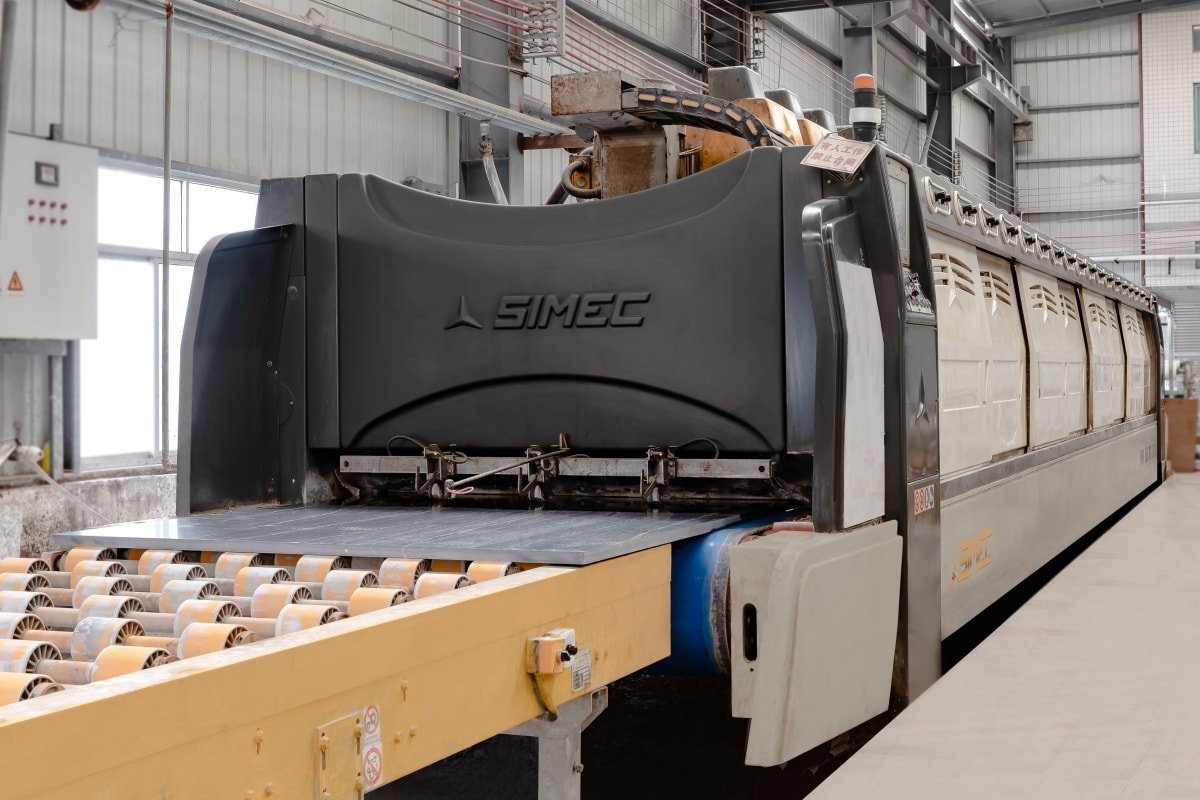
The real live-page photograph labeled “Simec Polishing Machine.”
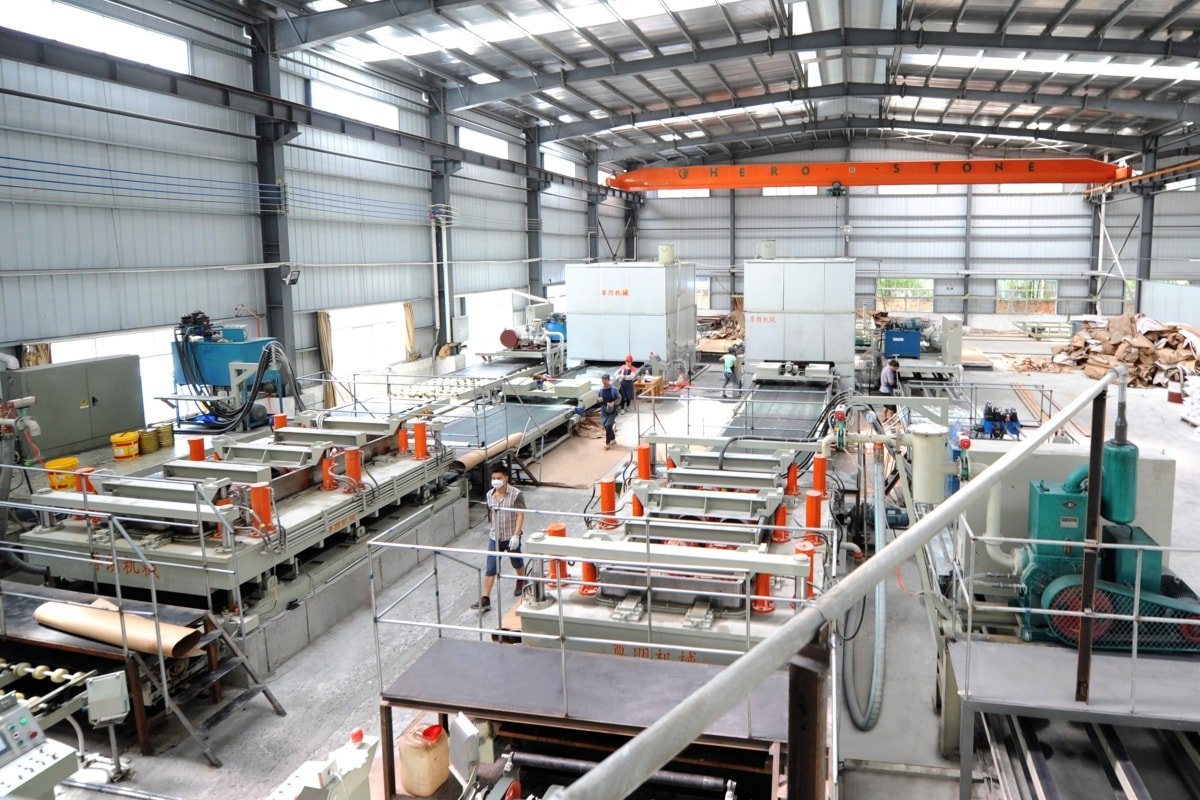
The real live-page photograph labeled “Pressing Machine.”
The page currently shows four labeled photographs, dated June 2024 in the list template:
- Quartz Raw Material
- Air recycle system
- Pressing Machine
- Simec Polishing Machine
Those labels are the published equipment facts on this page. The photographs do not open into specification sheets — the links point to “#” — and the page does not name models, capacities, or operating settings. Small numbers that appear beside the titles in the list layout should not be read as machine counts.
The About page, fetched the same day, states that the factory has 3 quartz pressing lines and that production is in-house on Italian Simec equipment, in a plant of more than 25,000 sq.m, founded in 2008 in Foshan. The equipment page labels only the polishing machine as Simec. This article does not extend “Italian Simec equipment” into a full inventory, and it does not assume that the press is a named Simec model.
The cut-to-size workshop is described separately. The cut-to-size page says the center covers 4,000 sq.m and is equipped with infrared cutting machines, water jets and edge polishing machines. The Our Workshop page, which also lacks an H1, shows photographs labeled Cutting machine, Water Jet, Edge polishing and Well packing. Those workshop figures and labels are not a whole-factory machine list.
SIMEC’s own catalogue, including a polishing machine described as the NPA 1700 RS for quartz-based agglomerated slabs, is manufacturer literature. It is cited here only as an industry example of the kind of machine a supplier in this sector may use. It is not a statement that Aspire Stone operates that model.
What questions belong in a factory-equipment audit?
Use these questions on a visit, and ask to stand at the line that will make your product:
- Which pressing line and which polishing line will run this color, size and thickness?
- May we see the equipment in operation, not only at rest?
- How are weighing systems, press controls and polishing heads calibrated, and where is that recorded?
- What tooling is used for the finish we are buying, and what is the change-out rule?
- How are process settings recorded for a batch, and who can change them?
- What recent process or inspection records match the slabs in the racks today?
- If cut-to-size is part of the order, which cutting, waterjet and edge machines will be used, and how are finished pieces checked?
- May we see packed or stored slabs from a recent lot of the same product?
Judge the answers against evidence: equipment photographs that match the machines you saw, process records, sample output, and inspection or test reports for the named product. A branded nameplate is a starting clue, not a conclusion.
FAQ
Does factory equipment affect quartz slab quality?
Yes, it can. Presses, kilns, calibration and polishing lines influence density, thickness, flatness and surface finish, and workshop machines influence the accuracy of cut pieces. Equipment is only one part of the result. Recipe control, maintenance, tooling and operators are the others, and they can outweigh a well-known brand.
What machines are used to polish quartz?
After curing, slabs are usually calibrated to an even thickness and then ground and polished with a sequence of diamond abrasive heads on a dedicated line. Some Italian machinery companies, including SIMEC, publish polishers designed for quartz-based agglomerated slabs. The exact machine on a given floor should be identified by the factory. Aspire Stone’s live equipment page labels a photograph as a Simec Polishing Machine, without naming a model.
What should I check in a factory audit?
See the working line for your product, not only a showpiece. Check the condition of dosing, pressing, curing and polishing equipment, the state of tooling, and the records for calibration and inspection. Look at finished slabs and, if relevant, the cut-to-size workshop. Compare what you are told with what you can see and read.
Is newer equipment always better?
No. A new machine that is poorly set, poorly maintained or run by untrained operators can be less consistent than an older line that is kept in adjustment. Age is a question worth asking; condition, records and output are better answers.
Can I judge a factory from an equipment list or a photo gallery?
Not reliably. Lists omit condition and process control, and galleries can be incomplete or outdated. Aspire Stone’s equipment page is a useful, limited public record of four labeled photographs. It should be read as that, then checked on a visit, rather than expanded into an inventory the page does not provide.
Using equipment evidence in a supplier decision
If you are shortlisting manufacturers, treat equipment as one evidence stream: what the live pages show, what you see on the floor, and what the records say about maintenance and output. To ask Aspire Stone about the line that would run a specific product, contact Mr. Lin at +86 135 0025 4616 or [email protected], or use the Contact page, and request to see the relevant machines and current process records on a visit.


 WhatsApp
 EMAIL