




Custom Quartz Countertops: A Drawings-to-Delivery Workflow
A custom quartz countertop for a commercial project should follow a controlled path from inquiry and drawings to quotation, approval, fabrication, and delivery. The shop needs complete drawings, dimensions, material, finish, edge, and cut-out data before it can quote or cut. This article walks that workflow and points to Aspire Stone’s published cut-to-size service, using only workshop facts still shown on that page.
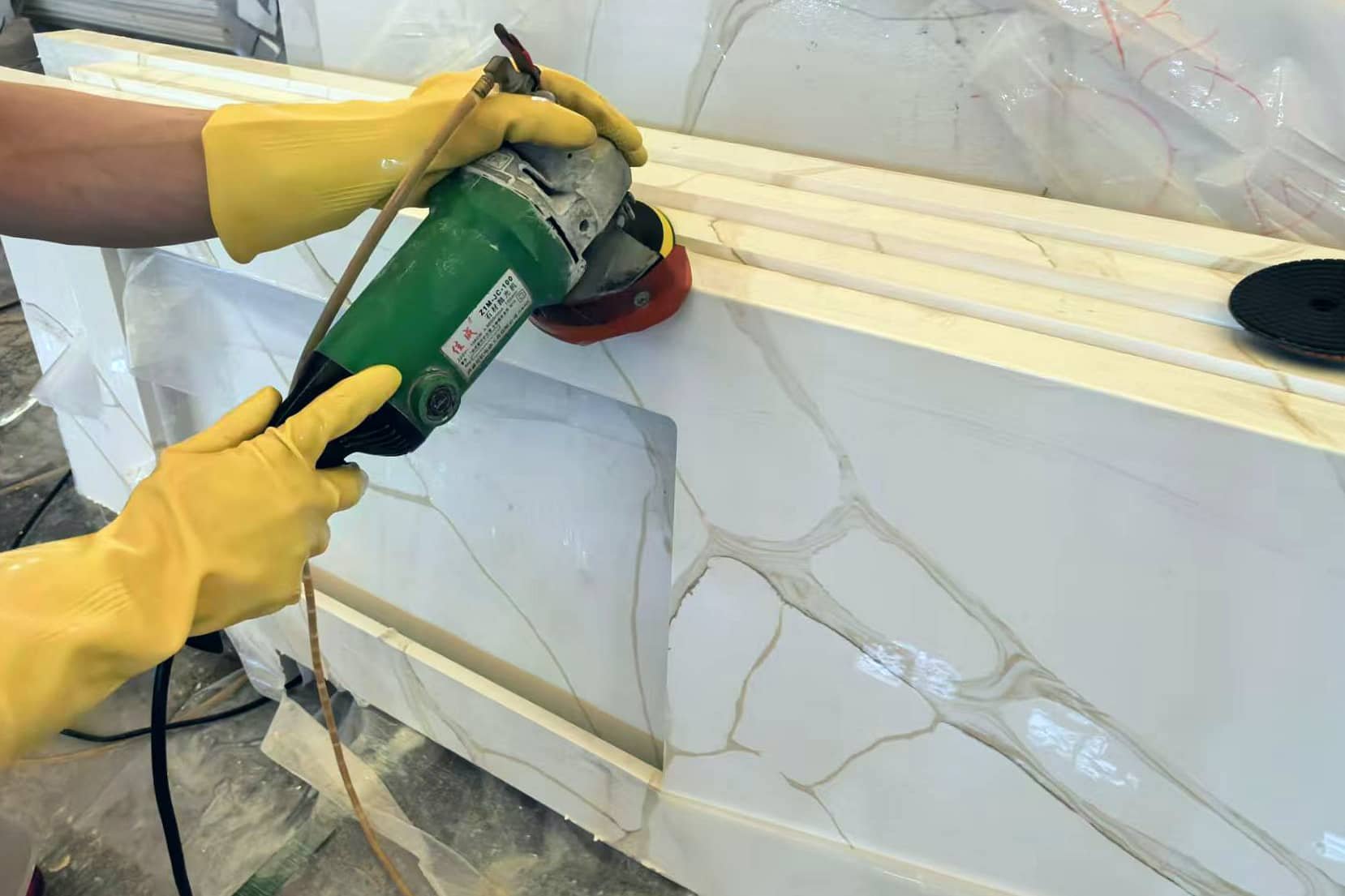
A quartz countertop being edge-polished during cut-to-size fabrication.
Aspire Stone’s Cut-to-Size Quartz Slabs page, fetched 23 November 2026 (Asia/Shanghai), is titled “Cut-to-Size Quartz Slabs & Countertops | Aspire Stone,” with the on-page heading “Cut-to-Size Quartz Slabs.” It states that the company operates a quartz cut-to-size centre for kitchen countertops, vanity tops, and commercial projects, including multi-family and hotel work, and that buyers can send dimensions for a quote and then receive cut, polished, packed slabs for installation. Typical applications listed there include kitchen countertops, bathroom vanity tops, bars and restaurants, and precision-cut pieces for interior wall or tile work. The page also says the factory both presses and cuts slabs, including low-silica and printed options. Those are published service descriptions, not named project case studies.
What is the workflow from inquiry and drawings to delivery?
The sequence below is a typical commercial path. Some steps can overlap, but a later stage should not start while an earlier approval is still open.
| Stage | What the buyer provides or does | What the shop or supplier does | Checkpoint before moving on |
|---|---|---|---|
| Inquiry | Project location, use, quantity, and a first set of drawings or dimensions | Confirms that the request is for slabs, cut-to-size pieces, or a mix, and identifies missing data | The enquiry is complete enough to review |
| Drawing review | CAD or PDF drawings, unit or room IDs, and notes on edges and cut-outs | Marks conflicts, missing dimensions, and questions | A clarification list is agreed |
| Material and sample approval | Selected model, finish, and thickness; signed sample or mock-up where needed | Confirms the selected product and any batch-matching request | Written sign-off on the standard of work |
| Quotation | Confirmed quantities, destination, and packing assumptions | Issues a quotation for the agreed scope | The buyer accepts the quotation and the drawing revision on which it is based |
| Shop drawings or cut list | Answers to remaining technical questions; current fixture templates | Issues a fabrication drawing or cut list for approval | Formal release to fabricate |
| Fabrication | No informal mid-cut changes | Cuts, forms cut-outs, finishes edges, and inspects | Pieces match the approved drawing and the signed sample |
| Packing and delivery | Site access and labelling instructions | Cleans, labels, packs, and ships to the agreed instruction | Packing list and labels match the schedule |
| Site check | Local fabricator or installer verifies pieces against cabinets | Supports replacement of documented nonconformances | Pieces are checked before they are fixed |
Shop fabrication practice is described in more detail in how to fabricate quartz countertops. Measuring and yield are covered in how to measure and calculate quartz slabs. For the specification context that often sits in front of this workflow, see how to specify quartz surfaces for large residential projects.
What drawings and information does the shop need?
A fabricator cannot quote or cut from a colour name and a rough length. At inquiry, send:
- Drawings in CAD or PDF, dimensioned, with units stated, and with room or unit identifiers if the project has many repeats.
- Finished sizes, including returns, islands, overhangs, and any splash, upstand, or waterfall panels.
- The material choice: manufacturer, series, exact model code, finish, and the published thickness for that model.
- Edge profiles and which edges are polished or laminated.
- Cut-outs: current sink, basin, hob, or equipment templates, with centres dimensioned, and a note on undermount, drop-in, or other fittings.
- Seam preferences and any required vein or bookmatch direction.
- Quantity by type, and whether the order is a one-off commercial counter or a repeated package.
- Destination, packing constraints, and any limit on piece size imposed by lifts or access.
Aspire Stone’s homepage, fetched the same day, lists shop drawings, estimating, and cut-to-size fabrication among its published services. Incomplete drawings produce incomplete quotations. If cabinet corners have not been verified on site, say so: a drawing with assumed right angles is a preliminary file, not a fabrication release. Caesarstone’s August 2023 Fabrication & Installation Guide, used here as one manufacturer example, warns that a 1° error in a 90° corner creates a 52 mm deviation over 3 m (about 2 in over 118 in). That is why a template, a digital measure, or a checked dimensional survey matters more than a sketch.
How are drawing review, clarification, and sample approval handled?
The review stage is where conflicts are found: a sink that does not fit the cabinet, a seam over an unsupported opening, a vein direction that fights the nest, or a piece that will not enter the building. The shop should issue questions in writing. The buyer should answer them in writing. Do not treat a silence as approval.
Approve a sample of the selected colour and finish, and say whether it is a small chip or a larger piece. For a veined reception desk or a repeated commercial vanity, review a full-slab image or a reserved slab and, where the quantity is large, a first-article or mock-up piece. Keep that signed standard for inspection later.
Dimensional tolerances should come from the shop’s own process and from the slab manufacturer’s guide, not from a generic figure in an article. Aspire Stone has not published cutting or polishing accuracy, or a maximum custom size, on the pages fetched for this article. Those limits should be confirmed for the live job and for the selected slab format.
What happens during fabrication, inspection, labelling, packing, and delivery?
On the cut-to-size page fetched on 23 November 2026, Aspire Stone describes its cut-to-size centre as covering 4,000 sq.m, equipped with infrared cutting machines, water jets, and edge polishing machines, with a team of 50 skilled workers handling cutting, polishing, sink-hole cutting, lamination, mitered edges, and more. Those figures are workshop figures for the published cut-to-size centre. They are not a whole-factory headcount, and they should not be confused with the factory area and pressing-line description on the About page. The same cut-to-size page also states “more than 15 years of cut-to-size experience.” Equipment brands, models, and accuracies are not named on that page and are not invented here.
The published process images on that page are grouped as cutting machine, water jet, edge polishing, and packing. After fabrication, the page states that every countertop and vanity top is “cleaned, sealed, labeled, and packed for delivery.” That is the factory’s published packing sequence. It should not be read as advice to apply a topical sealer to the finished face. Confirm what each step means when the order is placed.
A practical inspection before dispatch should check:
- Sizes and cut-outs against the approved drawing and the current fixture templates.
- Edge profile and finish against the signed standard.
- Colour and pattern against the approved sample or reserved batch.
- Labels against the room or piece schedule.
- Packing against the agreed method, with a packing list the site can check.
The page tells buyers in the UK, Canada, Australia, and the UAE that they can send dimensions for a quote and receive cut, polished, packed slabs for installation. Australia’s presence on that market list is not a statement that a given product is importable under Australia’s engineered-stone rules. Destination regulations should be checked before the order is placed.
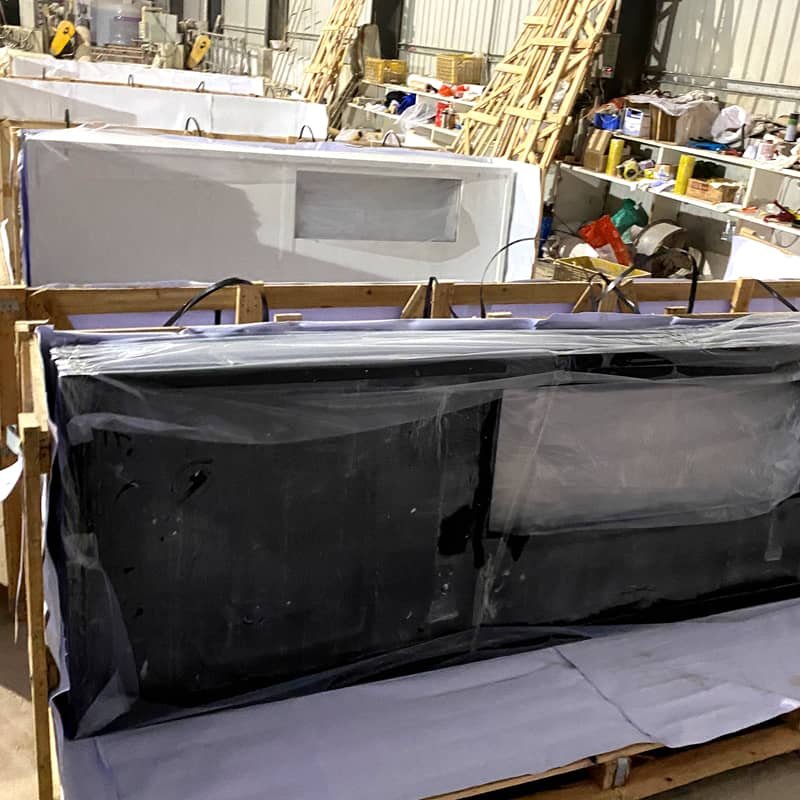
Cut-to-size quartz countertops packed in timber crates for delivery.
How should change control, tolerances, and installation coordination be managed?
Once a drawing has been released for cutting, treat any change as a formal revision. A late move of a sink centre, a different edge, or an added waterfall can invalidate both the nest and the quotation. Record who requested the change, what was agreed, and whether pieces already cut are still usable.
Do not assume factory-cut pieces will drop onto cabinets without a site check. Pre-cut tops still have to be verified against the installed carcasses, wall conditions, and services. The local fabricator or installer remains responsible for that check, for support, and for final seams. Factory pre-cutting can reduce site work; it does not remove installation risk.
If a piece is damaged in transit or does not match the approved drawing, use the packing list and labels to record the nonconformance, and agree whether a replacement will come from the same batch. Commercial packages that repeat many identical vanities or tea-point tops benefit from a small, agreed reserve of the same batch, as discussed in the specification and bulk-supply articles in this cluster.
Project inquiry checklist
| Item | Include with the enquiry |
|---|---|
| Drawings | Dimensioned CAD or PDF, with units, room or unit IDs, and revision date. |
| Sizes and details | Finished lengths and depths, overhangs, splash or waterfall pieces, edge profiles. |
| Material | Exact model code, finish, and published thickness. |
| Cut-outs | Current fixture templates, centres, and mounting type. |
| Pattern and seams | Vein direction, bookmatching if any, allowed seam locations. |
| Quantity and use | Number of pieces or repeats, and whether the tops are for kitchen, vanity, reception, bar, or another indoor use. |
| Samples | Request or return a signed sample; note lighting if a mock-up is needed. |
| Packing and access | Destination, labelling code, and maximum piece size for site access. |
| Programme | Required delivery window — to be confirmed in the quotation, not assumed from this article. |
| Destination rules | Any engineered-stone, silica, or other local requirements already identified. |
FAQ
Can quartz countertops be made to custom dimensions?
Yes, within the usable face of the selected slab format and the shop’s confirmed process. A custom size is not unlimited. Long runs may need seams; thick laminated edges and waterfall ends need extra material. Confirm the limits for the live job rather than assuming a maximum size from a catalogue page.
What drawings does a fabricator need?
Dimensioned drawings with units, finished sizes, edge profiles, seam and pattern notes, and current templates for every cut-out, plus the exact material identity. A sketch without centres or a drawing with unverified corners is not enough to release a cut.
Can suppliers provide pre-cut quartz?
Some manufacturers can. Aspire Stone’s cut-to-size page, fetched 23 November 2026, invites buyers to send dimensions for a quote and describes factory cutting, polishing, and packed delivery. Pre-cut pieces still need a site check against the cabinets before installation.
How are custom stone projects delivered?
After inspection, pieces are labelled and packed to the agreed method and shipped with a packing list the site can check. The cut-to-size page states that tops are cleaned, sealed, labelled, and packed for delivery; confirm what that sequence includes. Access, offloading, and storage should be agreed before the shipment leaves.
When should a drawing be released for cutting?
Only after the quotation, the material and sample approval, and the shop drawing or cut list have been accepted in writing, and after fixture templates are current. Releasing an incomplete file to “save time” is how cut-outs land in the wrong place.
What if the design changes after fabrication has started?
Treat it as a formal change. Ask what can still be altered, what must be recut, and how the quotation and the batch reservation are affected. Do not instruct a mid-cut change only by telephone.
Send the drawings for a cut-to-size review
If you have CAD or PDF drawings, dimensions, or a repeated commercial package, start with Aspire Stone’s cut-to-size page and send the inquiry checklist through the contact page. The published Foshan workshop can cut, polish, and pack pieces from a confirmed layout. The site measure, the final check against cabinets, and installation remain the project team’s responsibility.


 WhatsApp
 EMAIL