




Ten Published Calacatta Quartz Designs for Luxury Interiors
Calacatta-style quartz is engineered quartz made to recall a light background and distinctive grey, taupe, or gold veining, not a quarry block of Italian marble. This article is not a popularity ranking: Aspire Stone has not published a sales chart, and no search-volume list is used here. It presents ten named designs from the first page of the live Calacatta Series catalog, fetched on 23 November 2026.
What do buyers look for in a Calacatta-inspired pattern?
In the trade, “Calacatta” on a quartz slab describes a design style, not a geological source. Buyers usually look at four things: the background tone (bright white, soft white, or slightly ivory), the vein color (grey, taupe, gold, or a mix), the scale and contrast of the movement, and whether the pattern is quiet enough for a long run or bold enough for an island or feature wall. Aspire Stone’s Calacatta Series is described on that page as using a white background with grey or gold veining, as a marble-look surface for kitchen countertops, vanity tops, and commercial interiors. For the material definition, see what Calacatta quartz is. Printed quartz can be specified when a marble-look pattern needs closer repetition; see what printed quartz is.
A small sample will show background tone and finish. It will not reliably show how a broad vein falls across an island, a waterfall end, or a bookmatched pair. Luxury interiors usually need current full-slab photographs, or inspection of the actual slabs, before the layout is locked.
How were these ten designs selected?
On 23 November 2026 the live Calacatta Series catalog listed 35 published designs across three pages (12 on page one, 12 on page two, and 11 on page three). The ten designs below are the named models on the first catalog page — the group the site currently presents first. Two further first-page listings, G075 and G076, are published under model codes only and are not annotated here; they remain available options. This is a catalog selection, not a claim that these ten are the most sold or most searched.
Each entry uses only the published name, model code, and specifications from that product page. Visual notes refer to the published product photograph on the same page, as fetched on 23 November 2026. A photograph is often a crop, not a complete slab map, and a later lot can differ, so current slab images or the slabs themselves should be reviewed before approval. On the product pages checked the same day, each of these ten designs is listed at 3200×1600 mm (126×63"), in 20 mm or 30 mm. Those figures are the published specifications for those listings, not an industry-wide standard. Product-page finish lines also list “Polished, Honed, Acid, Sandblasted, etc.” Confirm any texture other than the polished and honed finishes clearly discussed elsewhere on the site.
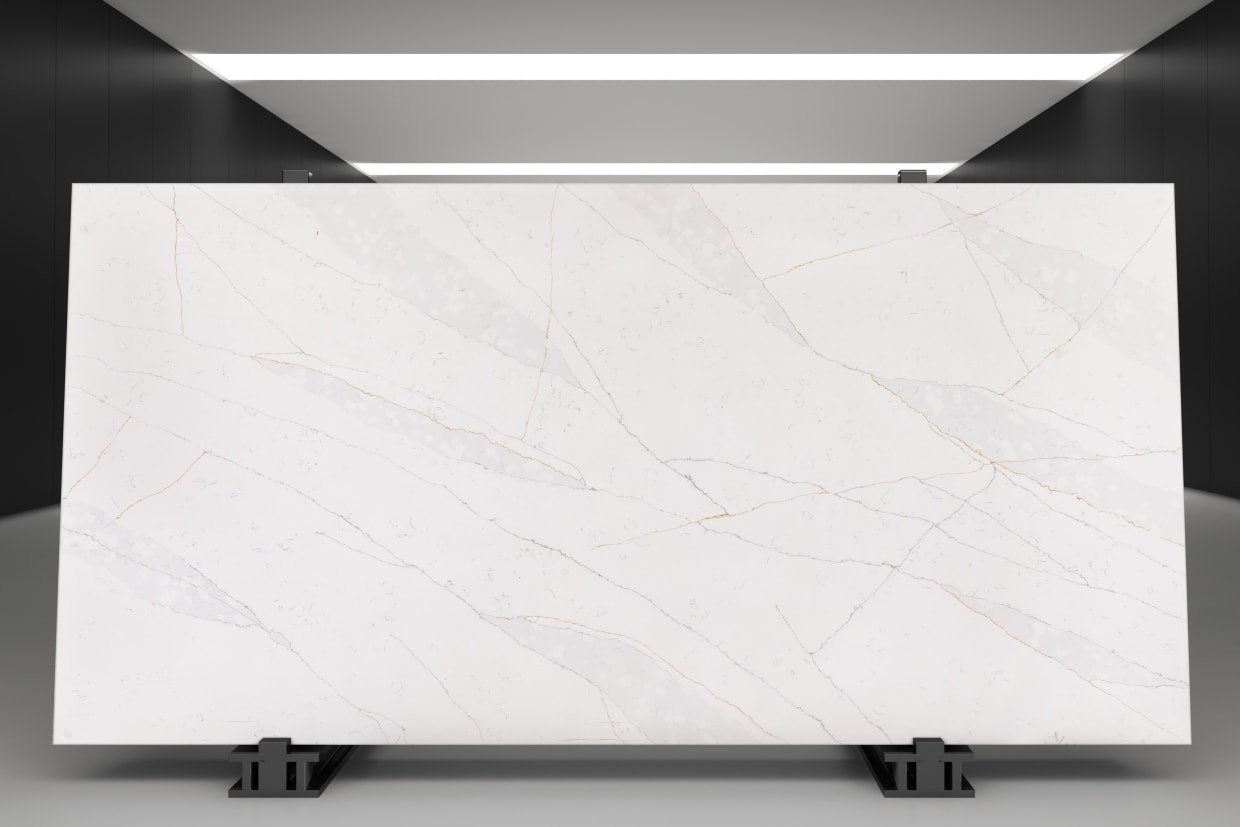
Product photograph of Calacatta Fresh (G047) from the Aspire Stone listing.
Ten published Aspire Stone Calacatta designs
1. Calacatta Fresh (G047)
Calacatta Fresh (G047) is listed for kitchen countertops, vanity tops, bar tops, and commercial interiors. The published product photograph shows a light white field with soft grey cloudy patches, fine grey veins, and thin gold lines — movement that is present but not heavy.
2. Calacatta Italia Extra (G071)
Calacatta Italia Extra (G071) is listed to the same applications and slab size. The published photograph shows a bright white field crossed by bolder taupe-to-beige veins, with finer branching lines. The higher contrast means vein placement on an island or splashback deserves a full-slab review.
3. Calacatta Macchia (G209)
Calacatta Macchia (G209) is listed to the same published size and uses. The published photograph shows flowing mid-grey veins on a white ground, with some broader grey bands. “Macchia” is the model name, not a technical grade. It is a cooler grey Calacatta direction rather than a gold one.
4. Calacatta gold (G208)
Calacatta gold (G208) uses the published name as it appears on the product page. The photograph shows softer, wider pale bands with a warm gold or beige edge on a white ground. It is a quieter warm-vein option and should be viewed next to cabinets and metals, because warm light will change how the gold reads.
5. Calacatta Luna (G218)
Calacatta Luna (G218) is listed at the same published size. The product photograph shows a clean white field and a more graphic network of mid-grey veins, some with a slightly darker edge, leaving larger open areas of white. That open drawing works on a large island if the main veins are placed deliberately, and looks busier if a seam cuts through a strong line.
6. Calacatta Aria (G107)
Calacatta Aria (G107) is listed for the same published applications. The photograph shows diagonal, airy grey bands with thin gold threads on a light ground. It sits between a cool grey Calacatta and a warm gold one, so it should be checked in the project lighting before it is paired with brass, chrome, or a particular wood.
7. Calacatta Supreme (H001)
Calacatta Supreme (H001) is listed at 3200×1600 mm, in 20 mm or 30 mm. The published photograph shows a white field with cooler grey veins that include some thicker, river-like bands and finer connecting lines. The contrast is stronger than on a soft grey design, so it may dominate a small top and can be a feature on a larger surface.
8. Calacatta Borghini (Q9)
Calacatta Borghini (Q9) is listed to the same specifications. The photograph shows grey veins with visible gold edges and a more intertwined movement across the field — a warmer, layered grey-and-gold direction. Adjoining slabs and any planned bookmatch should be reviewed together, not from a single chip.
9. Calacatta VanGogh (Q7)
Calacatta VanGogh (Q7) is listed under that published spelling and code. The photograph shows clearly directional, diagonal veins in grey with warmer taupe or gold fills. That pattern can look calm when the veins run with the length of an island, and awkward when a seam or cooktop cut-out interrupts the main lines, so a dry-lay matters more than on a quieter design.
10. Calacatta Rattaello (G067)
Calacatta Rattaello (G067) is listed under that published spelling. The photograph shows the warmest of these ten looks: broader copper or amber-brown veins, with some grey in the movement, on a slightly warm white ground. It often sits more comfortably with warm woods and brass than with a very cool grey cabinet, but that is a design judgement to test in the project lighting.
| Published name | Model code | Published size and thickness | Product page |
|---|---|---|---|
| Calacatta Fresh | G047 | 3200×1600 mm; 20 mm or 30 mm | https://aspirestonecn.com/categories/245.html |
| Calacatta Italia Extra | G071 | 3200×1600 mm; 20 mm or 30 mm | https://aspirestonecn.com/categories/242.html |
| Calacatta Macchia | G209 | 3200×1600 mm; 20 mm or 30 mm | https://aspirestonecn.com/categories/241.html |
| Calacatta gold | G208 | 3200×1600 mm; 20 mm or 30 mm | https://aspirestonecn.com/categories/240.html |
| Calacatta Luna | G218 | 3200×1600 mm; 20 mm or 30 mm | https://aspirestonecn.com/categories/239.html |
| Calacatta Aria | G107 | 3200×1600 mm; 20 mm or 30 mm | https://aspirestonecn.com/categories/238.html |
| Calacatta Supreme | H001 | 3200×1600 mm; 20 mm or 30 mm | https://aspirestonecn.com/categories/237.html |
| Calacatta Borghini | Q9 | 3200×1600 mm; 20 mm or 30 mm | https://aspirestonecn.com/categories/236.html |
| Calacatta VanGogh | Q7 | 3200×1600 mm; 20 mm or 30 mm | https://aspirestonecn.com/categories/235.html |
| Calacatta Rattaello | G067 | 3200×1600 mm; 20 mm or 30 mm | https://aspirestonecn.com/categories/234.html |
These ten sit inside a wider published range. If a project needs another vein scale or ground, review the remaining designs on catalog pages two and three rather than inventing names.
How do large islands, waterfall edges and bookmatching affect the choice?
Broad or directional veins are most exposed on a large island, a waterfall end, or a feature wall. A quieter design is often easier to seam; a bolder design works when the main veins are placed on purpose and disappoints when they are not.
Bookmatching is a layout method, not an automatic property of every Calacatta model. Aspire Stone’s article What Is Bookmatching in Quartz Slabs describes it as placing two or more slabs so that the pattern and veining are mirrored and continue from one slab into the other. Whether a named design can be supplied as a mirrored pair should be confirmed before a luxury interior is drawn that way.
Slab format also matters. The Calacatta product pages above publish 3200×1600 mm. Aspire Stone’s Super Jumbo page describes a larger 138×78" format intended for kitchen islands, feature walls, and commercial surfaces that need fewer seams. That page does not list which Calacatta models are produced in Super Jumbo, so format should be confirmed model by model. Island layout, seams, and edges are covered in quartz kitchen islands: design ideas, sizes and edge profiles. Waterfall ends and mitered edges appear as published capabilities on the cut-to-size page; other edge profiles should not be assumed.
Do Calacatta quartz patterns repeat from slab to slab?
Engineered quartz is generally more consistent than natural Calacatta marble, but slabs of the same model are not guaranteed to be identical. Background shade, vein thickness, and the path of a main line can vary between slabs and lots. Printed quartz is specified when a project needs a more controlled, repeating image; conventional Calacatta-style designs should still be reviewed as a set when several slabs will sit together. Ask for a layout drawing that shows where the principal veins will fall, and whether leftover pieces will still match a splashback or a waterfall panel.
How should Calacatta designs be paired with cabinets and metals?
Cool grey veins usually sit more quietly with cool white, grey, or black cabinetry and with chrome or stainless hardware. Gold, taupe, and copper veins usually sit more quietly with cream, oak, walnut, and brass or bronze. These are starting points, not rules, and should be tested in the project’s lighting. See best quartz countertop colors for modern kitchens and how to match quartz countertops with cabinets and flooring.
Sample and slab review checklist
| Item | Why it matters |
|---|---|
| Exact model name and code | “Calacatta quartz” is a style name. The order should cite the published name and code, for example Calacatta Fresh (G047). |
| Current lot photographs | A catalogue crop can lag behind a running batch. Lot photos reduce surprise after shipment. |
| Background tone and vein color | Confirm whether the slab is a cool grey, a warm gold, or a mix, next to cabinets and metals. |
| Vein scale, contrast and direction | Check how the pattern will read on the largest plane, especially an island or feature wall. |
| Finish | Polished and honed change both gloss and how strongly the veins read. Confirm the finish to be supplied. |
| Size, thickness and format | Confirm the actual slab dimensions, including whether a larger format is available for that model. |
| Seam and cut-out layout | Avoid sending a principal vein through a seam, sink, or cooktop unless that is intentional. |
| Bookmatch or vein-match capability | Only some designs and some orders can be supplied as mirrored pairs. Confirm this before drawing one. |
| Approval record | Agree whether a sample, a slab photo, or a physical slab inspection is the approval record. |
FAQ
Which Calacatta quartz design looks most natural?
There is no single “most natural” design. Natural Calacatta marble itself varies from block to block, with grey, beige, or gold veins on a light ground. On quartz, a softer grey movement with modest contrast often reads closer to quieter marble, while high-contrast or strongly gold veins look more theatrical. The better test is a current full-slab image next to the other finishes in the room.
What is bookmatched quartz?
Bookmatching is the practice of placing two or more slabs so that their veining and movement are mirrored and continue from one slab into the other. Aspire Stone explains the method in its bookmatching article. It is a layout and supply question, not something to assume for every Calacatta model or every order.
How do I choose veining for a kitchen island?
Choose the vein scale and direction for the largest visible plane first. Quiet veins are more forgiving of seams and cut-outs; bold or directional veins need a layout that places the main lines where you want them. Review the actual slab or a current full-slab photograph, not only a small sample, and confirm whether one slab — or a larger format — can cover the island with an acceptable seam plan.
Do Calacatta quartz patterns repeat?
They are generally more repeatable than natural marble, but they do not behave like printed wallpaper. Shade and vein placement can vary from slab to slab. If a project needs a closely controlled, repeating image, printed quartz should be considered separately, and conventional Calacatta slabs should be reviewed together.
Specify the model, then review the slabs
If you are shortlisting Calacatta-style surfaces, start with the live Aspire Stone Calacatta Series, note the model name and code, and contact the factory for current slab photos, dimensions, and a sample. Naming the exact design is more useful than asking only for “popular Calacatta quartz.”


 WhatsApp
 EMAIL