




Carrara Quartz for Countertops: How It Differs from Natural Carrara Marble
Carrara quartz is engineered quartz designed to recall Bianco Carrara marble: a soft white or grey-white background with relatively fine, diffuse grey veining. It is not natural Carrara marble and does not come from the quarries above Carrara in Tuscany. The useful comparison for kitchens and bathrooms is appearance, consistency, etching, and day-to-day care—not a shared geology.
What is Carrara quartz, and what is natural Carrara marble?
Carrara quartz is a design style of engineered quartz. In specification work, the name should be read as “Carrara-look quartz,” not as a statement of origin. The slab is manufactured, typically from mineral aggregate, polymer resin, and pigments, then pressed and finished as a sheet.
Natural Bianco Carrara is a calcareous marble from the Apuan Alps above the town of Carrara in Tuscany, Italy. Trade descriptions consistently present it as a fine-grained stone with a white to grey-white ground and soft, often thread-like grey veins. Italian marble houses also note that commercial grades, such as “C,” “CD,” or “Venato,” describe different degrees of veining in the natural stone. Those grade names belong to quarry marble. They should not be copied onto an engineered colour as if the slab had been extracted from the same basin.
Aspire Stone groups Carrara-look designs with other veined patterns in its Carrara and Veined Series. That series page, checked on 23 November 2026, lists slabs at 3200×1600 mm, in 20 mm or 30 mm, with polished or honed finishes among the options on each product page. Intended uses named there are kitchen countertops, vanity tops, and bar tops. Not every colour in the series is a classic Carrara look; some designs are more strongly veined or darker. The model name and code, not the series title alone, should appear on the purchase order.
Product pages checked the same day illustrate how listings are written. Elegant Gray (G054A) and Alaska Bianca Extra (V324) are each published at 3200×1600 mm (126×63"), in 20 mm or 30 mm, for kitchen countertops, vanity tops, bar tops, and commercial interiors. Those figures are the published specifications for those models, not a universal Carrara quartz size.
Carrara-style quartz should also not be confused with natural quartz, or with how engineered quartz differs from natural quartz as a mineral. For the wider quartz-versus-marble decision, see quartz versus marble.
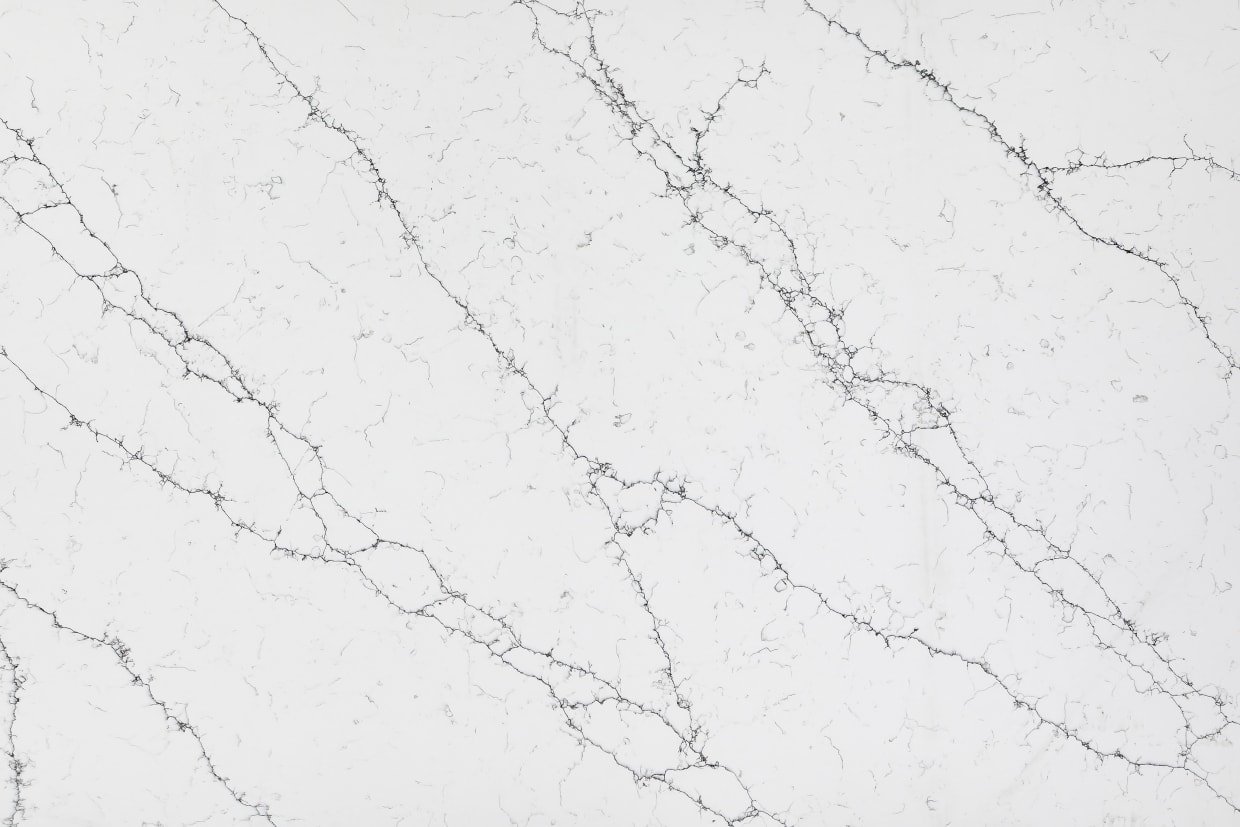
Alaska Bianca Extra (V324) from the Carrara and Veined Series, showing that model’s background and vein scale.
How does the typical Carrara look differ from a Calacatta look?
In natural stone, Carrara is usually described as softer and more evenly veiled, while Calacatta is described as having a brighter or ivory ground and more distinctive, often broader veins. Engineered colours borrow those design conventions. A Carrara-style quartz slab is often chosen when the surface should recede slightly and support cabinetry, rather than dominate the room. A Calacatta-style slab is often chosen when the veining is meant to be the feature.
Those are tendencies, not rules. Some engineered “Carrara” designs are more active than their name suggests, and some “Calacatta” designs are relatively quiet. Compare the actual slab, then read what Calacatta quartz is, and how those designs are specified, if the project is deciding between the two looks.
How do Carrara quartz and natural Carrara marble compare in use?
| Point of comparison | Carrara-style engineered quartz | Natural Carrara marble |
|---|---|---|
| What the name means | A manufactured design style inspired by Carrara marble | A natural marble from the Carrara / Apuan Alps area of Tuscany |
| Appearance consistency | More repeatable than quarry stone, though shade and vein layout can still vary by slab and lot | Each slab is unique; a small sample will not show the movement of a full sheet |
| Kitchen acids | The surface is not calcite marble, but it is still not “acid-proof.” Follow the manufacturer’s cleaning advice and avoid harsh chemicals | The Natural Stone Institute notes that the calcite crystal in true marble is vulnerable to mild acids commonly found in kitchens and bars. Etching can dull a polished finish |
| Staining and porosity | ISFA 3-01 (2013) describes quartz surfacing as solid and non-porous and sets a maximum water absorption of 0.12% (ASTM C97/C97M-09). That threshold is not a test result for a named Aspire Stone slab, and low absorption is not the same as stain-proof | Absorption varies by stone and finish. The Natural Stone Institute states that impregnating sealers can improve stain resistance but do not make stone stain-proof, and they do not prevent acid etching |
| Fabrication | Cut, edged, and installed as engineered quartz, with the usual attention to support, seams, and cut-outs | Cut as natural stone; the pattern runs through the thickness, so a honed or repolished edge still shows the same marble |
| Typical care | Usually a soft cloth and a pH-neutral cleaner, plus prompt wipe-up of spills. Confirm care with the supplier | Neutral stone cleaner, prompt spill removal, and an acceptance that etching and patina can develop in a working kitchen |
Etching and staining are often mixed together in sales language. Etching is chemical damage to a calcite surface. A stain is a substance absorbed into the stone. A dull mark on polished Carrara marble after lemon juice is typically an etch, not a stain, and sealing does not prevent it. Carrara quartz does not have that calcite surface, which is one reason many kitchens specify it. It can still be marked by prolonged contact with dyes, inks, solvents, or damaged areas, so “does not stain” is not a claim this article makes.
Where is Carrara quartz commonly used?
The usual applications are kitchen countertops, bathroom vanity tops, and bar tops—the uses named on Aspire Stone’s Carrara and Veined series page. The quieter vein structure also suits long runs of worktop in apartments, offices, and hotels, where a strong marble pattern might be harder to repeat across many units.
Because engineered patterns are more repeatable than natural marble, Carrara-style quartz can be easier to use in multi-unit projects, provided the buyer still controls lot consistency. It remains a visual product: if several floors must match, slabs should be reviewed as a set.
How should designers choose vein scale and background tone?
Start with the background, then the vein. A cooler, slightly grey-white ground will read differently against warm oak than a brighter white will. A fine, misty vein supports a quiet kitchen. A more linear or slightly broader vein adds movement without crossing into a Calacatta-style statement, unless the specific model is already that active.
Finish changes the reading of the same colour. A polished surface sharpens contrast and shows reflections. A honed surface softens the vein and can hide everyday marks better, while also changing how colour is perceived. Aspire Stone’s series page notes polished or honed finishes among the options on each product page; the finish must be confirmed for the named model, not assumed.
Cabinet colours are a design choice, not a technical property of the slab. Soft Carrara-style grounds often sit well with white or off-white cabinets, light to mid oak, greige, navy, or charcoal. High-contrast two-tone kitchens can work when the worktop stays relatively calm. Always judge the combination against a physical sample or a slab photo in the actual finish, under both daylight and artificial light.
What should a sample approval checklist include?
| Approval step | What to check |
|---|---|
| Model identity | Write down the exact name and factory code, such as Elegant Gray (G054A), not only “Carrara quartz.” |
| Finish | Approve the same finish that will be shipped, polished or honed. |
| Background and vein | Compare the sample with full-slab images. A chip can show tone; it cannot show the movement of a 3200 mm sheet. |
| Lot consistency | If more than one slab is required, ask for current photographs of the production lot and agree whether all slabs must come from one batch. |
| Size and thickness | Confirm the published dimensions and thickness for that model, and whether they suit the longest run or island without an unplanned seam. |
| Care brief | Record the supplier’s cleaning guidance in the project file so the client is not given marble-care advice by mistake, or the reverse. |
FAQ
Is Carrara quartz the same as Carrara marble?
No. Carrara quartz is engineered quartz designed to recall the look of Carrara marble. It is not quarried in Carrara and should not be specified as natural stone.
Does Carrara quartz stain?
Industry standards describe quartz surfacing as a low-absorption, non-porous material compared with many natural stones, but that is not a stain-proof guarantee. Prolonged contact with strong dyes, inks, or harsh chemicals, or damage to the surface, can still leave a mark. Wipe spills promptly and follow the supplier’s care instructions. Natural Carrara marble has a different risk: mild kitchen acids can etch the calcite surface even when the stone has been sealed.
What cabinet colors match Carrara quartz?
Soft white or grey-white, finely veined surfaces are often paired with white, off-white, light oak, greige, navy, or charcoal cabinets. Warmer woods and two-tone kitchens can also work when the slab itself is relatively quiet. There is no single correct match; judge the actual finish and background tone against the door sample.
How do I select a Carrara quartz slab?
Select a named model and code, confirm size, thickness, and finish, and review full-slab images or the physical slabs rather than relying only on a small sample. If several slabs must match, agree the lot and the approval record before production or shipment.
Is every slab in a “Carrara and veined” series a Carrara look?
Not necessarily. Aspire Stone’s Carrara and Veined Series includes Carrara-style designs and other veined colours. Read the individual model page and look at the actual pattern before assuming a classic Carrara appearance.
Approve the slab, not only the name
If you are choosing a Carrara-look quartz for a kitchen or vanity, browse the Carrara and Veined Series, record the model code, and request a sample plus current slab photographs. That approval step is more useful than ordering “Carrara quartz” as a generic description.


 WhatsApp
 EMAIL