




Materials, Technology and Market Forces Shaping Engineered Stone
The near future of engineered stone is being shaped by workplace regulation, fabricator safety, lower-silica and alternative formulations, and changes in how slabs are printed and sized. Those forces do not move at the same speed in every country. This review separates rules already in force, technologies already commercial, and proposals or forecasts still open, using official sources checked on 23 November 2026 (Asia/Shanghai, UTC+8).
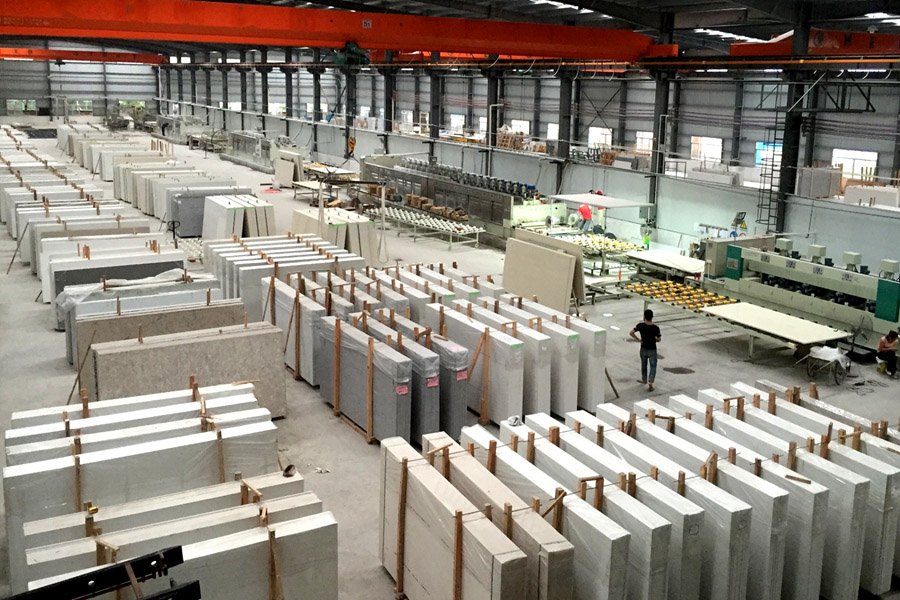
Current published products stored at the Aspire Stone factory. This photograph is not a claim that any model is ban-compliant, silica-free, or next-generation.
What forces are shaping engineered surfaces now?
Four pressures interact. Regulators in some countries have prohibited certain engineered-stone benchtops, panels, and slabs, or have tightened the way they may be cut. Occupational-health bodies continue to treat respirable crystalline silica (RCS) as a serious workplace hazard. Manufacturers have responded with lower-crystalline-silica formulations, silica-free claims, printed and large-format products, and, in some plants, more automated cutting. Design demand still favours marble-look surfaces, quieter neutrals, and fewer seams on large islands. No single trend tells a buyer what is lawful in a given destination.
A short status table is a better starting point than a prediction.
| Force | Status as of 23 November 2026 | Official or primary source, checked that day |
|---|---|---|
| Australia: ban on manufacture, supply, processing, and installation of engineered stone benchtops, panels, and slabs | In force from 1 July 2024, with limited legacy work still permitted | Safe Work Australia, “Engineered stone ban” |
| Australia: import prohibition | In force from 1 January 2025, with narrow permission and exemption routes | Customs (Prohibited Imports) Amendment (Engineered Stone) Regulations 2024, inserting regulation 5M |
| Great Britain: workplace controls for engineered stone | In force under COSHH; HSE guidance is not a product prohibition | Health and Safety Executive, “Working engineered stone: Control silica risk” |
| United States federal OSHA silica rule | In force; PEL 50 µg/m³ as an 8-hour TWA | 29 CFR 1910.1053 |
| California fabrication rules (Title 8, section 5204) | Permanent standard in force (adopted February 2025), including high-exposure trigger tasks | California Department of Industrial Relations, respirable crystalline silica resources page |
| California proposal to prohibit fabrication and manufacture of artificial stone at or above 1% crystalline silica | Discussion draft and petition process; not an adopted ban on 23 November 2026 | Cal/OSHA advisory page, updated discussion draft dated 22 October 2026; DIR news release 22 May 2026 |
| Lower-silica and silica-free formulations; printed and jumbo formats | Already commercial in published catalogues, including Aspire Stone’s live series pages | Manufacturer catalogue pages, which are not by themselves compliance certificates |
How is regulation changing the market, especially in Australia?
Australia remains the jurisdiction to cite first, because the rule is a prohibition, not only a workplace exposure limit. Safe Work Australia’s official page, checked on 23 November 2026, states that the manufacture, supply, processing, and installation of engineered stone benchtops, panels, and slabs is banned, and that the Commonwealth and all states and territories implemented amendments to the model work health and safety regulations on 1 July 2024. For the model regulations, engineered stone is an artificial product that contains at least 1% crystalline silica as a weight/weight concentration, is created by combining natural stone materials with other chemical constituents such as water, resins, or pigments, and becomes hardened. Concrete, ceramic tiles, and porcelain or sintered stone that do not contain resin are among the exclusions listed on the same page.
The same official page gives examples of products that are not prohibited, including an artificial stone benchtop, panel, or slab that contains less than 1% crystalline silica, because the definition requires at least 1%. That example is a legal definition in the Australian model-WHS context. It is not a health guarantee, and it is not a statement about any named commercial product. Safe Work Australia published a review of the prohibition (publication date 4 December 2025) which found that the ban is operating as intended, while noting that implementation is still in its early stages. A related feasibility study on engineered, ceramic, and natural stone “reinforces the need to continue managing work health and safety risks associated with processing all types of stone materials.”
Import rules are separate from the workplace ban. The Customs (Prohibited Imports) Amendment (Engineered Stone) Regulations 2024, made on 5 December 2024 and commencing on 1 January 2025, inserted regulation 5M into the Customs (Prohibited Imports) Regulations 1956. Regulation 5M prohibits the importation into Australia of engineered stone benchtops, panels, or slabs unless written permission, a specified confirmation, or a relevant WHS exemption is produced. Permission may be granted only for genuine research and analysis, for sampling and identification, or where there are exceptional circumstances. A country listing on a manufacturer’s website is not such a permission. Aspire Stone’s About page, checked on 23 November 2026, lists Australia among published markets; that listing is not a claim that Aspire products are ban-compliant or importable into Australia. See also engineered stone regulations buyers should watch.
What is changing in worker safety outside Australia?
Where conventional engineered stone is still sold, official pressure is often on how it is processed, not only on whether it may be supplied. OSHA’s general-industry standard, 29 CFR 1910.1053, requires employers to keep employee exposure at or below 50 µg/m³ of RCS as an eight-hour time-weighted average, unless a stated exception applies, and to use engineering and work-practice controls where they are required.
California has gone further than the federal baseline, without, as of 23 November 2026, adopting a product ban. The Department of Industrial Relations explains that December 2023 and February 2025 updates to Title 8, section 5204, impose enhanced protections for “high-exposure trigger tasks,” including work on artificial stone products containing more than 0.1% crystalline silica by weight. A DIR news release dated 22 May 2026 reported that the Occupational Safety and Health Standards Board had granted a petition initiating a process to prohibit fabrication and installation of artificial stone containing more than 1% crystalline silica. Cal/OSHA later posted discussion drafts, including an updated draft dated 22 October 2026, for proposed new section 5204.1. Those drafts are proposals under comment, not current California law.
In Great Britain, the Health and Safety Executive’s page “Working engineered stone: Control silica risk,” checked on 23 November 2026, states that RCS can cause silicosis, chronic obstructive pulmonary disease, and lung cancer, and that employers must assess and control exposure under COSHH. For powered handheld rotary tools, the page’s control steps include using stone with the lowest crystalline silica content, controlling water-suppression mist, using powered air-purifying respirators with an assigned protection factor of at least 20 for processing, cleaning, or maintenance, reviewing controls, providing health surveillance where appropriate, and regular cleaning. That is workplace guidance, not an Australian-style prohibition on supply.
Are low-silica and silica-free surfaces replacing traditional quartz?
They are a commercial response, not a completed replacement. Lower-crystalline-silica formulations and silica-free claims are already sold, and fabricators in some markets are being advised to prefer a lower content. That does not mean conventional quartz has left the trade, or that “low-silica” is a global legal category. Low-silica is not silica-free. A lower content is not automatically risk-free, and it does not make uncontrolled cutting acceptable. Dust from residual crystalline silica, and from other constituents, can still be generated. See what low-silica quartz is and silica-free surfaces explained.
Aspire Stone publishes a low-silica and silica-free quartz surfaces series. The page, checked on 23 November 2026, says these slabs are “made with a lower crystalline-silica content, or with a silica-free formulation, compared with conventional quartz,” and lists designs including Calacatta Athens, Bianca Gloria, Onda White, and Galaxy White. The listings are not split into a verified low-silica group and a verified silica-free group, and they do not publish percentages. Until a current accredited report is provided for a named model, a catalogue name is not evidence that the slab falls on a particular side of a 1% legal line, or of any other country’s threshold.
Which manufacturing and design technologies are already commercial?
Some changes often described as “future” are already on published series pages. Thermal-transfer printing on engineered quartz is a current production method, used to create a consistent marble or stone look, including, in some catalogues, full-body printed options. Aspire Stone’s printed-quartz page — the live slug is Prined-Quartz-stone-slabs, and that spelling is the real URL — describes high-resolution thermal-transfer printing, consistent pattern from slab to slab, and full-body printed options, with a high-gloss finish available on request. See what printed quartz is. That is commercial technology, not a forecast.
Large formats are also commercial. The Super Jumbo page, checked the same day, describes regular slabs as commonly around 120×56", jumbo around 128×63", and Super Jumbo as 138×78", and presents the larger sheet as a way to reduce seams on islands, feature walls, and commercial surfaces. Those dimensions are that page’s published examples, not an industry standard. Automation in pressing, polishing, and cut-to-size work is already used in factories; Aspire Stone’s About page refers to in-house production on Italian Simec equipment, and the cut-to-size page refers to infrared cutting machines, water jets, and edge polishing. Those are published capabilities, not unreleased research.
Design demand is slower to measure from official sources than regulation is. Catalogues still offer marble-look whites and soft neutrals widely, use printed designs where a repeatable pattern is valued, and sell larger sheets where a long island or a wall needs fewer joints. That is a catalogue observation, not a measured trend share. Energy use, water treatment, process waste, packing, and transport can be measured; a general “green” or carbon figure is only as good as the current, named method behind it. No life-cycle number for Aspire Stone products is published here.
What should manufacturers and buyers monitor next?
Regional differences will persist. A product that is routine to import into one market may be prohibited, or tightly conditioned, in another. Watch official regulators, not only trade headlines: legal definitions, accepted test methods, the difference between a workplace rule and an import rule, and whether a draft in one state becomes a final standard. A reformulated slab does not remove the need to control dust when crystalline silica, or other hazardous dust, may be released.
Practical questions follow. Which destinations still accept conventional quartz, and under what workplace duties? Where a lower crystalline-silica content or a silica-free formulation is offered, what report, method, and date sit behind the claim? Which printed or large-format options are already in production, and which ideas are only at sample stage? How will a factory communicate a formula or pattern change? A visit or a clear process description, such as inside a quartz slab factory, is still the most direct way to see what is actually being made.
FAQ
What is the future of engineered stone?
There is no single future. In Australia, conventional engineered stone benchtops, panels, and slabs are already prohibited to manufacture, supply, process, install, and, from 1 January 2025, to import, subject to narrow exceptions. In other markets the material remains in trade, while workplace rules and formulations are tightening. The durable themes are documented composition, controlled fabrication, and honest labelling of what is already commercial.
Are low-silica surfaces replacing traditional quartz?
They are gaining a commercial role, especially where fabricators or regulators encourage a lower crystalline-silica content, but they have not been shown, in official global trade figures cited here, to have replaced conventional quartz everywhere. Low-silica is not silica-free, and a lower content is not automatically lawful or risk-free. Each model needs a current report and a check against the destination’s own definition.
What technologies are changing slab manufacturing?
Already-commercial methods include thermal-transfer or digital printing, including some full-body printed options, large-format pressing, and more automated cutting and polishing. Lower-silica and silica-free formulations are also already offered. Ideas that have not been made as production slabs should stay in the “sample or forecast” column until a factory has approved a production reference.
Which trends matter most to stone distributors?
The ones that change what you may legally sell, what documents your customers will demand, and what you must hold in stock. Regulatory status by destination comes first. After that, a documented lower-silica option, a reliable core colour range, and a clear path for printed or jumbo specials will usually matter more than a prediction about a single design fashion.
Can Aspire Stone products be imported into Australia under the current ban?
This article does not make that claim. Australia’s import prohibition, in force from 1 January 2025, applies to engineered stone benchtops, panels, and slabs as defined in the relevant WHS law, with only limited permission and exemption routes. A published mention of Australia among a manufacturer’s markets is not a market-access approval. Any assessment would need current official rules, a current composition report for the named model, and advice from the competent authorities or a licensed adviser.
Watch the official texts, then judge the catalogue
If you are reviewing what to offer next, start with the destination’s rules, then ask for current documents on composition and on designs already in production. Aspire Stone’s published series can be used as a catalogue for that discussion, not as a forecast of unreleased research. For a factual enquiry about current products, use the Contact page, or write to [email protected] (Mr. Lin, +86 135 0025 4616).


 WhatsApp
 EMAIL