




Silica-Free Surface Claims: Materials, Testing and Market Requirements
“Silica-free” is a commercial claim, not a legally defined grade. In stone surfaces it usually means that crystalline silica is absent, or below a laboratory’s detection limit, in a tested sample. It is not the same as low-silica, not proof of zero dust risk, and not evidence that a product meets a country’s rules. Buyers should ask for the method, detection limit, date, and named sample behind the claim.
What does “silica-free” mean, and where are the limits of the claim?
The phrase is used in marketing to reassure fabricators and importers who are managing respirable crystalline silica (RCS). Used carefully, it should be tied to a chemical result for crystalline silica—commonly quartz, cristobalite, and tridymite—on a stated sample. Used loosely, it can mean almost anything: no quartz aggregate, a very low crystalline-silica percentage, a “not detected” result, or simply a brand name.
Several limits follow from that looseness.
- A marketing name is not a test result. The product title, series name, or a slogan such as “silica-free quartz” cannot replace a laboratory report.
- “Not detected” is not the same as a proven zero. Every method has a detection or quantification limit. A result below that limit should be reported as such, with the limit stated.
- Crystalline silica is not the only meaning of “silica.” Silicon dioxide also exists in amorphous form. Safe Work Australia’s July 2025 review of the engineered-stone prohibition recorded stakeholder concern that some recycled-glass products are marketed as “silica free” despite containing amorphous silica, which can lead workers to assume that the dust is not hazardous.
- The claim, even when chemically supported, does not automatically satisfy a legal definition in every country, and it does not automatically make fabrication dust harmless.
Low-silica and silica-free should be kept apart. Low-silica, as explained in what low-silica quartz is, and how the term should be used, means a reduced crystalline-silica content compared with conventional engineered quartz. That reduced content may still be substantial. Silica-free is a stronger claim and needs stronger evidence. Aspire Stone’s live series page uses both phrases together and does not publish percentages, so a colour name from that catalogue should not be treated as proof of either status.
How do crystalline silica, amorphous silica, and total silica differ?
Silicon dioxide (SiO2) can be crystalline or amorphous. Crystalline silica has an ordered lattice. OSHA and NIOSH identify quartz, cristobalite, and tridymite as the forms most often discussed in workplace health, and they describe RCS as very small airborne particles that can cause silicosis and other serious diseases. Amorphous silica lacks that crystal structure. Total silica, or total SiO2, is a broader chemical measure and may include both forms.
A buyer verifying a silica-free claim should therefore ask which substance was measured. A low total-silica result and a low crystalline-silica result are not interchangeable. Conversely, a product can be low in crystalline silica and still contain amorphous silica, as in some glass-based surfaces. That product may be correctly described as having little or no crystalline silica and still be wrongly described as containing “no silica” in the chemical sense.
Material composition and the test method have to be disclosed together. Without the method, a percentage cannot be compared with a legal threshold. Without the composition, a buyer cannot tell whether the product is a resin-bound engineered stone, a porcelain or sintered panel, a glass composite, or something else—and those categories are treated differently in some regulations.
Which surface categories are sometimes confused with “silica-free”?
| Material category | What can be said from official or standards sources | What should not be assumed |
|---|---|---|
| Conventional engineered quartz | OSHA and NIOSH state that crystalline silica can comprise up to 95% of some engineered stone, with a published typical range of less than 0.2% to 95% | That a product in this category is low-silica or silica-free without a test |
| Low-silica engineered stone | A commercial description for slabs made with less crystalline silica than conventional quartz; the actual percentage still has to be measured | That “low” means silica-free, below 1%, or lawful in a named country |
| Products marketed as silica-free | The claim should rest on a current, accredited crystalline-silica result for the named product, including the detection limit | That the product contains no silicon dioxide of any kind, or that cutting dust is harmless |
| Porcelain or sintered stone | Safe Work Australia excludes porcelain and sintered stone from the model WHS definition of engineered stone, provided they do not contain resin | That the exclusion means the product is silica-free, or that it generates no hazardous dust |
| Ceramic tiles and similar fired products | Also listed among the exclusions from that Australian engineered-stone definition | That an exclusion from one definition is a crystalline-silica result |
| Natural marble or limestone | OSHA and NIOSH list typical crystalline silica in marble/limestone as less than 5%. The UK HSE lists marble at up to 2%, noting that these stones can contain silica layers | That every marble slab is silica-free, or that marble has no other fabrication or kitchen-use limits |
| Recycled-glass or cement-matrix composites | OSHA and NIOSH note that some engineered stones containing recycled glass and pigments in a portland cement matrix have less than 0.2% crystalline silica | That all glass or cement composites meet that figure, or that “silica-free” is an accurate label if amorphous silica is present and undisclosed |
Category names are a starting point for questions, not an end point for compliance. A porcelain slab, a glass composite, and a resin-bound engineered stone can all be sold for kitchens. Only the composition file and the official definition in the destination market can say how each one is treated.
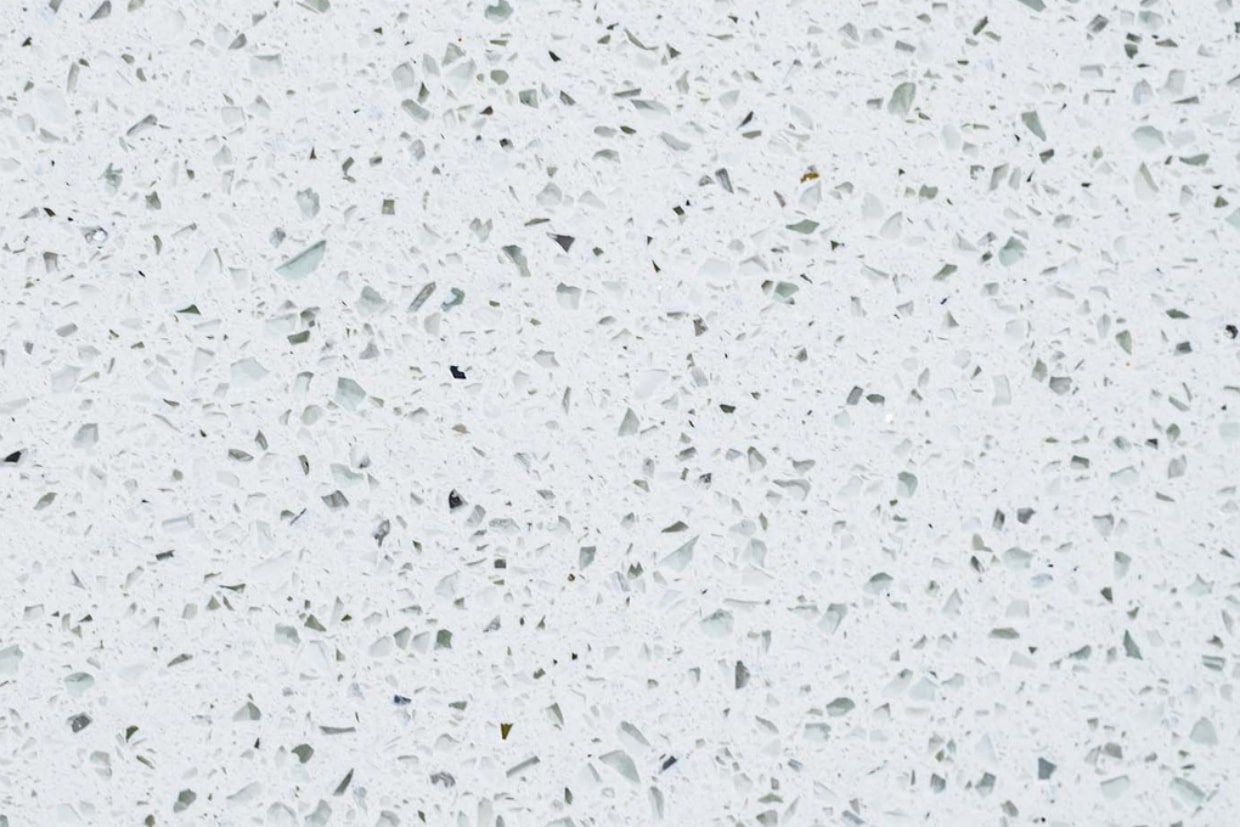
Galaxy White, a named model from Aspire Stone’s live series pages. This photograph is not a silica-content claim.
What documentation and independent verification should buyers request?
A silica-free claim should arrive as a file, not as a headline. The core items are the same kind of documents discussed for low-silica products, but the result has to be read more strictly.
- A composition statement for the exact model and, where possible, the production batch.
- An accredited laboratory report giving crystalline silica as a weight/weight result, with quartz, cristobalite, and tridymite identified when the method allows it.
- The test method, the date, the sample identity, and the detection or quantification limit.
- A safety data sheet or equivalent that does not contradict the report.
- A clear statement of whether any “not detected” result is being used to support a silica-free claim, and at what limit.
X-ray diffraction is widely used to identify crystalline silica in stone. OSHA and NIOSH point to XRD and petrographic analysis for determining exact content in countertop materials. A method written for airborne workplace samples is not automatically the right protocol for a bulk slab, so the report should name the method used on the product itself. In Australia, Safe Work Australia’s July 2025 review found that there is no nationally recognised, standard approach to test whether a product is engineered stone, that several types of analysis may be required, and that “it is not possible to test for engineered stone with one simple test.” That finding is another reason not to treat a single marketing phrase as sufficient.
Independent verification means the buyer, or an importer’s consultant, can repeat or review the test on a sample they control if the destination market requires it. A certificate that cannot be tied to the delivered batch is weaker evidence than a report on a retained or incoming sample.
For a longer document checklist, see what buyers should verify for low-silica and silica-free surfaces. The wider regulatory landscape is covered in engineered stone regulations.
Why is a product name not enough to meet market requirements?
Rules are written around definitions, exposure, or both, and they differ by country. They are not written around brand names.
Australia is the clearest current example of a product-level prohibition. Safe Work Australia states that, from 1 July 2024, the manufacture, supply, processing, and installation of engineered stone benchtops, panels, and slabs is banned under the model WHS Regulations as implemented by the Commonwealth and the states and territories, and that from 1 January 2025 those products are prohibited imports under regulation 5M of the Customs (Prohibited Imports) Regulations 1956. Engineered stone is defined there as an artificial product that contains at least 1% crystalline silica by weight, is created by combining natural stone materials with other chemical constituents such as water, resins, or pigments, and becomes hardened, subject to listed exclusions. SWA states that an artificial stone benchtop, panel, or slab with less than 1% crystalline silica is not subject to that ban.
A silica-free claim is therefore sometimes used in connection with that 1% line. The claim still has to be proved, and even a product that falls outside the ban is not thereby “safe to work with.” SWA’s review recorded that misconception explicitly, and stakeholders asked for a consistent message that “all dust is bad dust.” Control measures can still be required. Implementation can also vary by Australian jurisdiction, and import questions sit with the Australian Border Force as well as with WHS regulators.
The United States and Great Britain, by contrast, have not adopted the same product ban in the official sources cited for this article. They do regulate workplace exposure to RCS. OSHA’s general-industry permissible exposure limit is 50 μg/m3 as an 8-hour TWA, with an action level of 25 μg/m3. The UK HSE states a workplace exposure limit of 0.1 mg/m3 as an 8-hour TWA, under COSHH. A silica-free or very low crystalline-silica product may help a fabricator manage exposure in those markets; it does not cancel the employer’s duty to assess and control any RCS that is still present, or to control other dust hazards.
This article does not state that any Aspire Stone product is silica-free, is below 1% crystalline silica, or meets the rules of Australia, the United States, the United Kingdom, or any other country. No such product test was verified here. Aspire Stone’s low-silica and silica-free series page, checked on 23 November 2026, groups both descriptions on one catalogue page and does not publish test figures. That page is a starting point for a design discussion, not a substitute for a report.
What due-diligence steps should importers and fabricators follow?
| Step | Action |
|---|---|
| 1. Name the product | Record the exact model, code, thickness, and batch or production period, not only a series title such as “silica-free quartz.” |
| 2. Name the market | Write down the country, and where relevant the state or territory, whose official definition will be applied. |
| 3. Collect the file | Obtain the composition statement, accredited report, method, date, detection limit, and safety data sheet before shipment or before cutting. |
| 4. Read the result against the definition | Check crystalline silica as weight/weight, and check whether other definitional elements (such as the presence of resin) apply in that market. |
| 5. Do not translate names across borders | A claim accepted in one catalogue market is not automatically valid in another. |
| 6. Plan fabrication controls | Even if crystalline silica is not detected, control dust. Do not treat “silica-free” as permission for dry, uncontrolled cutting. |
| 7. Keep the evidence with the job | Retain the report and the sample reference in the project or import file so later inspections can be answered. |
FAQ
What does silica-free mean?
In responsible use, it means a current test of the named product found no crystalline silica, or found it below a stated detection limit. In loose marketing use, it may mean much less than that. The report, not the name, should be used to interpret the claim.
Is silica-free the same as zero silica?
Not necessarily. “Not detected” depends on the method’s detection limit, and “silica” in everyday language is often used when the speaker means crystalline silica only. A product can also contain amorphous silica, which is still silicon dioxide. Ask the laboratory to state exactly what was measured.
How can buyers verify silica content?
Request an accredited laboratory report for the named model, with the method, date, sample identity, and detection limit, preferably identifying quartz, cristobalite, and tridymite. Where the destination market requires it, have an incoming or retained sample tested independently. Do not rely on a series name or on a report for a different colour.
Are silica-free surfaces automatically compliant?
No. Compliance depends on the official definition and procedures of the destination country, and sometimes on import rules as well as workplace rules. A supported silica-free or below-threshold result may be relevant to that assessment; the name alone is not. A product that is not prohibited can still require dust controls.
Is a silica-free surface risk-free to fabricate?
No. The absence or non-detection of crystalline silica reduces the specific RCS hazard from that mineral, but cutting and grinding still create dust. Safe Work Australia’s review emphasised that workers should not assume alternative or non-prohibited products are safe to work with, and that dust still needs to be controlled.
Verify the claim, then keep the file
If you are being offered a silica-free surface, start with the report and with the official rules of the destination market, not with the series title. Aspire Stone’s low-silica and silica-free catalogue can be used to review current designs, then the factory should be asked for a current accredited test file for the named model.


 WhatsApp
 EMAIL