




Inside Aspire Stone: From Raw Materials to Export Packaging
Aspire Stone is a Foshan quartz manufacturer, founded in 2008, that presses slabs in-house and also cuts them to size. This article follows a typical path from raw materials to export packing, using industry process knowledge together with facts Aspire Stone has published about its plant, workshop and product range. It is a process briefing for buyers, not a substitute for a factory visit or a product-specific test report.
Who is Aspire Stone, on the evidence published today?
The profile below is taken from live pages fetched on 23 November 2026 (Asia/Shanghai, UTC+8), especially the About page, and is used in that published wording rather than expanded.
Aspire Stone presents itself as a quartz stone manufacturer in Foshan, China, founded in 2008. The export brand on the site is Aspire Stone; the footer and contact block use ASPIRESTONE CO., LTD. This article does not invent an official English legal name for the Chinese factory company.
The About page states that the factory covers more than 25,000 sq.m and has 3 quartz pressing lines, with production in-house on Italian Simec equipment. It says the company produces regular, jumbo and super-jumbo quartz slabs and supplies cut-to-size pieces for kitchens, bathrooms and commercial projects. The range named there includes Calacatta, printed, low-silica and silica-free quartz surfaces, including heat-transfer ink full-body designs.
Typical uses listed on the same page include kitchen countertops, vanity tops, bar tops and kitchen islands. The page also says Aspire Stone supplies buyers in the UK, Canada, Australia, and the UAE (Dubai and Abu Dhabi). Those named markets are marketing facts on the site. They are not a claim that any product may be imported or installed under a particular country’s engineered-stone rules, including Australia’s. Market-access questions have to be checked against current official requirements for the destination and the product.
The published address is No.12, Mingxi Road, Mingcheng Town, Gaoming District, Foshan City, Guangdong, China. Enquiries are directed to Mr. Lin, +86 135 0025 4616, and [email protected].
What the pages do not publish is also part of this briefing. Capacity, shift patterns, formulas, press and cure settings, laboratory results, current certifications, prices, lead times and additional named export countries are not filled in here. A public test report was not found on the live site on the same day.
How does the production path run from raw materials to a finished slab?
The industrial sequence is the same family of steps described in how quartz slabs are made. This article does not repeat that process guide in full. It walks the path as a buyer would, and it keeps typical practice separate from what Aspire Stone has shown.
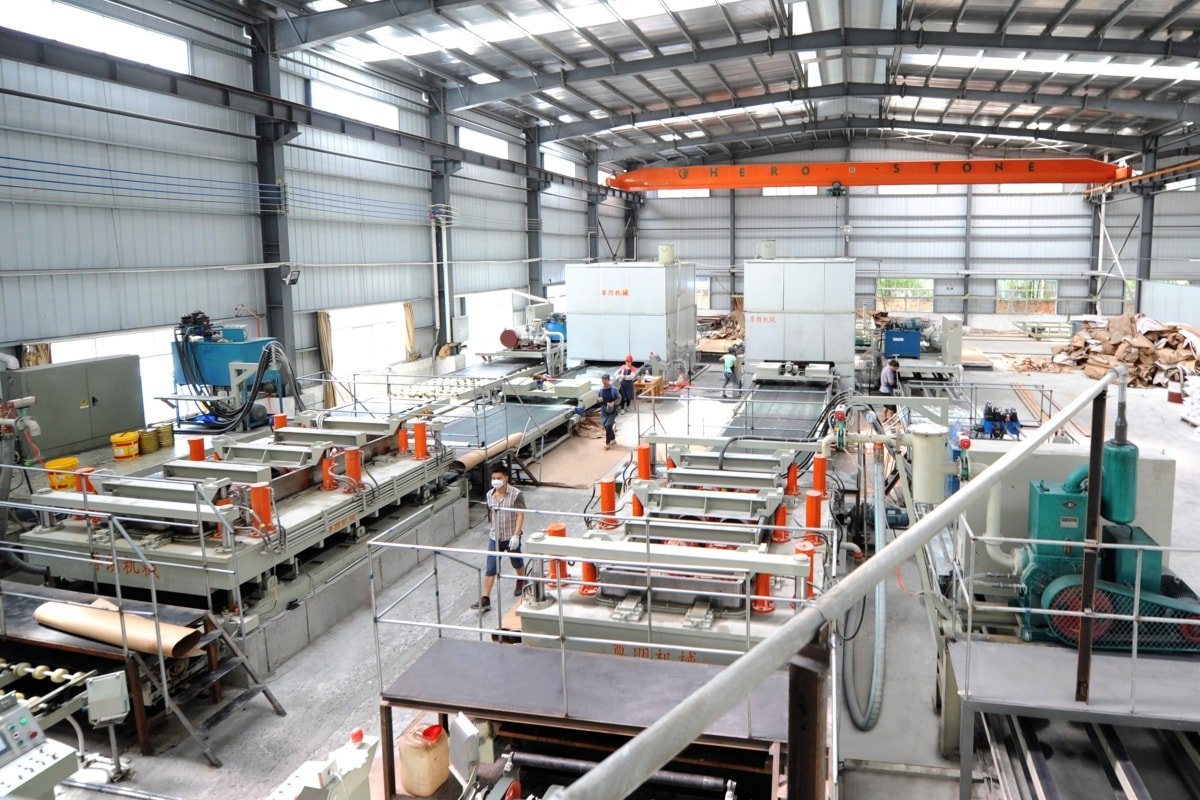
A real Aspire Stone pressing-line photograph, from the live “Pressing Machine” image.
European standard EN 14618:2009 describes agglomerated stone as an industrial product made mainly of hydraulic cement, resin, or a mixture of both, together with stone and other additions, and moulded in geometrical shapes at a fixed plant. Kitchen quartz slabs usually use a resin binder and crushed mineral aggregate — often ground quartz — with pigments and additives. Composition ratios published by other companies or plant suppliers are industry descriptions, not Aspire Stone’s unpublished recipe.
| Stage | What typically happens in the industry | What Aspire Stone has published (fetched 23 Nov 2026) |
|---|---|---|
| Raw materials | Aggregate, resin, pigments and additives are received, checked and stored by lot | The equipment page includes a photograph labeled “Quartz Raw Material.” No incoming-check procedure is published. |
| Batching and mixing | Ingredients are weighed to a recipe and mixed so the resin coats the particles | Not described in detail on the live pages. Do not invent a mixer list or recipe. |
| Forming and pressing | The mix is placed in a mould or on a belt and compacted; many lines use vacuum and vibration | About states 3 quartz pressing lines and in-house production on Italian Simec equipment. The equipment page labels a “Pressing Machine” photograph. No press settings are published. This article does not assume a Breton line is installed. |
| Curing and cooling | Heat hardens the resin binder; slabs are cooled for handling | No kiln temperature or dwell time is published. Figures from other manufacturers, such as Caesarstone’s own 90°C / 45-minute cure, are not Aspire settings. |
| Calibration and polishing | Slabs are trimmed, ground to an even thickness, and finished to the specified gloss or texture | The equipment page labels a “Simec Polishing Machine.” The About line “Italian Simec equipment” is used as published, not as a full machine list. |
| Air or dust systems | Plants typically manage process air and dust around finishing and handling | The equipment page labels an “Air recycle system” photograph, without a published specification. |
| Inspection and identity | Dimensions, finish, appearance and shade are checked; slabs are labeled by color and batch | The homepage says slabs are produced in-house “with attention to color consistency, surface finish, and export packing.” No tolerances or test reports are published. |
| Cut-to-size, when ordered | Finished slabs are cut, edged and, where required, prepared with sink openings or laminated edges | The cut-to-size page describes a 4,000 sq.m center with infrared cutting machines, water jets and edge polishing machines, and a team of 50 skilled workers — workshop figures, not whole-factory headcount. It also states more than 15 years of cut-to-size experience. |
| Packing and dispatch | Finished slabs or pieces are protected, identified and packed for storage or export | The Our Workshop page, which has no H1, includes a photograph labeled “Well packing.” The cut-to-size page says every countertop and vanity top is “cleaned, sealed, labeled, and packed for delivery.” “Sealed” is quoted as published packing language; it is not advice to face-seal quartz as if it were natural stone. No crate or A-frame specification is published. |
For a zone-by-zone view of how factories are organized, see inside a quartz slab factory. Equipment should be judged by condition, records and output, not by a brand name alone.
Where do quality checks and product identification sit on that path?
In a well-run plant, checks are not left until the slab is on a truck. Incoming lots are approved, recipes are locked to batches, and finished slabs are inspected for dimensions, finish and appearance before they are stored or packed. Color is compared with a retained reference under consistent light, with the understanding that reasonable variation is part of a mineral-and-resin product.
Aspire Stone has not published a written quality manual, dimensional tolerances, or laboratory results on the pages reviewed for this article. The honest way to use the company in this story is to treat the homepage emphasis on color consistency, surface finish and export packing as a stated focus, then ask for the current inspection standard, batch-marking method and, if required, a named test report. Those documents should come from the company; they should not be invented here.
Product identification matters as soon as more than one batch or finish is in the warehouse. Buyers should expect a color or model code, thickness, finish and a batch or slab mark to travel with the piece and the packing list, especially when later additions must match.
What products and processing options are on the live site?
The categories page, fetched the same day, lists Calacatta, printed, low-silica and silica-free, Carrara and veined, solid color, sparkling, exotic, super jumbo, and new arrival series, with cut-to-size available for kitchen countertops, vanity tops and commercial projects. Low-silica and silica-free surfaces should be treated as distinct claims and verified for the named product; a lower-silica slab is not automatically silica-free, and neither description removes the need for safe fabrication practice.
Sizes should be taken from the page that states them, because the site does not use one consistent example everywhere. A product page such as Calacatta Fresh (G047), fetched the same day, lists a slab size of 3200×1600 mm (126×63") in 20 mm and 30 mm. The Super Jumbo page — the typo in that URL is the live slug and is not “corrected” here — describes regular slabs as commonly around 120×56", jumbo around 128×63", and Super Jumbo at 138×78". Those are that page’s published examples, not a single factory standard. Finish and application lines on product pages can be templated; they should not be read as a technical approval for every use.
The cut-to-size page says the workshop handles cutting, polishing, sink-hole cutting, lamination, mitered edges “and more,” and that Aspire Stone both presses slabs and cuts them to size, including low-silica and printed options. The homepage also mentions shop drawings and estimating for kitchen, vanity and commercial projects. Those are published service descriptions. Capacity, minimum order and lead time are not stated on those pages and are not added here.
How are slabs packed, and how is export usually coordinated?
Export packing for quartz slabs typically protects the face and edges, keeps pieces identifiable, and holds them securely for road and ocean transport. A-frames, crates, film or edge guards are common in the trade, but the exact method should come from the supplier’s packing specification. Aspire Stone has published a “Well packing” photograph and the cut-to-size line that pieces are cleaned, sealed, labeled and packed. That is all this article treats as confirmed packing language. If a buyer needs timber type, frame style, or loading drawings, those should be requested.
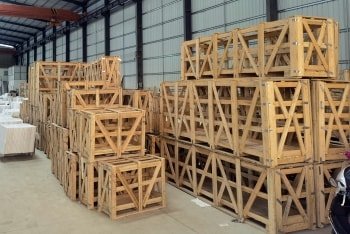
The real Aspire Stone “Well packing” workshop photograph, showing pieces in timber crates. This is packing, not a factory face-sealing process.
Container planning is a separate calculation, based on slab size, thickness, packing method and legal load limits. How to calculate a container load is the place for that working, once packing details are known. How to import quartz from China covers the wider commercial path — documents, responsibilities and destination rules — without turning this process briefing into a customs guide.
The named markets on the About page, again, are not an import-approval list. A buyer shipping to Australia, or to any other destination with silica or engineered-stone rules, must check current official requirements for the product and the use. This article does not make a market-access claim.
FAQ
Where are Aspire Stone quartz slabs made?
Aspire Stone states that it is a quartz stone manufacturer in Foshan, China, founded in 2008, with a factory of more than 25,000 sq.m and three quartz pressing lines. The published address is No.12, Mingxi Road, Mingcheng Town, Gaoming District, Foshan City, Guangdong, China. A factory video page also exists at https://aspirestonecn.com/video/305.html; the page itself has little descriptive text and is not used here as evidence of unpublished process settings.
What products does Aspire Stone manufacture?
The live categories page lists Calacatta, printed, low-silica and silica-free, Carrara and veined, solid color, sparkling, exotic, super jumbo and new arrival series, plus cut-to-size pieces. About also mentions heat-transfer ink full-body designs. Confirm the current color, size and finish on the product page or quotation for the item you are buying.
Does Aspire Stone offer custom processing?
Yes, on the terms published on the cut-to-size page: a 4,000 sq.m workshop with infrared cutting machines, water jets and edge polishing machines, and a team of 50 skilled workers handling cutting, polishing, sink-hole cutting, lamination and mitered edges, among other operations. The homepage also refers to shop drawings and estimating. Ask the company for current scope, drawings requirements and timing for a specific job.
How are slabs packed for export?
The company has published a workshop photograph labeled “Well packing,” and it says cut-to-size countertops and vanity tops are cleaned, sealed, labeled and packed for delivery. A detailed packing specification — frame type, protection materials and loading method — is not on those pages and should be requested if you need it for logistics. “Sealed” in that sentence is not a recommendation to apply a face sealer as if the material were natural stone.
Does listing Australia as a market mean the slabs can be imported there?
No. The About page’s list of buyers in the UK, Canada, Australia and the UAE is a published marketing fact about stated markets. It is not a determination that a given product may be imported, fabricated or installed under Australia’s engineered-stone rules, or under any other country’s rules. Check current official requirements for the destination and the product.
Visiting the process, then asking a precise question
If you need a factory visit or a quotation, come with the product, size, finish and destination in mind, and ask which line and which workshop operations would be used. Aspire Stone’s published plant and workshop pages are a starting record, not a complete technical file. Contact Mr. Lin at +86 135 0025 4616 or [email protected], or use the Contact page, and request current packing details, inspection standards and any test reports your order requires.


 WhatsApp
 EMAIL