




How Are Quartz Slabs Made? From Raw Materials to Finished Surfaces
Engineered quartz slabs are manufactured surfaces, not blocks sawn from a quarry. Factories typically combine crushed mineral aggregate — often ground quartz — with a polymer resin, pigments and additives, then form, compact, cure and finish the sheet. Recipes and cycle times differ by plant and product, so the steps below describe a widely used industrial process, not one unpublished factory setting.
What raw materials go into a quartz slab?
The mineral ingredient most often named in the trade is crushed natural quartz, a form of silicon dioxide. The University of Minnesota’s Common Minerals guide describes quartz as SiO2 with a Mohs hardness of 7. In slab production it is used as a graded aggregate — grit and powder in several particle sizes — rather than as a decorative crystal.
A polymer binder, commonly described as an unsaturated polyester resin, holds the aggregate together after it is cured. Pigments tint the mix. Manufacturers also refer to minor additives such as catalysts, accelerators and silane coupling agents that help the resin cure and adhere to the mineral surface. Some decorative designs add glass or reflective particles for a sparkling or special-effect surface.
Composition figures should be read with care. Breton, the Italian plant supplier behind the Bretonstone process, has described stone materials as constituting up to 94% of the finished product by weight, with an organic resin as the binder. Caesarstone has described its quartz surfaces as using up to 90% crushed quartz. The Natural Stone Institute’s Use Natural Stone campaign notes that the oft-cited figure of about 93% mineral quartz is a maximum, that actual content can be lower, and that such percentages are usually given by weight, not volume. These are industry-described ranges, not a single formula, and they are not Aspire Stone’s unpublished recipe.
European standard EN 14618 treats this family of products as agglomerated stone: industrial goods made mainly of hydraulic cement, resin, or a mixture of both, together with stone and other additions, and moulded in geometrical shapes at a fixed plant. Most kitchen and bathroom quartz slabs use a resin binder rather than a cement binder.
How are materials inspected, weighed, batched and mixed?
Production usually starts with incoming inspection and segregated storage, so aggregates, resins and pigments are not cross-contaminated. Graded quartz is often held in silos so each particle-size fraction can be dosed accurately.
Batching is a controlled weighing step. The plant doses aggregates, resin, pigments and additives according to the formula for that color or design, then mixes them until the resin coats the particles and the color is as uniform as the design allows. For veined or multi-tone slabs, more than one mix may be prepared and deposited in a programmed pattern.
Buyers who need repeatable color from lot to lot should ask how the factory controls raw-material lots, pigment batches and mixer recipes. Those controls matter as much as the press, which is why how manufacturers control quality and color consistency is a separate, practical question.
How is a quartz slab formed and compacted?
After mixing, the material is distributed into a slab-shaped mould or onto a forming belt, in a layer thick enough for the intended finished gauge. At this stage the mix is still a compactable paste, not a rigid stone.
Many industrial lines then compact the slab by vibration and compression under vacuum — a method Breton describes as the core of its patented Bretonstone process. Breton states that this allows a high concentration of stone aggregates while reducing the amount of binder. The vacuum helps remove trapped air, and the vibration plus pressure helps the particles pack more tightly.
Caesarstone, describing its own process, likewise says the mix is poured into a mould, then compressed and vibrated in a vacuum to remove air. Exact pressures, vacuum levels and cycle times are manufacturer-specific and should not be treated as universal numbers.
Aspire Stone, a quartz manufacturer in Foshan founded in 2008, states on its About page that it operates three quartz pressing lines on Italian Simec equipment in a factory of more than 25,000 sq.m. Its equipment pages currently show a pressing machine and a Simec polishing machine. Those are confirmed plant facts, not a substitute for unpublished press settings or output figures. For a closer look at factory layout and at Aspire Stone’s own process story, see inside a quartz slab factory and from raw materials to export packaging.
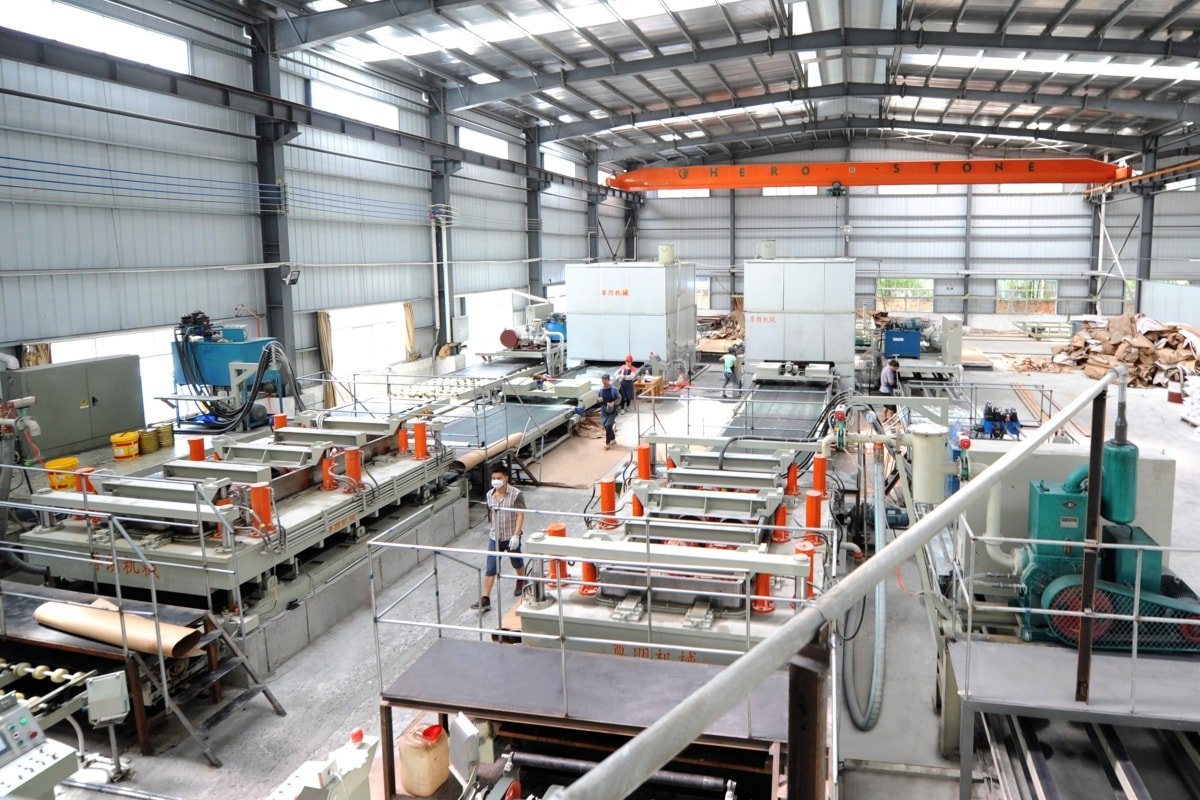
Compaction on the pressing line, from the live “Pressing Machine” photograph on Aspire Stone’s equipment page.
How are slabs cured, calibrated and polished?
Once compacted, the binder has to harden. On resin-bound lines, slabs typically move into a curing kiln, where heat completes the polymer reaction. Caesarstone publishes a curing step of 90°C for 45 minutes for its own process. Other descriptions of Breton-type lines also refer to a heated hardening stage, but temperatures and dwell times are not identical across plants. After curing, slabs are cooled so they can be handled without distortion.
Finishing usually includes trimming the slab to the intended length and width; calibration, or grinding so that thickness is even; successive grinding and polishing with diamond abrasives to the specified gloss or texture; then inspection, labeling and packing.
A polished finish is taken through finer abrasives to a high sheen. A honed or matte finish is processed to a lower gloss. Calibration is what makes a nominal 20 mm or 30 mm slab usable for tight joints. The finished thickness still has a tolerance, which should come from the supplier’s specification. Slab sizes, thicknesses and finishes should be confirmed on the quotation for each product, not copied from a generic chart.
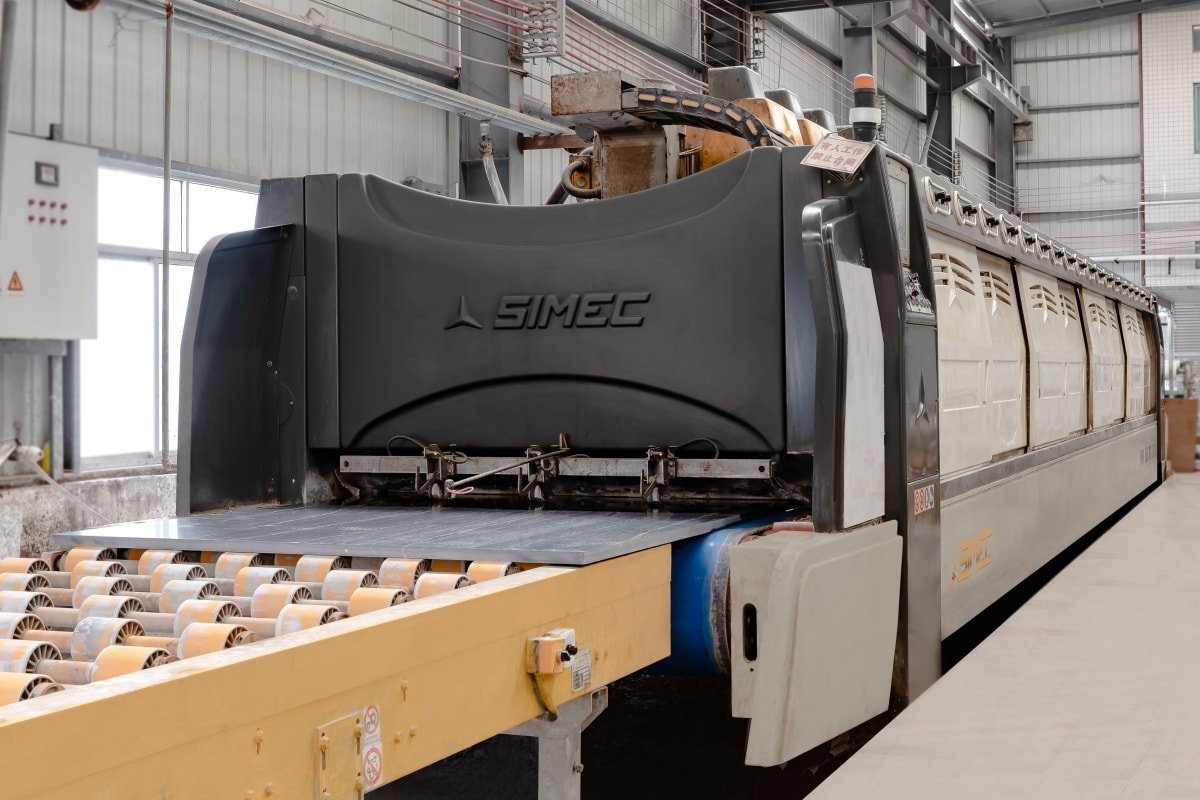
After curing and calibration, slabs are ground and polished. This is the live “Simec Polishing Machine” photograph.
How are colors, veins and printed effects created?
Surface design is part of production, not an afterthought.
Solid colors rely mainly on pigmented mixes and controlled aggregate color. Veined and marble-look slabs are typically created by depositing contrasting mixes, or by in-body veining systems, so the pattern is present in the thickness of the slab. Breton also describes in-body decoration and automatic veining systems.
Printed designs are a different route. Aspire Stone’s printed quartz pages describe high-resolution thermal-transfer printing on an engineered quartz surface, including full-body printed options. That method can produce a consistent pattern from slab to slab, but it is not the same as a fully pigmented, through-body vein. Buyers should review how the face, the edge and any cut-outs will look after fabrication.
How do manufacturers inspect finished slabs?
A finished slab is usually checked for both geometry and appearance before it is packed. Typical checkpoints are summarized below. Each slab should also carry identification for color or code, batch, slab number and finish.
| Checkpoint | What is typically reviewed | Why it matters to the buyer |
|---|---|---|
| Dimensions | Length, width, nominal thickness, thickness variation, flatness | Affects yield, joint quality and whether the slab matches the order |
| Appearance | Pits, voids, cracks, blotches, polish quality, pattern breaks | Determines whether the face is acceptable for the intended visible use |
| Identification | Color or code, batch, slab number, finish | Allows shade matching and traceability after shipment |
| Sample testing | Water absorption, density, flexural or compressive strength, reported against a named method | Supports specification review; not usually a test of every slab |
Performance testing is usually done on samples rather than on every slab. Buyers often request laboratory results for water absorption, density, flexural strength and compressive strength. Methods cited in the industry include ASTM C97/C97M for absorption and bulk specific gravity of dimension stone, ASTM C880 for flexural strength, ASTM C170 for compressive strength, and the EN 14617 series for agglomerated stone in European specifications. ASTM C97 is written for dimension stone, not specifically for resin-bound slabs, so results should be read in the context of the method stated on the report.
Aspire Stone has not published current test values or a public quality-control procedure in the sources used for this article. Importers should ask for the current inspection standard and recent test reports for the product they intend to buy.
How are finished slabs packed and stored?
After inspection, slabs are typically labeled, then packed in A-frames or similar stillages, with protection at the faces, edges and corners, so polished surfaces do not rub and the pack stays stable in the warehouse and in a container.
Storage conditions matter. Because the binder is a polymer resin, prolonged exposure to direct sunlight can affect appearance. Indoor storage, even support and clear batch identification help fabricators pull matching slabs for a single job.
Cut-to-size work, if required, happens after the slab is finished. Aspire Stone’s cut-to-size workshop is described on the live site as about 4,000 sq.m, with infrared cutting, water-jet cutting and edge polishing, and a team of 50 skilled workers. That figure is not a whole-factory headcount.
If you are comparing factories, useful questions concern process control: how materials are batched, how compaction and curing are controlled, how shade lots are managed, and how finished slabs are inspected and packed. For a definition of the material itself, see what quartz stone is. To discuss current sizes, finishes or packing for a specific order, contact Aspire Stone.
FAQ
What are the main ingredients in a quartz slab?
Most engineered quartz slabs are made from crushed mineral aggregate — often ground quartz — bound with a polymer resin, plus pigments and small amounts of curing and coupling additives. Industry descriptions often place the mineral portion around 90% or more by weight, but the exact ratio varies by manufacturer and color and is not a universal formula.
How is a quartz slab formed?
The mixed material is distributed into a slab-shaped mould or onto a forming line, then compacted into a dense sheet. Many factories use vibration and compression under vacuum to remove air and pack the particles, after which the resin is heat-cured so the slab can be calibrated and polished.
Why are vacuum and vibration used in production?
Vacuum helps draw trapped air out of the mix. Vibration and compression help the aggregate particles settle into a tighter packing. Breton describes vibro-compression under vacuum as a way to use a high proportion of stone aggregate with less binder. Other manufacturers describe the same idea, though machine settings differ.
How are quartz slabs polished?
After curing and cooling, slabs are typically trimmed and calibrated to an even thickness, then ground and polished with successive diamond abrasives. A polished finish is taken to a high gloss. Honed or other lower-gloss finishes are processed to a different surface texture.
How do manufacturers inspect finished slabs?
Factories commonly check dimensions, thickness, flatness, appearance, edges and shade identification on the finished slab. Physical tests, such as water absorption or flexural strength, are usually performed on samples and reported against a named test method. Buyers should request the current inspection standard and recent reports for the color they are purchasing.


 WhatsApp
 EMAIL