




How to Estimate a Quartz Slab Container Load for Import
A quartz slab container load is calculated from slab size, thickness, packed weight, packing method, and the container’s payload and door opening—not from a single “slabs per box” figure. Any worked example below is a labelled estimate, using published third-party mass figures and one carrier’s container sheet. The real load is controlled by packed weights, packing geometry, the container’s data plate, and carrier or road limits.
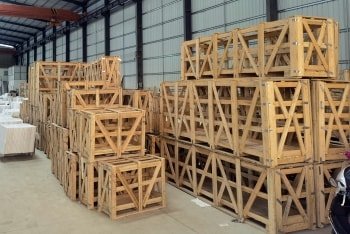
Packed quartz pieces in timber crates, from Aspire Stone’s live “Well packing” workshop photograph. The published file is a small thumbnail, and the photograph does not show a container being loaded.
Why do size, thickness, weight, and packing control the load?
Engineered-quartz slabs are dense. The first planning figure is the mass of the bare slab, which rises with area and thickness. The second is the packed unit: an A-frame or crate that includes timber or steel, protection between faces, straps, and dunnage. The third is geometry. A frame that is too wide for the container door, or too long for the internal length, will not load, even if the payload still has spare kilograms.
Aspire Stone’s Super Jumbo page does not publish a slab weight or a loading table, and this article does not invent one. A useful scale, not a factory figure, comes from other published data, in the same way the jumbo and super jumbo article treats mass. Confirm actual size, thickness, density, and packed weight with the factory before you book a container. Measurement and area calculations for project cutting lists are a separate task, covered in how to measure and calculate quartz slabs for custom projects.
Which container types are used, and what limits apply?
Stone slabs are commonly planned in general-purpose dry containers, often 20-foot boxes, because the cargo is heavy and the payload of a 40-foot box is not proportionally larger. That is a planning observation from published payload figures, not a rule that every quartz shipment must use a 20-foot container. Open-top or other special equipment is a discussion with the carrier if a load cannot be stowed through a standard door.
The figures below are from Maersk’s published dry-container equipment specification sheet, checked on 23 November 2026. They are one carrier’s published values. Individual containers differ. The maximum gross mass, tare, and payload on the container’s CSC plate, and any lower limit imposed by the road, rail, or terminal leg, control the real load.
| Container type (Maersk published sheet) | Internal length × width × height | Door opening (width × height) | Published tare / maximum payload / maximum gross |
|---|---|---|---|
| 20' standard steel | 5,896 × 2,350 × 2,393 mm | 2,350 × 2,274 mm | 2,280 kg / 28,200 kg / 30,480 kg |
| 40' standard steel | 12,032 × 2,350 × 2,393 mm | 2,340 × 2,274 mm | 3,700 kg / 28,800 kg / 32,500 kg |
| 40' high cube steel | 12,032 × 2,350 × 2,697 mm | 2,340 × 2,577 mm | 3,880 kg / 28,620 kg / 32,500 kg |
On that sheet, the 40-foot standard box has only 600 kg more published payload than the 20-foot box, with about twice the internal length. A heavy stone load will often reach the weight limit long before it fills the volume of a 40-foot container. Maersk’s cargo-weight FAQ, also checked that day, lists slightly different payloads (28,300 kg for a 20-foot standard steel box) and states that specific weight limits can vary by country. Use the plate on the box you are given, and ask the forwarder about inland limits on the planned route.
How are slabs packed and secured?
In the stone trade, slabs are commonly shipped standing in timber or steel A-frames or in reinforced crates, with protection between faces, edge and corner protection where needed, and straps or other restraints so the pack cannot rack or loosen. Two or more packed units may be stowed in one container if dimensions and weight allow. This article does not state how many frames Aspire Stone places in a container, or how many slabs go on a frame, because no such factory table has been published for use here.
The 2014 IMO/ILO/UNECE Code of Practice for Packing of Cargo Transport Units (CTU Code) is a non-mandatory global code for packing and securing cargo for sea and land transport. For a heavy load, distribute weight, keep the centre of gravity under control, secure the cargo against movement, and do not rely on the container walls alone. Use a dry, structurally sound box. Photograph the empty container, the loading sequence, the lashing, and the seal number, and keep those photographs with the shipping file.
A worked example, clearly labelled as an estimate
The calculation below is an estimate for planning only. It is not a quotation, not an Aspire Stone packing specification, and not a promise of how many slabs will fit in a container. The assumed product is a rectangular slab of 3200 × 1600 × 20 mm, which is the size listed on Aspire Stone’s Carrara and Veined series page, checked on 23 November 2026. That figure is that page’s published example, not an industry standard. The assumed packing method is standing A-frames or equivalent crates inside a 20-foot general-purpose container. Packed frame weights are unknown here and are therefore not invented.
| Step | Assumption and result |
|---|---|
| 1. Face area | 3.20 m × 1.60 m = 5.12 m² per slab. |
| 2. Bare-slab mass from ISFA minimum density | ISFA 3-01 (2013) sets a minimum density of 2,200 kg/m³, tested to ASTM C97-09. At 20 mm, that density implies 44 kg/m², so 5.12 × 44 = 225.28 kg, or about 225 kg per bare slab. This is a minimum-density scale, not a measured Aspire Stone mass. |
| 3. Bare-slab mass from a published manufacturer range | Caesarstone’s US Design & Specification page, checked on 23 November 2026, publishes 43–48 kg/m² for 2 cm slabs and 66–70 kg/m² for 3 cm slabs. Applied only as a third-party scale to the 5.12 m² assumption: about 220–246 kg per bare 20 mm slab, or about 338–358 kg per bare 30 mm slab. These are not Aspire Stone weights. |
| 4. Packing mass | The A-frame or crate, protection, and lashing add mass. Without a factory packed weight, stop here. Do not treat the bare-slab mass as the shipping mass, and do not use these estimates for lifting plans. |
| 5. Container payload check | On the Maersk 20-foot sheet, the published maximum payload is 28,200 kg. The buyer’s check is whether the sum of all packed frames, plus any dunnage, is below that payload and below any lower road or carrier limit. Geometry must also clear the 2,350 × 2,274 mm published door opening and the internal length of 5,896 mm. |
It is tempting to divide 28,200 kg by 225 kg and call the result a container load. That arithmetic is misleading. It ignores packing weight, stowage geometry, weight distribution, and any limit below the plate rating. This article therefore does not convert the estimate into a piece count.
If a factory later confirms that one packed A-frame of stated slab size and thickness weighs a stated number of kilograms, and that a stated number of frames can be stowed in the chosen container, the buyer can then complete the check: combined packed weight against payload, and packed length, width, and height against the door and the internal dimensions. Until those factory figures exist, the load remains uncalculated.
Oversized sheets need a tighter geometry check. Aspire Stone’s Super Jumbo page, checked the same day, describes Super Jumbo as 138×78", which is about 3,505 × 1,981 mm. A 1,981 mm width already uses most of a 2,350 mm published internal width and door opening once an A-frame’s own structure is added. Confirm packed dimensions before assuming that format will load in a standard dry box.
How should weight distribution, loading, and moisture be handled?
Plan the loading sequence so that weight is spread, packed units cannot shift, and the first frames in are still accessible to the lashing plan. Keep residual moisture out of the box: a dry container, protected faces, and no standing water in the packing are basic precautions for a long sea voyage. If the goods are cut-to-size pieces rather than whole slabs, the packing design changes; do not assume a slab-frame plan still applies. Agree who will declare the packed container’s weight to the carrier under the verified-gross-mass procedure used at the load port.
What should be checked before the container is sealed?
The list below is an editorial pre-loading checklist, not an Aspire Stone procedure and not a substitute for the contract.
| Check | What to record |
|---|---|
| Product | Colour, size, thickness, quantity, and labels match the packing list and the approved sample range. |
| Packed units | Number of frames or crates, packed weights, and external dimensions, as given by the factory. |
| Container | Type, number, CSC plate payload and tare, condition, and cleanliness. |
| Stowage | Fit through the door, weight distribution, lashing, and moisture protection. |
| Photographs | Empty box, each packed unit, loaded stow, lashing, and applied seal. |
| Documents | Invoice, packing list, and draft bill of lading data match the cargo. See documents needed when importing quartz slabs. |
The wider import sequence, including Incoterms and destination customs, is in how to import quartz slabs from China.
FAQ
How many quartz slabs fit in a container?
There is no single answer, and this article does not publish a fixed piece count. The load depends on slab size and thickness, packed weight, the packing system, the container type, the payload on the data plate, and any lower carrier or road limit. Ask the factory for packed weights and frame dimensions for the actual order.
How much does a quartz slab weigh?
It depends on area, thickness, and density, plus packing if you mean the shipping weight. ISFA 3-01 (2013) sets a minimum density of 2,200 kg/m³. Caesarstone’s US page publishes 43–48 kg/m² for 2 cm and 66–70 kg/m² for 3 cm, as that company’s figures. Applied to a 3200 × 1600 mm example, those scales suggest roughly 220–246 kg for a bare 20 mm slab and 338–358 kg for a bare 30 mm slab. They are not Aspire Stone weights.
Which container is used for stone slabs?
A 20-foot general-purpose dry container is a common planning choice for heavy stone, because published payloads for 20-foot and 40-foot dry boxes are similar. A 40-foot or high-cube box may still be used when geometry or mixed cargo requires it. Confirm the equipment with the factory and the forwarder.
How are stone slabs secured for shipping?
They are commonly packed standing in A-frames or crates, protected between faces, and lashed so the load cannot shift. The CTU Code provides non-mandatory guidance on weight distribution and securing in containers. Loading photographs and a seal number are part of a complete file.
Can I plan a Super Jumbo load from the 20-foot internal width alone?
No. A published 138×78" sheet is already wide relative to a typical dry-container door. Packed frame thickness must be measured and compared with the actual opening before the booking is treated as confirmed.
Need packed weights for a planned shipment?
If you are planning a container with Aspire Stone, ask for the packed weight and external dimensions of each frame or crate for your size and thickness, and for loading photographs from a comparable shipment if they can be shared. Send the colour, size, thickness, quantity, destination port, and Incoterms rule through the Contact page or to [email protected].


 WhatsApp
 EMAIL