




Calacatta Quartz for Kitchens and Interiors: Design Features and Applications
Calacatta quartz is an engineered quartz surface designed to recall natural Calacatta marble: a light white or ivory background with distinctive grey, taupe, or gold-toned veining. It is not natural marble; the name describes a design style, not a quarry source. Buyers typically specify it for kitchen countertops, vanity tops, and commercial interiors when they want a marble look with the usual care profile of engineered quartz.
What is Calacatta quartz, and how is it different from Calacatta marble?
Calacatta quartz is a design category of engineered quartz, not a type of natural stone. In the trade, “Calacatta” on a quartz slab refers to a marble-inspired look: a light background and more pronounced veining than a typical Carrara-style pattern. The slab is manufactured, usually as a composite of mineral aggregate, polymer resin, and pigments, rather than cut from a quarry block.
Natural Calacatta is a family of white or ivory marbles historically associated with the Carrara area and the wider Apuan Alps in Italy. Italian producers such as Franchi Umberto Marmi and Savema describe a light background crossed by distinctive veins that may be grey, dove grey, beige, or gold, with each block and slab unique. That origin and uniqueness do not transfer to an engineered slab that uses the same design name.
The distinction matters in specifications. A drawing that says “Calacatta” without naming the material can be read as natural marble. If the intent is engineered quartz, the specification should say so, and it should include the model name and code, not only the word Calacatta.
Engineered quartz should also not be confused with quartzite, which is a natural metamorphic rock, or with the mineral quartz alone. Calacatta quartz is a finished slab product in the engineered-quartz category. For a broader definition of that category, see what quartz stone is and how it is made.
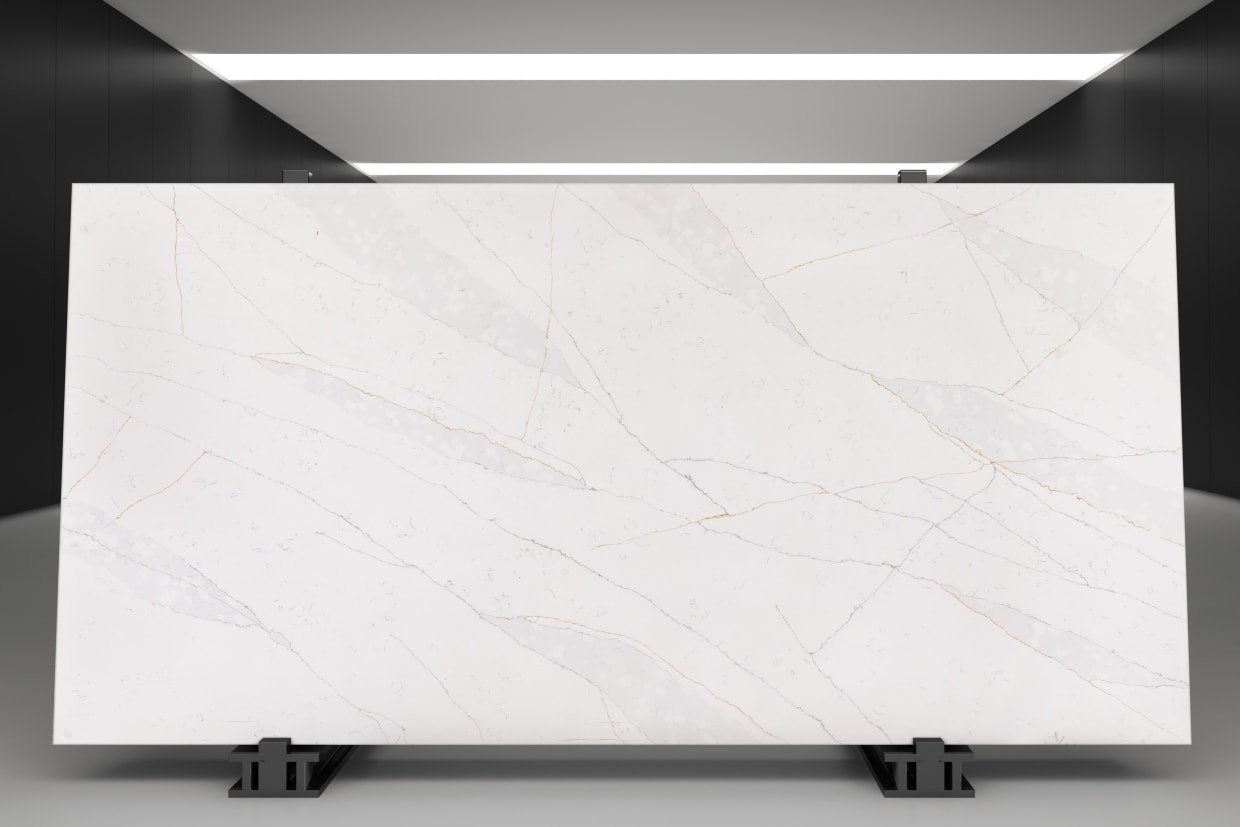
Calacatta Fresh (G047), a Calacatta Series slab, showing that model’s white background and grey and gold veining.
What visual features define a Calacatta-style quartz slab?
Most Calacatta-style quartz designs share a light background and veining that reads more boldly than a soft Carrara-style pattern. Vein colour is often grey, sometimes with gold or warmer tones. Vein scale may be tight and linear or broader and more dramatic, depending on the model.
Aspire Stone’s Calacatta Series is described on that page as using a white background with grey or gold veining, as a marble-look surface for kitchen countertops, vanity tops, and commercial interiors. Designs listed on the series page include Calacatta Fresh, Calacatta Italia Extra, and Calacatta Macchia, among others.
On the individual product pages checked on 23 November 2026, Calacatta Fresh (G047), Calacatta Italia Extra (G071), Calacatta Macchia (G209), and Calacatta gold (G208) are each listed at 3200×1600 mm (126×63"), in 20 mm or 30 mm. Those figures are the published specifications for those listings; they should not be treated as an industry-wide standard size for every Calacatta quartz slab.
Pattern variation still exists inside a single model. Engineered quartz is generally more repeatable than natural marble, but vein placement, background shade, and movement can differ from slab to slab and from a small sample to a full sheet. A sample chip is useful for tone and finish; it is not a reliable preview of the full-slab composition.
How do Calacatta quartz and natural Calacatta marble compare?
| Point of comparison | Calacatta-style engineered quartz | Natural Calacatta marble |
|---|---|---|
| What the name refers to | A manufactured design style inspired by Calacatta marble | A natural marble family associated with the Carrara / Apuan area of Italy |
| Composition | An engineered slab. ISFA 3-01 (2013) describes quartz surfacing as generally consisting of natural quartz particles, resins, pigments, and additives | A metamorphic rock whose basic building block, according to the Natural Stone Institute, is the calcite crystal |
| Appearance from slab to slab | More controllable than quarry stone, but vein layout and shade can still vary by batch and slab | Each block and slab is unique; matching requires selection of specific stones |
| Kitchen acids (lemon, vinegar, wine) | The mineral aggregate is not calcite marble; care still depends on the resin surface and the finish. It is not “acid-proof” | The Natural Stone Institute notes that calcite is vulnerable to mild acids commonly found in kitchens; etching can dull the polish |
| Porosity and sealing | ISFA 3-01 describes quartz surfacing as solid and non-porous and sets a maximum water absorption of 0.12% (ASTM C97/C97M-09). That is a standard threshold, not a test result for a named Aspire Stone slab | Absorption varies by stone and finish. The Natural Stone Institute states that sealing can improve stain resistance but does not make stone stain-proof, and sealing does not prevent acid etching |
| Typical interior uses | Kitchen countertops, vanity tops, bar tops, and commercial interiors, as listed on Aspire Stone’s Calacatta product pages | Floors, walls, vanities, and, where the client accepts etching and patina, kitchen tops |
A fuller material comparison of engineered quartz and marble sits in quartz versus marble. The shorter difference for specification work is this: Calacatta quartz copies a look; it does not reproduce the geology or the maintenance behaviour of marble.
What design options, vein scales, and bookmatching choices are available?
Design choice usually starts with background tone and vein scale. A quieter grey vein on a bright white ground suits a minimal kitchen. A wider gold or high-contrast vein becomes the feature of an island or a reception desk. Neither choice is automatically “more premium”; it is a question of how much movement the room can carry.
Bookmatching is a layout method, not a material type. It places two or more slabs so the veining is mirrored and continues across the joint. Aspire Stone’s article on bookmatching in quartz slabs describes that method. Whether a specific Calacatta model can be supplied as a bookmatched pair should be confirmed before drawings are locked.
A later guide in this series, 10 popular Calacatta designs, is intended for model-level comparison. Until that page is published, start with the live series catalogue.
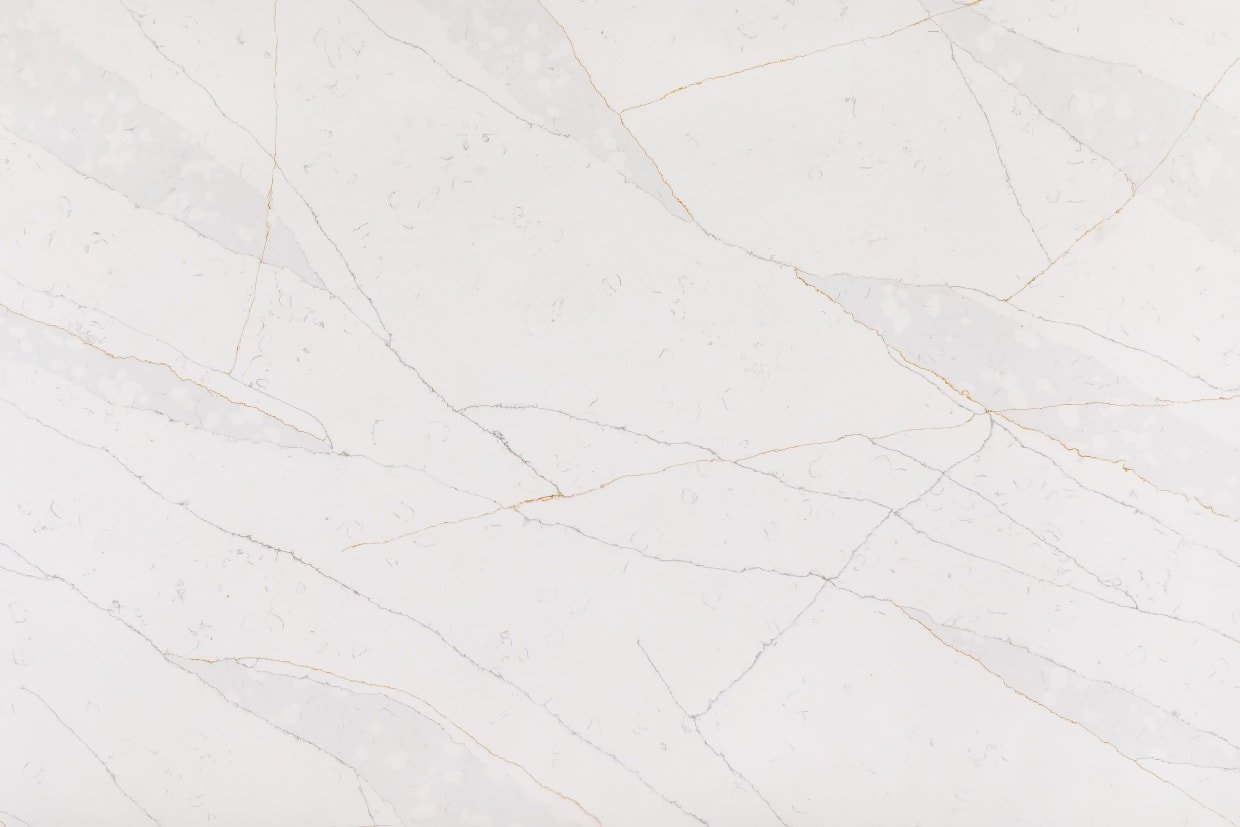
A close-up of Calacatta Fresh (G047) helps judge vein thickness and background tone; it does not replace a full-slab review.
Where is Calacatta quartz commonly used, and how should it be coordinated?
The most common uses are kitchen countertops and islands, bathroom vanity tops, bar tops, and commercial reception or feature surfaces. Aspire Stone’s Calacatta listings name kitchen countertops, vanity tops, bar tops, and commercial interiors as intended applications.
Edge detail changes how strong the veining feels. A simple eased or slightly bevelled edge keeps the emphasis on the face. A mitered or laminated edge creates a thicker-looking build-up; review the cut face and the joint if the vein is bold, because the edge will not always continue the face pattern.
Cabinetry and flooring should be chosen against the actual slab, not a screen image. Cool grey veins often sit well with white, greige, or mid-tone oak cabinets; gold or warmer veins often sit better with cream, walnut, or brass details. These are starting points, not rules. For large islands, confirm the available slab size before promising a seamless top. A 3200×1600 mm sheet, where that size is offered, will cover many layouts, but cut-outs, overhangs, and grain direction can still force a joint.
How should buyers evaluate slab-to-slab pattern consistency?
Engineered Calacatta patterns are more repeatable than natural marble, but “consistent” does not mean identical. Buyers should look at more than a 10 cm sample.
- Compare at least two full-slab photographs, or inspect physical slabs, from the same model and batch when the project needs a visual match.
- Check background shade in natural and in showroom light. A warm ivory and a cool white will not read as the same material once installed.
- Look at vein distribution across the whole sheet, not only at the most attractive corner. Islands and waterfall ends often use the centre or the end of the slab.
- If several rooms use the same model, agree in writing whether slabs must come from one production lot.
- Do not approve a polished sample and then order a honed finish, or the reverse, without seeing that finish on the same colour.
If the installed work will be bookmatched or vein-matched across a long run, the fabricator should mark slab numbers and cut direction on the drawings before cutting begins.
What should buyers ask before ordering Calacatta quartz?
| Ask for | Why it matters |
|---|---|
| Exact model name and factory code | Several designs share the word Calacatta. Aspire Stone listings use both a name and a code, such as Calacatta Fresh (G047) or Calacatta Italia Extra (G071). |
| Published slab dimensions and thickness | Confirm the size and thickness for the specific model, not a generic “jumbo” label. Some Aspire Stone Calacatta listings currently publish 3200×1600 mm, in 20 mm or 30 mm. |
| Finish | Polished and honed surfaces change both gloss and how strongly the veins read. Confirm the finish that will be supplied. |
| Current images of the production lot | A catalogue image can lag behind a running batch. Lot photos reduce surprise after shipment. |
| Bookmatch or vein-match capability | Only some designs and some orders can be supplied as mirrored pairs. Confirm this before promising a feature wall or a waterfall island. |
| Sample and slab approval process | Agree whether a sample, a slab photo, or a physical slab inspection is the approval record. |
Designers who want a softer, finer vein should also look at Carrara-style quartz and how it differs from natural Carrara marble, rather than assuming every white quartz slab is a Calacatta look.
FAQ
Is Calacatta quartz real marble?
No. Calacatta quartz is engineered quartz made to recall the look of Calacatta marble. It is not quarried marble and should not be specified as natural stone.
What makes Calacatta quartz different?
In design terms, Calacatta-style quartz usually has a light background and bolder or more distinctive veining than a typical Carrara-style pattern. In material terms, it is an engineered slab, so it does not share marble’s calcite surface chemistry or the unique geology of an Italian quarry block.
Does Calacatta quartz have consistent patterns?
It is generally more consistent than natural Calacatta marble, but slabs of the same model are not guaranteed to be identical. Background shade and vein placement can vary. Review full-slab images or the actual slabs when a close match is required.
Where is it commonly used?
It is commonly used for kitchen countertops, vanity tops, bar tops, and commercial interiors. Those are the applications named on Aspire Stone’s Calacatta product pages.
Does Calacatta quartz need to be sealed like marble?
Industry standards describe quartz surfacing as a low-absorption, non-porous material compared with many natural stones, and it is not usually maintained like marble. That is not a promise that a surface cannot mark, and it is not a substitute for the manufacturer’s care instructions. Sealing natural marble also does not prevent acid etching, which is a separate issue from staining.
Specify the model, not only the name
If you are shortlisting Calacatta-style slabs, start with the live Aspire Stone Calacatta Series, note the model name and code, and contact the factory for current slab photos, dimensions, and a sample. Naming the exact colour is more useful than asking only for “Calacatta quartz.”


 WhatsApp
 EMAIL