




What Are the Main Applications of Quartz Slabs?
Engineered quartz slabs are most often specified for interior work surfaces: kitchen countertops and islands, bathroom vanities, and commercial tops such as reception desks and hospitality counters. Suitability depends on heat, UV, moisture, chemicals, impact, seams and maintenance, and on the specific product’s technical file. Conventional resin-bound quartz is widely used indoors; outdoor and high-heat exposures need separate confirmation and are often not recommended.
Where are quartz slabs used in homes?
The most common residential use is the kitchen worktop. A factory-finished slab can be cut into run tops, islands, peninsula pieces and, where the design requires it, matching upstands or splashbacks. Because the sheet is produced in a large, consistent format, fabricators can often plan long island tops with fewer seams than a smaller natural-stone block would allow. Color and pattern can also be coordinated across the kitchen, which is one reason designers shortlist quartz colors for modern kitchens.
Bathroom vanities are the next frequent use. A dense, low-absorption surface is attractive in a wet room because spilled water sits on the face rather than soaking in quickly. That does not make the material immune to staining, soap residue or harsh cleaners, but it does explain why many manufacturers position quartz for vanity tops and, in some technical files, for shower or tub surrounds. Details for vanity specification are covered in quartz countertops for bathroom vanities.
Other interior uses include bar tops, window sills, desk tops and, in some projects, interior wall cladding or feature panels. Aspire Stone’s About page lists typical uses as kitchen countertops, vanity tops, bar tops and kitchen islands. Its cut-to-size page adds bathrooms, bars and restaurants, and precision-cut pieces for interior wall or tile work, and shows fabrication categories for vanity bowls, sink cut-outs, islands and waterfall ends.
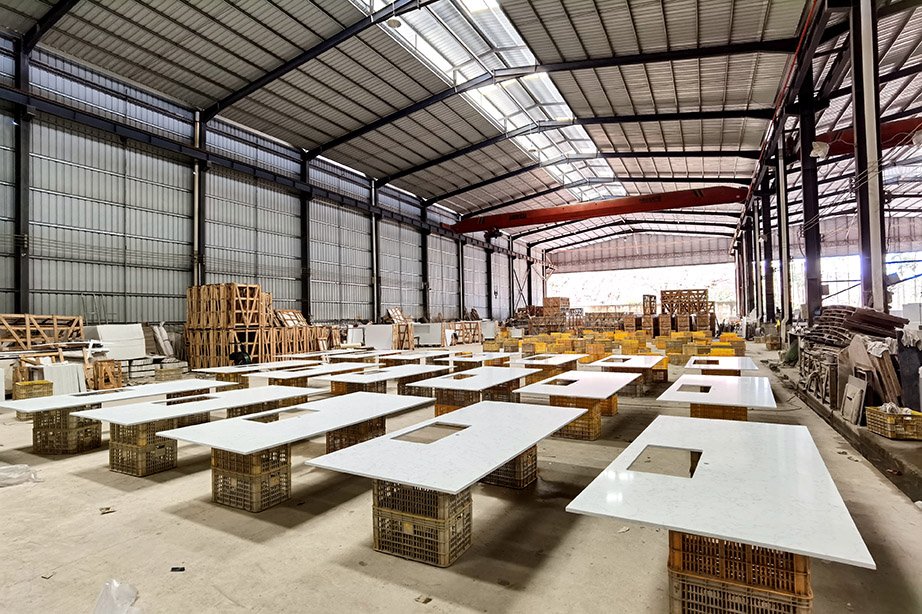
Interior kitchen worktops cut from engineered quartz slabs in the Aspire Stone workshop.
Some individual product pages also list stairs, sills, columns, carved objects, sinks or tubs, and wall or floor tiles. That broader list should be treated with caution until the factory confirms that the specific color and thickness are approved for the use. A generic application line on a product page is not the same as a technical approval.
What commercial applications are common?
In commercial interiors, engineered quartz is widely used wherever a cleanable work surface is needed and the exposure stays indoors. Typical examples include reception desks, restaurant and hotel counters, retail display tops, office tea points and, where the product is listed for that purpose, certain laboratory or healthcare worktops.
Breton, describing applications for compound-stone slabs made on its plants, lists kitchen countertops, bathroom tops, tables and bar or reception counters as main uses, with vertical internal coverings and flooring as other possible applications. Vicostone’s fabrication guideline similarly places its quartz surfaces in interior settings such as residences, restaurants, hotels, hospitals and laboratories, and names kitchen countertops, bathroom vanities, bathtub and shower surrounds, fireplace mantels and stairs among common uses — while also warning against exterior use and prolonged direct sunlight.
Food-preparation areas are a frequent request. Some engineered quartz products are listed under NSF/ANSI 51, the food-equipment materials standard, but that listing is product-specific. It should be verified on a current NSF listing for the exact manufacturer, trade designation and color. Aspire Stone’s current public pages do not provide an NSF listing, so no food-zone certification is claimed here.
For hospitality and other commercial schemes, see quartz surfaces for hotels, restaurants and commercial interiors and how to specify quartz for large residential projects. Aspire Stone’s cut-to-size page states that it supplies developers, contractors, fabricators and installers for villas, hotels, apartments and school dormitories. Those are stated customer types, not named case studies.
What factors decide whether quartz is suitable?
A use that looks similar on a drawing can still fail if the exposure is wrong. The main factors to check are:
Heat. Conventional engineered quartz is not heat-proof. Caesarstone, Cosentino (Silestone) and Cambria all instruct users to keep hot cookware on trivets or stands. Cosentino notes that thermal shock from a sudden temperature difference can damage the surface. PentalQuartz’s 2026 fabrication manual adds that thicker slabs are more resistant to thermal shock than thin ones, and that the product should not contact a firebox or surfaces exceeding 212°F (100°C).
UV and sunlight. The polymer resin in conventional quartz can change color, and in some cases warp, if it is exposed to unfiltered sunlight for a long period. Vicostone and PentalQuartz both warn that direct sunlight can alter color and/or cause warping, including in some interior locations. Cosentino’s care manual says Silestone should not be placed outdoors or anywhere exposed to direct UV rays.
Moisture and chemicals. Many manufacturers describe finished quartz as non-porous or low-absorption, which is why it is widely used in kitchens and bathrooms and why sealing is often said to be unnecessary. That is not a license to ignore spills or to use harsh cleaners. Cosentino and Caesarstone both warn against strong acids, high-pH products, paint strippers and similar chemicals, and they recommend prompt cleaning of spills.
Impact, seams and maintenance. Edges, corners and cut-outs are weaker than the field of the slab. Cambria states that no stone is chip-proof, and that objects hitting edges, particularly at sinks or dishwashers, may cause chips. Seams will be visible. A polished dark or solid color can also show everyday marks more clearly than a busy pattern. These are design and fabrication issues, not reasons to avoid the material, but they should be planned for.
How do edges, cut-outs, backsplashes and custom work fit in?
Most architectural uses of quartz are fabricated pieces, not raw slabs installed as they leave the press. Cut-outs for sinks and hobs, edge profiles, laminated or mitered thick edges, waterfall ends, splashbacks and prepared joints are all part of fitting the slab to the room.
Aspire Stone’s cut-to-size workshop is described as about 4,000 sq.m, with infrared cutting machines, water jets and edge polishing machines, and 50 skilled workers who handle cutting, polishing, sink-hole cutting, lamination and mitered edges. That matters for commercial packages and repeated vanity units, because the same factory that pressed the slab can also cut it to a drawing. It does not remove the need for on-site templating, support and installation standards.
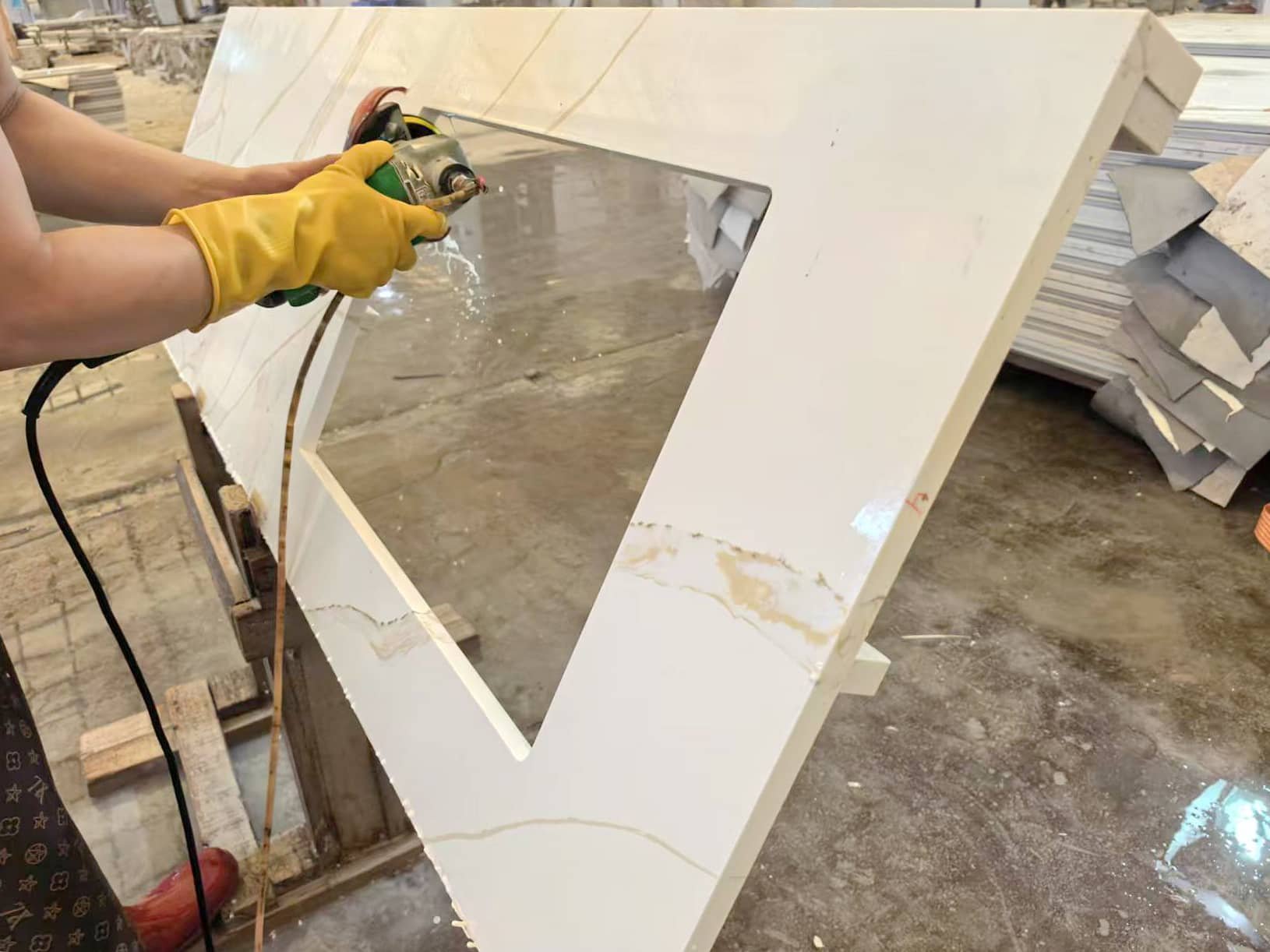
Cut-to-size fabrication, including a sink cut-out and wet edge polishing.
Backsplashes and interior wall panels are usually a good fit where the exposure is indoor and the panel is properly supported. Full-height walls, large reception faces and bookmatched feature panels benefit from jumbo or super-jumbo sheets, but they still need joints, movement allowances and a confirmed finish.
Which applications may be unsuitable?
Some uses should be treated as unsuitable unless the manufacturer’s current technical file clearly allows them.
Outdoor kitchens, exterior cladding and other unfiltered UV exposures are the clearest example. Cambria states that its product is not approved for outdoor use. Vicostone and PentalQuartz do not recommend exterior applications, and Cosentino tells users not to place Silestone outdoors or in direct UV. A different material, or a product specifically warranted for exterior use, should be considered instead.
High-heat applications are the second example. Fireplace surrounds that face a firebox, barbecue tops, and any surface expected to take open flame or sustained high temperature are outside the usual guidance. PentalQuartz allows fireplace mantels only with a temperature limit and says the material should not be used for fireplace surrounds. Aspire Stone has not published a fireplace or high-heat technical note on the pages fetched for this article, so those uses should not be assumed.
Engineered quartz is also not a structural support material. Cambria states this directly for its slabs: 2 cm and 3 cm countertops must be supported, and thinner material used horizontally must be fully supported. Flooring is sometimes listed as a possible use by plant suppliers, but slip resistance, impact and thickness requirements are different from those of a worktop. Do not specify quartz as a floor finish unless the supplier confirms a suitable product and test data for that use.
Destination regulations can also close off an otherwise ordinary interior application. Requirements for engineered stone and crystalline silica differ by country and can change. They should be checked for the project location before a material is specified.
The matrix below is a practical starting point, not a substitute for the product data sheet.
| Application | Typical fit for conventional engineered quartz | Main points to confirm |
|---|---|---|
| Kitchen countertops and islands | Common indoor use | Heat protection, support, seam layout, cut-out detailing |
| Bathroom vanities and indoor wet-area tops | Common indoor use | Cleaner chemistry, splash and joint detailing, any surround approval |
| Reception, bar, restaurant and hotel tops | Common indoor commercial use | Traffic, impact at edges, cleaning regime, any food-zone listing if required |
| Interior splashbacks and wall panels | Often suitable if supported | UV from unfiltered glass, panel support, joint design |
| Outdoor kitchens or exterior cladding | Generally not recommended | Use only if the exact product is warranted for exterior / UV exposure |
| Fireplace surrounds or high-heat tops | Generally not recommended | Temperature limits, firebox clearance, manufacturer approval |
| Floors or structural elements | Not a default use | Separate technical approval, test data and support design |
For a broader definition of the material, see what quartz stone is. If you have drawings or dimensions for a kitchen, vanity or commercial package, Aspire Stone can review them through its cut-to-size workshop or via the contact page. Design shortlists often start from series such as Calacatta.
FAQ
Can quartz slabs be used for kitchen countertops?
Yes. Kitchen countertops are the most common application for engineered quartz. The surface is produced for indoor food-preparation work, but it is not heat-proof. Hot pans should be placed on trivets, and the worktop must be properly supported, with cut-outs and seams detailed by a competent fabricator.
Can quartz be used in bathrooms?
Yes, bathroom vanity tops are a standard indoor use, and some manufacturers also approve shower or tub surrounds for specific products. Confirm the intended wet-area use against the product file, and avoid harsh cleaners that the care guide does not allow.
Is engineered quartz suitable for commercial projects?
It is widely used for indoor commercial tops such as reception desks, hotel and restaurant counters, and retail fittings. Suitability still depends on traffic, cleaning chemicals, edge detailing and, where food contact certification is required, a current listing for the exact product. It is not automatically approved for every commercial environment.
Can quartz be used outdoors?
Conventional resin-bound engineered quartz is generally not recommended outdoors. Several major manufacturers warn against exterior use or direct UV exposure because the resin can discolor or, in some cases, warp. Do not specify outdoor use unless the exact product is clearly warranted for that exposure.


 WhatsApp
 EMAIL