




Market Opportunities and Challenges in a Quartz Slab Business
Selling quartz slabs can be a viable business, but it is not automatically profitable. Results depend on the model you choose — importing, distribution, wholesale, fabrication, or installation — and on how you handle working capital, logistics, colour consistency, local competition, and workplace or import rules. This article explains those moving parts without promising a margin or a return.
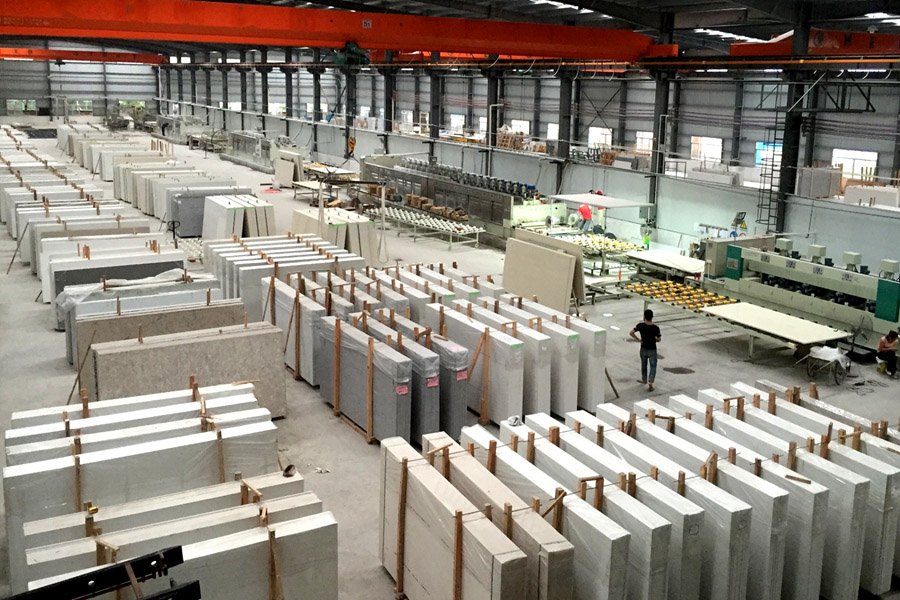
Stocked quartz slabs of mixed colours at the Aspire Stone factory in Foshan.
What business models are used to sell quartz slabs?
Several models exist, and they can be combined. The profit-and-loss profile of each one is different because the work, the inventory, the customer, and the legal duties are different. A company that only imports containers and sells whole slabs does not face the same dust-control obligations as a shop that cuts those slabs. A fabricator who buys locally may hold less ocean-freight risk, but still carries colour-match and credit risk.
Importing usually means buying from a factory or exporter, arranging international freight, and clearing the goods in the destination country. A practical sequence for that work is set out in how to import quartz slabs from China. Distribution typically means holding stock, serving a territory or a trade account list, and replenishing colours that sell. Wholesale may be lighter on showroom display and heavier on container or crate quantities sold to other traders or fabricators. Fabrication turns slabs into worktops, vanities, and other cut pieces. Installation sets the finished pieces on site. Some businesses do all of these; some specialise in one step and buy or sell at the boundary.
| Model | Typical commercial role | Main cost and risk categories — not a forecast of profit |
|---|---|---|
| Importing | Buys from a manufacturer or exporter and brings slabs into a destination market | Purchase cost, packing, freight, insurance, duties and taxes where they apply, currency, inspection, claims, and the time cash is tied up in transit |
| Distribution | Holds a range, serves trade or project accounts, and replenishes stock | Warehouse and handling, slow-moving colours, samples, breakage, customer credit, and the cost of keeping display and reserve slabs |
| Wholesale | Sells larger lots to other distributors or fabricators, often with a narrower service offer | Order volume and mix, payment terms, and the risk of being undercut if the range is easy to substitute |
| Fabrication | Cuts, edges, and finishes pieces from slabs | Equipment, labour, yield and offcuts, remakes, and workplace controls for respirable crystalline silica and other dust |
| Installation | Measures, delivers, and fits finished pieces on site | Site access, templates or digital measure, transport damage, call-backs, and residual on-site cutting if it cannot be avoided |
What actually drives revenue and cost?
Revenue comes from the mix you sell — whole slabs, cut-to-size pieces, or installed worktops — and from how reliably you can repeat a colour or a service. Cost is not only the factory invoice. Packing, inland haulage, ocean freight, insurance, duty, warehousing, sampling, breakage, credit, and fabrication waste all sit on top of the unit price. The factors that move a wholesale figure, without any industry average, are discussed in what affects the wholesale price of quartz slabs.
This article does not state a typical margin, a payback period, a minimum investment, or a market size. Those numbers vary by country, by the Incoterms rule on the purchase, by the thickness and format of the slab, and by whether you fabricate. Any figure you use in a plan should come from your own quotes, your destination’s official duty and tax rules, and a cash-flow forecast you have tested, not from an undated “industry average.”
Colour holds deserve a special mention. Veined designs can vary from slab to slab. If a project or a showroom needs a later match, you may have to reserve, buy, or store related slabs. That protects the sale, but it also ties up cash and floor space. A hold that is never converted is unsold inventory under another name.
How should you choose a market and a customer segment?
Start with the legal position in the destination, then with the customer you can actually serve. Kitchen and bathroom worktops, commercial interiors, and multi-unit housing do not buy in the same way. A fabricator wants reliable replenishment, consistent colour, and clear packing. A project buyer wants a named range, a schedule, and a plan for replacements. A retailer or showroom wants display pieces and a story that a consumer can understand. Competing with a well-established local brand on the same few colours, without a service or availability advantage, is a hard place to begin.
Geography matters because rules differ. Australia is the clearest current example. Safe Work Australia’s official engineered-stone page, checked on 23 November 2026 (Asia/Shanghai, UTC+8), states that the manufacture, supply, processing, and installation of engineered stone benchtops, panels, and slabs has been banned in Australia since 1 July 2024, and that those goods became prohibited imports from 1 January 2025 under regulation 5M of the Customs (Prohibited Imports) Regulations 1956. The legal definition, limited permissions, and remaining uncertainty belong in a compliance review, not in a sales forecast. Aspire Stone’s About page, checked the same day, lists Australia among published markets. That listing is not a statement that engineered stone may be imported or used under Australia’s current rules.
In other jurisdictions the product is still traded, but workplace rules still shape the cost of fabrication. In the United States, OSHA’s general-industry silica standard, 29 CFR 1910.1053, sets a permissible exposure limit of 50 µg/m³ of respirable crystalline silica as an eight-hour time-weighted average. In Great Britain, the Health and Safety Executive’s page on working engineered stone, checked the same day, sets out employers’ duties under the Control of Substances Hazardous to Health Regulations (COSHH). California has additional fabrication rules already in force, and a proposed prohibition remains a draft, not an adopted ban. Those distinctions belong in a destination review; they are not interchangeable with Australia’s prohibition.
What working-capital, inventory, and logistics issues should you expect?
Quartz slabs are heavy, breakable if poorly supported, and slow to replace if a colour is made to order or is between production runs. Cash is often committed when a deposit is paid, and it may not return until the customer pays after delivery or installation. The gap can cover production, ocean transit, customs, warehousing, and a credit period. If you also fabricate, you add equipment, labour, and the cost of pieces that have to be remade.
Inventory decisions are commercial, not cosmetic. A wide range looks impressive on a wall, but every unsold slab occupies a rack, a frame, and a line of insurance. A very narrow range is easier to fund, but it is easier for a customer to buy elsewhere. Samples and a smaller display set can support selling, while slower or highly distinctive designs are brought in against an order. Breakage in transit or in the warehouse is a cost until it is covered by insurance or a contract claim, and claims need photographs, a survey if required, and documents that match the shipment.
Logistics include packing method, container planning, last-mile delivery of heavy frames, and the condition of the warehouse floor and racks. None of these items has a single correct cost. They have to be estimated from quotations and from the way you actually receive and move slabs.
How do regulation and fabrication risk change the business case?
If you only sell whole slabs and never cut them, you still need to know what your customers are allowed to do, and what documents they will ask for — composition statements, safety data sheets, and test reports where a destination requires them. If you cut, edge, or install, workplace exposure to respirable crystalline silica is part of the operating model. Engineering controls, housekeeping, training, and medical surveillance, where required, are operating costs. A business that ignores them is not “more profitable”; it may be unlawful.
Low-silica or silica-free surfaces can be part of a range in markets where customers ask for them, but a lower crystalline-silica content is not the same as silica-free, and it is not automatically risk-free or permitted everywhere. Treat those products as a specification and document question, not as a shortcut around local law.
Supplier choice also belongs in the risk list. A relationship that is clear on range, quality, sampling, and communication is easier to fund than one that produces surprises. Practical ways to build that relationship are discussed in how to build a successful partnership with a quartz slab manufacturer. The mix you actually stock is a separate design problem; see how stone distributors can build a competitive quartz product portfolio.
What should a feasibility checklist include?
A plan is more useful when it answers operational questions than when it assumes a margin. The list below is a framework, not a calculation, and not a substitute for legal, customs, or accounting advice.
| Question to resolve before you commit capital | What a useful answer looks like |
|---|---|
| Which model are you actually running? | Import, distribution, wholesale, fabrication, installation, or a named combination, with a clear statement of what you will not do at the start |
| Is the product lawful to import, supply, fabricate, or install in your market? | A check against current official rules for that country or state, including workplace duties, not a copy of another market’s practice |
| Who is the first paying customer? | A defined segment — fabricators, showrooms, project accounts, or consumers — and a reason they would buy from you rather than from an existing supplier |
| What will you stock, display, and special-order? | A short core range, a sample plan, and a rule for colour holds, rather than a full catalogue in the warehouse |
| How will cash move? | Supplier payment terms, freight and duty timing, customer credit, and a reserve for transit damage, remakes, and slow-moving slabs |
| Who will inspect, store, and, if relevant, fabricate? | Named facilities, packing and handling method, and, for fabrication, a dust-control plan that meets local law |
| How will you repurchase a colour? | An agreed reference sample, a way to record batch or colour codes, and a supplier who can discuss variation before a press run |
FAQ
Is quartz slab distribution profitable?
It can be, for a business that has a clear customer, a controlled range, and enough cash to fund stock and credit. It is not guaranteed. Profitability is the result of selling prices, true landed and holding costs, yield if you fabricate, and how often capital sits in unsold slabs. No industry-wide margin is used here, because a credible figure would need a named market, a date, and a stated set of assumptions.
How much capital is needed to start a quartz slab business?
There is no single start-up figure that applies everywhere. The amount depends on whether you import full containers or buy locally, how many colours and thicknesses you hold, whether you need a warehouse and a showroom, and whether you also fabricate or install. Map the cash required for the first purchases, freight and duty, racks and handling, samples, insurance, and a reserve for delays and breakage. Then test that map against supplier and freight quotations, rather than against a round number from an undated article.
Should I import quartz slabs or buy them locally?
Importing can give you a direct factory relationship and a wider say over the range, but it usually lengthens the cash cycle and adds packing, freight, currency, and customs work. Buying from a local distributor or importer can be faster to replenish and easier to inspect before you pay for a large lot, but you may have less control over colour continuity and less room to differentiate. The better choice is the one that matches your customer lead times and your ability to fund transit stock, not a rule that one route is always cheaper.
What are the main risks of a quartz slab business?
The recurring ones are working capital tied up in slow-moving or reserved slabs, transit and handling breakage, colour variation that makes a later lot hard to match, customer credit, and regulatory change in the destination market. If you fabricate or install, add workplace exposure controls and the cost of remakes. A weak supplier relationship — unclear specifications, late communication, or no agreed claims process — turns those risks into disputes.
Does selling quartz slabs require a fabrication shop?
No. Many importers and distributors sell whole slabs to fabricators and never cut the material themselves. Fabrication can add a service margin, but it also adds equipment, skilled labour, yield loss, and legal duties for dust control. Include a shop in the plan only if you are ready to run it as a regulated workshop, not as a side activity.
Plan the business before you buy the first container
If you are testing whether a quartz slab business is feasible, write down the model, the market rules, the first customer, and the cash cycle before you place a stock order. Aspire Stone is a quartz stone manufacturer in Foshan, China, and can discuss a published range and supply options with importers and distributors. That conversation is not a profitability forecast. For a first contact, use the Contact page, or write to [email protected] (Mr. Lin, +86 135 0025 4616).


 WhatsApp
 EMAIL