




A Buyer’s Walk Through a Quartz Slab Factory
A quartz slab factory is organized around a sequence of zones: raw-material storage, batching and mixing, forming and compaction, curing, then calibration, polishing and inspection. Equipment in each zone affects consistency and throughput, but typical industry process knowledge is not the same as a plant’s published facts. The guide below explains the usual layout, then separates what Aspire Stone has actually disclosed.
What are the main zones in a quartz slab factory?
Most engineered quartz plants follow the same broad sequence, even when the machines and building layout differ. The product itself is an industrial sheet, not a block sawn from a quarry. European standard EN 14618:2009 describes agglomerated stone as an industrial product made mainly of hydraulic cement, resin, or a mixture of both, together with stone and other additions, and moulded in geometrical shapes at a fixed plant. Kitchen and bathroom quartz slabs usually use a resin binder.
A typical factory is therefore arranged so that raw materials can be received, stored and dosed; mixed and formed into a slab; compacted and cured; then calibrated, polished, inspected and packed. How quartz slabs are made explains that process in more detail. This article looks at the plant around it: the zones, the equipment categories, and what a visitor can usefully inspect.
Raw materials. Incoming aggregate, resin, pigments and additives are checked and stored so that lots remain identifiable and are not cross-contaminated. Graded quartz is often held in silos. Resin and pigments need clean, controlled storage.
Batching and mixing. Weighing systems dose each ingredient according to the recipe for that color or design. Mixers coat the particles with resin and distribute pigment. Veined or multi-tone slabs may require more than one mix, deposited in a planned pattern.
Forming and compaction. The mix is spread into a mould or onto a forming belt at a thickness that allows for later calibration. Many industrial lines then compact the slab by vibration and pressure under vacuum. Breton, an Italian plant supplier, describes vibro-compression under vacuum as the core of its Bretonstone process. Caesarstone, describing its own process, likewise says the mix is poured into a mould, then compressed and vibrated in a vacuum. Those are industry examples of a common method. They are not a description of any one unpublished press, and they do not mean that a Breton line is present on a given factory floor.
Curing and cooling. After compaction, a resin-bound slab still has to harden. Plants typically move slabs into a curing kiln, where heat completes the polymer reaction, then cool them so they can be handled without distortion. Cycle times and temperatures are manufacturer-specific. Caesarstone publishes 90°C for 45 minutes for its own process; that figure should not be copied as a universal setting.
Finishing, inspection and storage. Cured slabs are trimmed, calibrated to an even thickness, and polished or otherwise finished with successive diamond abrasives. They are then inspected, identified and moved into finished-goods storage or packing. A cut-to-size workshop, where it exists, is a separate fabrication zone, not the slab-pressing hall.
What equipment is used in a quartz slab factory?
Buyers often ask for an equipment list. The useful answer is by category and function, not by a brand name alone. A press, a polisher or a cutting machine can only do what its condition, tooling, settings and operators allow. Why manufacturing equipment matters when choosing a supplier takes that point further.
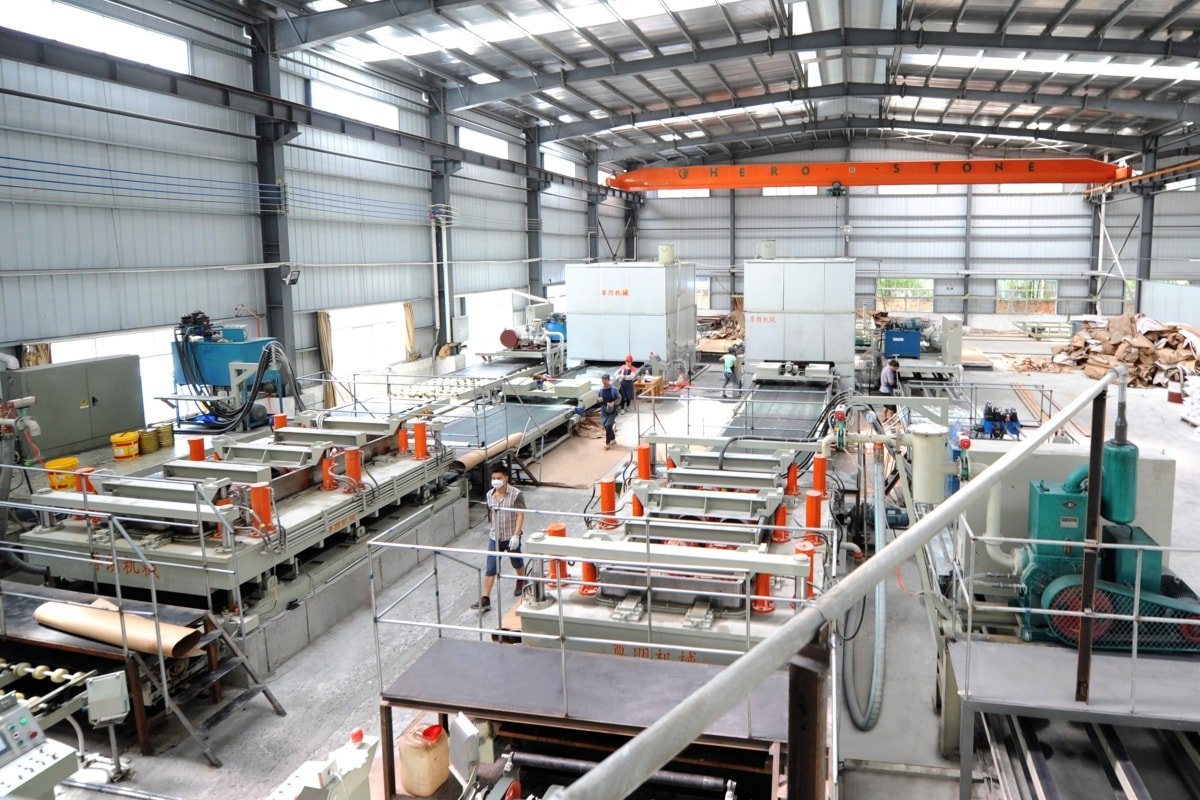
The live “Pressing Machine” photograph from Aspire Stone’s equipment page.
Typical categories, described here as industry equipment types rather than as one factory’s inventory, include storage and dosing systems; mixers and distributors; presses or compaction units (some with vacuum and vibration); curing kilns and cooling stations; calibration and polishing lines; handling, air or dust systems; inspection and packing equipment; and, in a cut-to-size workshop, cutting machines, waterjets and edge polishers.
SIMEC, an Italian machinery company, publishes polishing machines for quartz-based agglomerated slabs, including catalogue models such as the NPA 1700 RS. That is manufacturer literature about a machine type. It is not evidence that a particular model stands on any one plant floor. Press settings should come from the supplier being evaluated, not from another company’s brochure.
Maintenance and process control matter as much as the machine category. A well-kept older line can be more consistent than a new machine that is poorly calibrated. Visitors should ask how often weighing systems, press controls and polishing heads are checked, and how the factory records those checks.
How does workflow and process control move material through the plant?
Material usually travels in one direction: from storage toward mixing, forming, curing and finishing, with rejected pieces diverted out of the finished-goods flow. Cross-traffic of raw pigment into a polishing area, or of untreated slabs into the packed-goods bay, is a layout weakness, not a minor housekeeping issue.
Process control is the set of rules that keep that flow repeatable: recipe control, batch identification, in-process checks, and a clear decision when a slab is accepted, reworked or rejected. How manufacturers control quality and color consistency covers those controls in more detail. In the factory itself, buyers should look for evidence that the rules are used, not only that they exist on paper: labeled silos, batch tickets, retained samples, and inspection records that match the slabs in the racks.
Throughput depends on cycle time, line availability and the product mix, not on a machine count alone. Capacity and shift patterns should come from the supplier’s own confirmed data, not from a photograph.
How do factory layout and equipment affect consistency and throughput?
Layout affects both quality and speed. Short, clear paths between mixing and forming reduce the chance that a mixed batch sits too long or goes to the wrong mould. Space around a press or polishing line makes maintenance and handling more repeatable. Finished-goods storage that keeps batches together, and that protects faces and edges, is part of the process, not an afterthought.
Equipment condition shows up in the slab. Uneven thickness often points to calibration. Gloss variation or polishing marks can point to worn heads, inconsistent feed or poor support. Voids can relate to mixing, distribution or compaction, including trapped air if vacuum or vibration is used. Those clues rarely prove a single cause on a short visit, but they show where to ask better questions.
A solid color and a wide veined slab also do not test the same skills. Printed or heat-transfer designs add a decoration step that should be inspected as its own process. Buyers should walk the actual line for the product they intend to buy.
What has Aspire Stone published about its plant?
The description above is industry process knowledge. It should not be read as a walk-through of an unpublished Aspire Stone setting. The following points are facts Aspire Stone had published on its live site when these pages were fetched on 23 November 2026 (Asia/Shanghai, UTC+8).
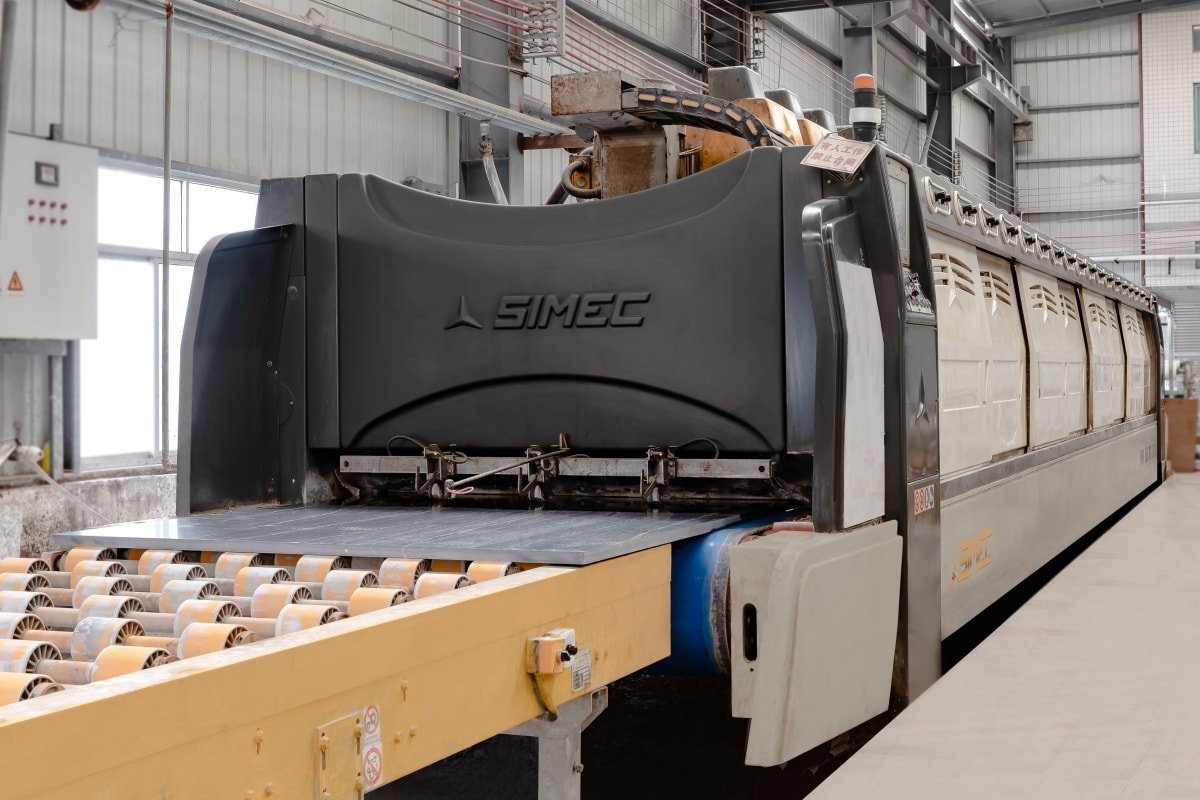
The live “Simec Polishing Machine” photograph from Aspire Stone’s equipment page.
On its About page, Aspire Stone states that it was founded in 2008 and is a quartz stone manufacturer in Foshan, China, producing regular, jumbo and super-jumbo slabs and supplying cut-to-size pieces. The same page says the factory covers more than 25,000 sq.m and has 3 quartz pressing lines, with production in-house on Italian Simec equipment. Those sentences are used here in that published wording. They are not a complete equipment list, and they do not disclose press settings, output, formulas or a headcount for the whole factory.
The Our Equipment page still has no H1. It currently shows four labeled photographs: Quartz Raw Material, Air recycle system, Pressing Machine, and Simec Polishing Machine. The items do not open into specification pages. The small numbers next to those titles should not be read as machine counts. The page does not name equipment models, and it does not say that a Breton line is installed.
The cut-to-size page describes a separate workshop of 4,000 sq.m, equipped with infrared cutting machines, water jets and edge polishing machines, and a team of 50 skilled workers. Those figures belong to the cut-to-size center, not to the whole factory. The Our Workshop page, which also lacks an H1, shows photographs labeled Cutting machine, Water Jet, Edge polishing and Well packing. A longer look at how Aspire Stone presents the path from materials to packing is in from raw materials to export packaging.
No production capacity, shift pattern, press or cure setting, or public laboratory test report is stated on those pages. Those items should be requested from the company if a purchase file needs them.
What should buyers inspect during a factory visit?
A short tour that only photographs a press is a weak audit. The checklist below is a practical agenda for importers and brand buyers. It is not a certification scheme, and a clean visit does not replace product-specific inspection or testing.
| Audit area | What to look at | Questions worth asking |
|---|---|---|
| Raw materials | Segregated storage, lot labels, incoming-check records | How are aggregate, resin and pigment lots identified and approved? |
| Batching and mixing | Weighing equipment, recipe control, mixer cleanliness, retained mix samples if used | How is the scale calibrated, and how are color recipes locked to a batch? |
| Forming and pressing | The actual press used for the product you may buy; handling of the un-cured slab | Which line will run this order, and how are process settings recorded? |
| Curing and finishing | Kiln flow, calibration, polishing heads and tooling condition | How is thickness and gloss checked, and when are tools changed? |
| Inspection and identification | Inspection area, defect examples, slab labels, shade or batch marks | What is accepted, repaired or rejected, and how can a slab be traced later? |
| Storage and packing | Rack condition, face and edge protection, batch grouping | How are slabs packed for export, and how are mixed batches prevented? |
| Cut-to-size, if relevant | Cutting, waterjet and edge-polishing areas as a separate workshop | Which operations are done in-house, and how are finished pieces labeled? |
| Evidence, not only machines | Process records, retained reference samples, recent inspection or test reports for the named product | May we see records that match the slabs on the floor today? |
Photographs of another factory, stock interiors, or generated images are not a substitute for this walk. If a supplier cannot show the line that will make your product, treat the gap as a commercial risk, not as a detail to be filled in later from a brochure.
FAQ
What equipment is used in a quartz slab factory?
A typical plant uses storage and dosing equipment, mixers, a forming and pressing line, a curing kiln, and a calibration and polishing line, plus inspection and packing equipment. A cut-to-size workshop, where one exists, adds cutting, waterjet and edge-polishing machines. Exact models and counts should come from the factory you are evaluating. Aspire Stone’s published equipment page currently labels photographs of raw material, an air recycle system, a pressing machine and a Simec polishing machine, and its About page refers to three quartz pressing lines and Italian Simec equipment.
How does a quartz factory work?
Raw materials are checked, weighed and mixed, then formed into a slab, compacted, cured and cooled. The hardened slab is trimmed, calibrated and finished, then inspected, identified and stored or packed. Many lines compact the slab under vacuum with vibration, but settings and layouts vary. The sequence is industrial and repeatable; it is not the same as quarrying or sawing natural stone.
What should buyers inspect during a factory visit?
Walk the route your product will actually take, from raw-material storage to packing. Check lot control, weighing and recipe discipline, the condition of the press and polishing line, inspection practice, slab identification, and how finished slabs are stored. Ask for process records and retained samples, not only a photograph of a machine. If cut-to-size is part of the order, inspect that workshop separately.
How is production quality controlled?
Quality control usually combines incoming checks, batch and recipe control, in-process checks, and final inspection of dimensions, finish and appearance. Laboratory tests, when they are offered, are typically done on samples and must name the product and the method. No factory process makes every slab identical. The practical question is whether variation is measured, recorded and kept within an agreed range.
Does a well-known equipment brand prove slab quality?
No. A brand can indicate the type of machine in use, but quality still depends on maintenance, tooling, process settings, operator skill and inspection. Buyers should judge the output and the records, not the nameplate alone.
Seeing the factory for yourself
If you are comparing suppliers, use the checklist above on a visit, and ask which line will run the color and thickness you intend to buy. For a first enquiry about Aspire Stone’s Foshan plant, contact Mr. Lin at +86 135 0025 4616 or [email protected], or use the Contact page. Request current information for the product you need; this article does not replace a factory visit or a product-specific inspection.


 WhatsApp
 EMAIL