




A Buyer's Guide to Importing Quartz Slabs from China
Importing quartz slabs from China is a sequence of product specification, factory verification, contract and payment terms, production and inspection, packing and ocean freight, and destination customs clearance. There is no single global HS code, duty rate, or document set. Classify the goods and confirm duties and paperwork with a licensed customs broker in the destination country, using official sources current at the time of entry.
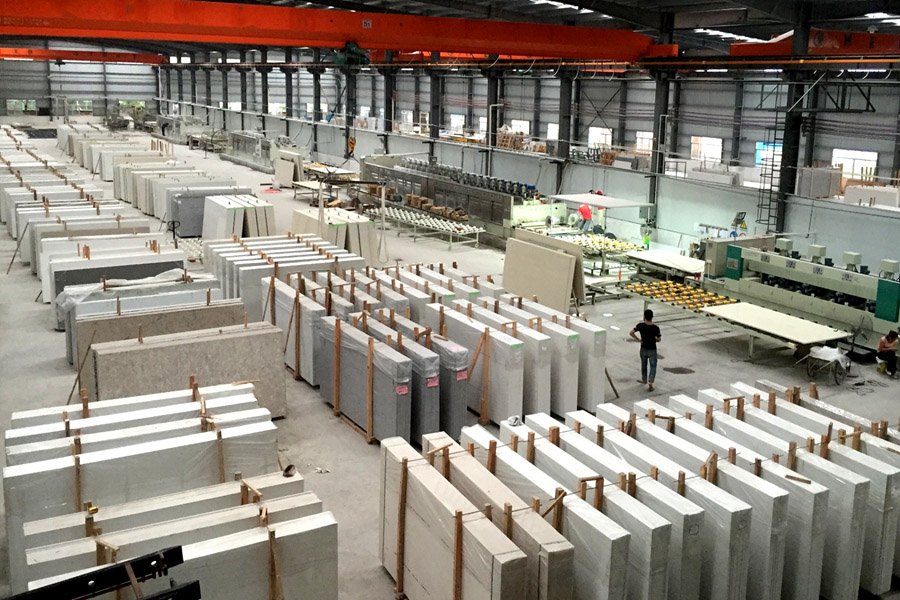
Quartz slabs standing in factory storage at Aspire Stone in Foshan, including wrapped bundles staged in the hall. The photograph does not show container loading.
How should you define the product before you request a quote?
A useful enquiry names the goods in enough detail that two factories would quote the same thing: colour or series, finish, nominal length, width and thickness, whole slabs or cut-to-size pieces, quantity, and the intended market and use. If veining or bookmatching matters, say so, and say whether later reorders must match an approved sample.
Published sizes are examples, not a single industry standard. Aspire Stone series pages checked on 23 November 2026 list slabs at 3200×1600 mm (126×63") in 20 mm or 30 mm. The Super Jumbo page—the live URL uses that spelling—describes regular slabs as commonly around 120×56", jumbo around 128×63", and Super Jumbo as 138×78". Treat those figures as that page’s published examples, and confirm the actual size on the order.
The intended destination is part of the specification. Australia is listed among Aspire Stone’s published markets on the About page, checked the same day. That listing is not a statement that engineered stone may be imported under Australia’s current rules. Check destination restrictions separately; see selecting compliant surfaces for international projects.
How do you research and verify a Chinese quartz factory?
Start by identifying the contracting party. A factory manufactures the slabs. A trading company buys and resells. A distributor stocks goods in a market. A fabrication shop cuts and finishes worktops and may not make the slabs. The contract should name the legal seller and where the goods will be produced. A method for that check is in how to find a reliable quartz slab manufacturer in China.
Verification usually combines desk research and, where practical, a visit. Ask for the Chinese company’s registered name and address, and compare them with the factory gate and later export documents. Ask to see the pressing lines, finishing equipment, and packing area that would handle your order. Aspire Stone’s About page, checked on 23 November 2026, describes a quartz stone manufacturer in Foshan, founded in 2008, with a factory covering more than 25,000 sq.m, three quartz pressing lines, and production in-house on Italian Simec equipment. The footer name on the site is ASPIRESTONE CO., LTD. The official English legal name of the factory company is not confirmed here and should come from current registration documents, not from marketing copy.
What should be agreed on samples, documents, contracts, and payment?
Approve a physical sample, or a clearly identified production range, before mass production starts. Keep a retained reference, photograph it, and record the batch or colour code. Ask for a specification sheet and for test reports that name the methods used. Request composition statements and safety data sheets, where the destination requires them, before the goods are made.
The sales contract should state the product description, quantity, packing method, inspection rights, claims procedure, and the Incoterms® rule, including the version and the named place or port. Incoterms 2020, published by the International Chamber of Commerce, allocate delivery, risk, and certain costs; they do not replace a complete contract. Under EXW, the seller makes the goods available at a named place and, under the rule itself, does not have to load or clear export. FOB and CIF are sea or inland-waterway rules: FOB delivers on board at the named port of shipment; CIF adds carriage to the named destination port and minimum insurance (Institute Cargo Clauses (C) by default). For containerised cargo handed over at a terminal, the ICC notes that FCA or CIP may fit better. State the rule in full, for example “FOB Nansha Incoterms® 2020.”
Payment milestones are for the parties to agree. Deposit-and-balance arrangements are common commercial practice, not a rule, and this article does not state Aspire Stone’s terms. Agree in writing what happens if production is late, if a batch does not match the sample, or if breakage is found at destination.
How should production, inspection, and batch consistency be handled?
Once the sample is approved, ask for a realistic production window and for a plan to keep later slabs in the same colour and pattern range as the first lot. Veined designs can vary from slab to slab; that is not automatically a defect, but it should be discussed before the press run. If you will reorder, agree how a reference will be retained and how material changes will be notified.
Pre-shipment inspection, whether by your staff, the factory, or a third party, should follow a written checklist and the tolerances in the contract. Those tolerances are agreed items, not a universal standard. A practical inspection list is in the quartz slab quality inspection checklist for international buyers. Photograph the slabs, labels, and packed frames before the container is closed, and keep those photos with the shipping file.
How should slabs be packed, loaded, insured, and claimed for if damaged?
Engineered-quartz slabs are heavy and sensitive to impact if poorly supported. They are commonly shipped standing in timber or steel A-frames or in reinforced crates, with protection between faces, then lashed so the load cannot shift. The packed weight and external size of each frame must be known before a container can be planned. A method for that calculation, using labelled estimates rather than a fixed piece count, is in how to calculate a quartz slab container load.
The 2014 IMO/ILO/UNECE Code of Practice for Packing of Cargo Transport Units (CTU Code) is a non-mandatory global code for packing and securing cargo in containers. For a heavy stone load, distribute weight, secure the cargo against movement, and do not rely on the container walls alone. Use a dry, sound container, and photograph the empty box, the loading sequence, the lashing, and the seal number.
Freight and insurance should match the Incoterms rule you chose. Under CIF, default insurance cover is limited; broader cover, such as Institute Cargo Clauses (A), has to be agreed or arranged separately. Transit-damage claims usually need prompt notice, photographs, a survey if required, and documents that match the shipment. The seller’s breakage policy is a separate contract term.
How do customs classification, duties, and import documents work?
Classification, duty, tax, and the document list are destination-specific and change over time. Do not treat one country’s heading as a worldwide HS code, and do not treat a general rate as the amount payable if safeguard, anti-dumping, or other measures apply. The notes below were checked on 23 November 2026 (Asia/Shanghai, UTC+8) against official sources. They illustrate those jurisdictions on that date; they are not advice for a particular shipment. A fuller document list is in what documents you need when importing quartz slabs. Landed-cost drivers, including freight and duty, are discussed in what affects the wholesale price of quartz slabs.
| Jurisdiction (checked 23 November 2026) | Official source, as read that day | What that source showed — still confirm with a broker |
|---|---|---|
| United States | USITC Harmonized Tariff Schedule, Revision 23 (2026), Chapter 68; Presidential Proclamation 11051 (31 July 2026), 91 FR 50645 (5 August 2026); CBP Quota Bulletin 26-602 | Heading 6810 covers articles of cement, concrete or artificial stone. Agglomerated quartz countertop slabs are listed under 6810.99.00 (statistical suffixes 20 and 40 by size). The published general rate is Free, but a quartz-surface tariff-rate quota also applies for 15 August 2026–14 August 2027: 25% in-quota (9903.45.30) and 50% over-quota (9903.45.31), cumulative with Chapter 68. Other duties may also apply. Entry and Importer Security Filing rules still have to be met. |
| United Kingdom (Great Britain) | UK Integrated Online Tariff, commodity 6810 99 00 00, date of trade 22 November 2026, origin China | Heading 6810 covers articles of cement, concrete or artificial stone; 6810 99 00 00 is the residual “Other” commodity. If that classification is correct, the tariff showed 0.00% third-country duty and 20.00% standard import VAT, charged separately. A GB EORI number and an import declaration are required. Confirm classification for the actual goods. |
| Canada | CBSA Customs Tariff 2026 (T2026), Chapter 68; Memorandum D1-4-1 (invoice requirements) | Heading 68.10 covers articles of cement, concrete or artificial stone. Subheading 6810.99.00 is published at a 5% most-favoured-nation rate, with Free treatment under listed preferential programmes where the goods qualify and proof of origin is provided. GST, HST, or provincial taxes may also apply. Invoice content must meet Memorandum D1-4-1. |
Those examples do not cover every market, and they will date. The United States quota quantities and rates are scheduled to change in later years of the same programme. Re-check the official tariff and any additional duty headings with the broker before shipment and again before entry.
What does an end-to-end buyer checklist look like?
The table is an editorial checklist, not a legal form and not an Aspire Stone procedure.
| Stage | Buyer actions |
|---|---|
| Specify | Colour or series, finish, size, thickness, quantity, whole slabs or cut-to-size, intended market and use, and any vein or bookmatch requirement. |
| Verify the seller | Factory, trader, or fabricator; registered identity; production site; equipment and packing; communication quality. |
| Sample and documents | Approve and retain a reference sample; request specification, test reports naming methods, and any destination documents such as a composition statement or SDS. |
| Contract | Description, quantity, Incoterms rule with version and named place, price currency, payment, inspection rights, packing, claims, and lead-time commitments as agreed. |
| Production and inspection | Production window, batch control, pre-shipment inspection, and photographs of slabs and packed frames. |
| Logistics | Packed weights and frame dimensions, container type, loading photos, seal number, freight booking, and insurance appropriate to the Incoterms rule. |
| Customs and delivery | Classification and duty confirmed for the entry date; invoice, packing list, and bill of lading matching the cargo; any origin, quota, or other filings; arrival inspection and claims notice if needed. |
What belongs in a request for quotation?
Send one complete brief: colour or sample reference; length, width, and thickness; finish; quantity as slab count or a cutting list; slabs or cut-to-size; destination port; the Incoterms® rule and version; intended country of use; packing and inspection preferences; and the documents your broker says the entry will need. Aspire Stone invites enquiries through its Contact page (Mr. Lin, +86 135 0025 4616, [email protected]; No.12, Mingxi Road, Mingcheng Town, Gaoming District, Foshan City, Guangdong, China). A complete brief produces a more comparable quotation than a request for “best price per slab.”
FAQ
How do I import quartz slabs from China?
Define the product and destination, verify who will manufacture and sell, approve a sample, contract the Incoterms rule and inspection rights, inspect before shipment, and clear the goods with a broker using matching documents. Duties depend on the destination and the entry date, not on a generic “China export” list.
What documents are needed?
A commercial invoice, a packing list, and a bill of lading are the usual core for an ocean shipment, together with the destination’s entry or import declaration. Origin certificates, safety data sheets, test reports, and quota or licence filings are required only where the destination or the contract says so. See the companion article on import documents, and confirm the list with your broker.
How do I verify a Chinese quartz factory?
Confirm the registered company, visit or audit the actual production site, and match the address and equipment to your order. Distinguish a pressing factory from a trading company or a fabrication shop. Marketing figures are a starting point, not a substitute for documents and a site check.
How should quartz slabs be packed for shipping?
They are commonly packed standing in A-frames or crates, protected between faces, and secured in a dry, sound container according to a loading plan that respects payload, door opening, and weight distribution. Ask the factory for packed weights, frame dimensions, and loading photographs. Do not plan the shipment from a single “slabs per container” figure.
Is there one HS code for quartz slabs?
No. Many tariff schedules place articles of artificial stone under heading 6810, and some countries publish more detailed breakouts for agglomerated quartz countertop slabs, but the correct code depends on the goods and on the importing customs authority. Additional duty headings can apply even when the general rate is free or zero.
Planning an import?
If you want a quotation from Aspire Stone, send the colour, size, thickness, quantity, destination port, and Incoterms rule, together with any inspection or document requirements for your market, through the Contact page or to [email protected].


 WhatsApp
 EMAIL