




Quartz vs Granite for Kitchen Countertops: How to Choose
Neither engineered quartz nor natural granite is automatically better for every kitchen. Quartz is typically more consistent from slab to slab and is usually installed without a sealer. Granite offers unique natural patterning and generally higher tolerance for cookware heat, though absorption and sealing needs vary by stone. Choose the surface that matches how the kitchen will be used, cleaned, and specified.
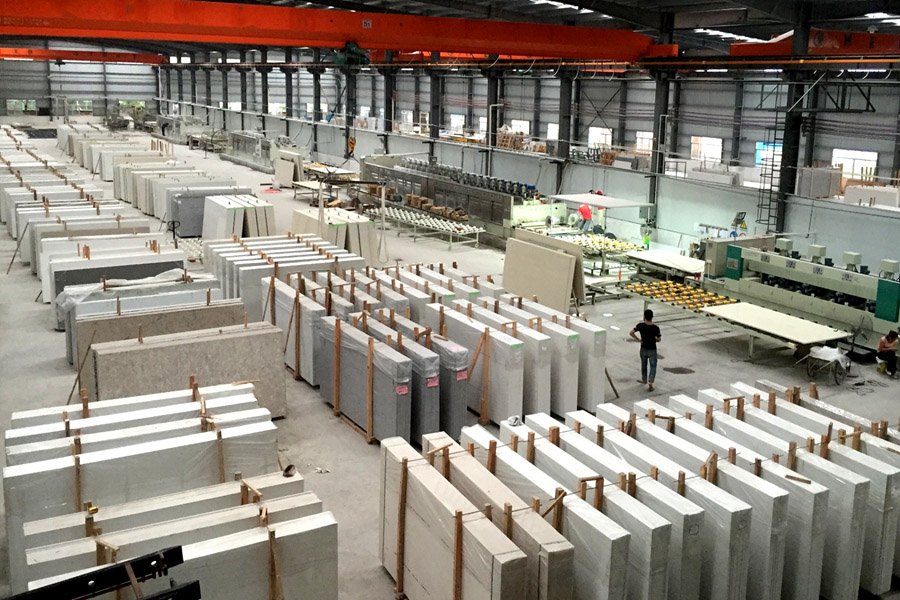
Finished engineered quartz slabs stored vertically at the Aspire Stone factory in Foshan.
What is the difference between engineered quartz and granite?
Engineered quartz is a factory-made slab, also called quartz surfacing or, in European standards language, a form of agglomerated stone. EN 14618:2009 defines agglomerated stone products as industrial products made mainly from hydraulic cement, resin, or a mixture of both, together with stone and other additions, and manufactured by moulding at fixed plants. Kitchen “quartz” slabs are typically resin-bound with silica-nature aggregates.
Recipes are not identical, and they are not Aspire Stone’s unpublished formula. Caesarstone’s technical data manual states that its surfaces “contain up to 90% crushed quartz” plus polyester resins and pigments. Cosentino’s April 2023 Silestone safety data sheet describes that family as 85–95% inorganic mineral fillers, 5–15% polymerized polyester resin, and less than 5% pigments and additives. “About 90% quartz plus resin” is shorthand for many conventional products, not a specification for every slab. A primer on what quartz stone is is useful if the material is still new to the team.
Granite is a natural dimension stone, quarried and cut into slabs. The Natural Stone Institute describes it as one of the hardest common dimension-stone types and a frequent choice for kitchen countertops, as well as for exterior cladding. ASTM C615/C615M is the specification used to select granite; absorption is tested by ASTM C97. Two slabs under the same color name can still differ in mineral distribution, movement, pits, and fissures.
How do composition and appearance compare?
Quartz is designed in a plant, so a color can be repeated with much tighter control than a quarry stone. Slabs are not identical: particle structure, veining, and small mineral spots can still vary. Marble-look and strongly veined designs need layout planning so seams and pattern direction stay consistent. Granite is unique by nature, which helps when a one-of-a-kind surface is the goal and complicates projects that need many matching tops or later additions. The Natural Stone Institute notes that factory resin treatments are sometimes used to fill micro-fissures or small indentations before polishing; that is common and does not, by itself, mean the stone is defective.
Judge appearance on the actual slab, not only on a small sample or a screen image. Engineered quartz is often chosen for white or lightly veined kitchens because those palettes are difficult to find in true granite. If the design depends on large-scale natural movement, granite may be the better visual match.
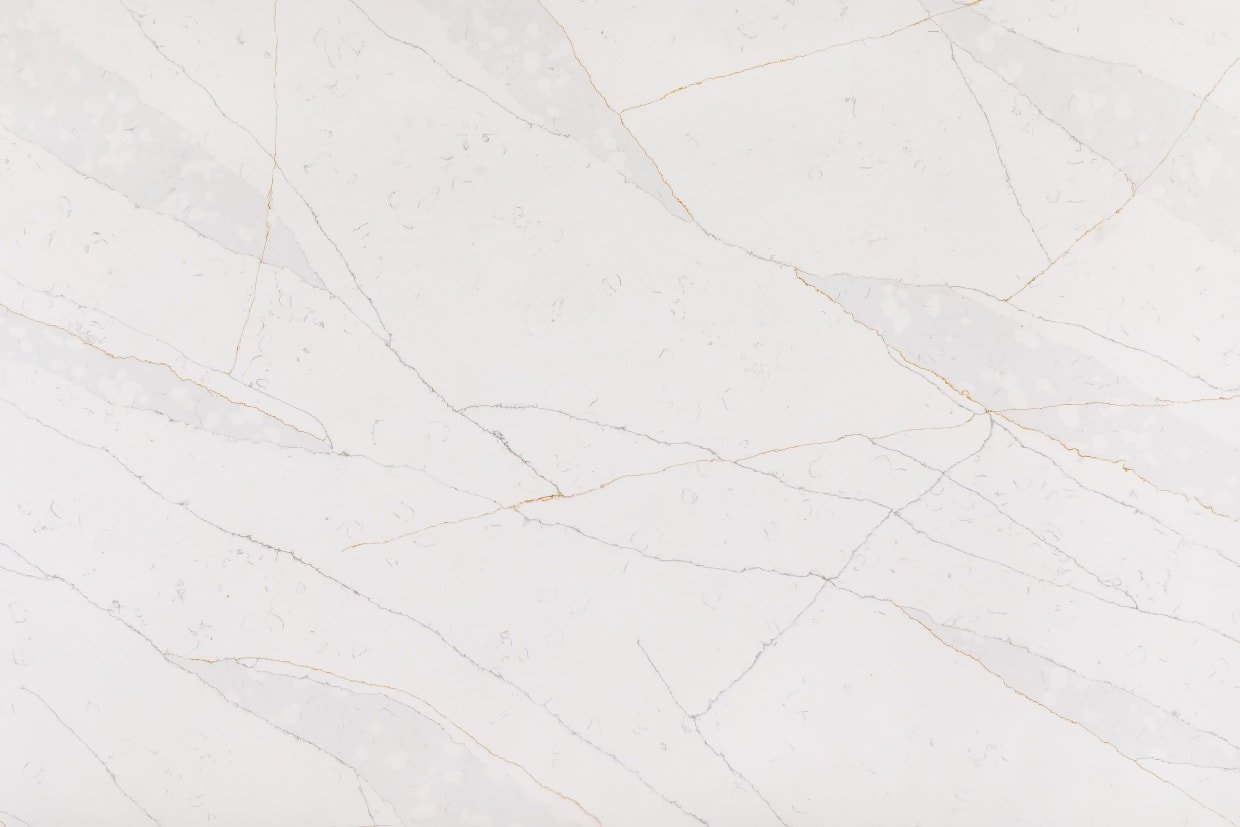
Close-up of a factory-finished engineered quartz slab face, at a scale suitable for judging a kitchen countertop pattern.
Which surface is less porous, and does granite need sealing?
Many quartz manufacturers describe their surfaces as non-porous or very low in absorption and say a sealer is not required. Caesarstone states that its quartz “maintains its appearance without sealants or waxes.” Cosentino’s Silestone care manual tells users not to apply repellents, sealants, or polish. Those statements are product-specific. Low absorption is not stain-proof: strong chemicals or prolonged contact with staining agents can still leave a mark or damage the resin.
Methods for agglomerated stone include EN 14617-1 for water absorption; some data sheets also report ASTM C97. Any published percentage belongs to that product, not to every quartz slab, so ask for the data sheet that matches the color you are specifying.
The Natural Stone Institute gives granite-group absorption of 0.05% to 0.40% by weight and says the pore volume that can hold a stain is slight. Its position is that most granite countertops do not need to be sealed, especially if they are cleaned after meals, but many still benefit from a quality impregnating sealer because it further reduces moisture migration. These products make stone more stain-resistant, not stain-proof. Check the actual slab rather than assuming every granite needs the same treatment.
How do heat, UV, scratch, and stain behavior compare?
Read these properties from the product’s own data and care guide. Material category alone is not a test report.
Heat. The polymer binder in engineered quartz is less heat-tolerant than the mineral. Caesarstone’s UK care guidance says the surface should be protected from temperatures above 150°C or 300°F and from sudden temperature changes, and that hot cookware should sit on a trivet. Cosentino’s Silestone manual gives the same practical rule; heat marks can be permanent. The Natural Stone Institute states that granite is typically heat resistant up to about 250°C (480°F), but warns that a localized heat source can create thermal gradients and initiate cracking. Granite generally tolerates a hot pan better than resin-bound quartz. Use trivets on both. Neither material is heat-proof.
UV, scratches, and stains. Conventional indoor quartz is generally specified for interior use. Silestone’s care manual says not to place the surface outdoors or anywhere exposed to direct UV rays, unless a product is designed and warranted for that exposure. Granite has a long record as exterior cladding and paving; still confirm the specific stone and finish in strong sunlight. A finished quartz slab is a composite, so the resin between grains is softer than Mohs 7 quartz crystals. Use a cutting board on both surfaces. The Natural Stone Institute notes that the minerals in most granites are harder than typical kitchen utensils, though “most” is not “all.” Neither surface is scratch-proof. Quartz’s low porosity helps everyday spills stay on the surface long enough to be wiped, but it can still stain if a pigmented or aggressive substance is left in place. Granite’s stain risk depends on the stone: denser slabs often absorb little; more open or lighter stones can darken with oil or colored liquids. Household acids do not etch typical granite the way they etch marble, but the Natural Stone Institute still advises against acidic cleaners and warns that hydrofluoric acid attacks silicates, including granite.
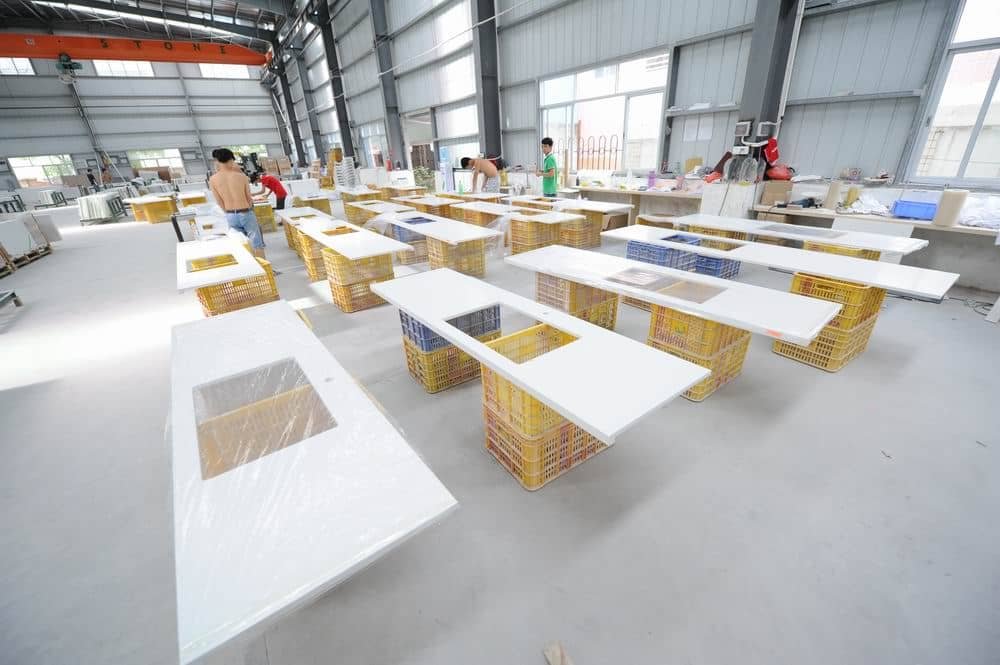
Kitchen countertops photographed after cut-to-size work in the Aspire Stone workshop.
What changes in fabrication, seams, and installation?
Both materials are cut, edged, and installed by stone fabricators, often with bridge saws, CNC tools, waterjets, and edge polishers. Quartz is consistent in thickness and texture compared with many quarry stones, which can simplify nesting, edge work, and color matching. Granite may need more slab selection to manage pits, fissures, and movement.
Seams depend on slab size and layout. A large island or a long galley often needs a joint in either material. Quartz color and pattern can usually be matched more closely at a seam; granite seams depend on how well the fabricator orients the natural movement. Veined quartz still needs a layout drawing. Follow support rules for the chosen thickness at edges, cut-outs, and overhangs. A companion article on quartz slab sizes, thicknesses, and finishes is useful when the layout will drive format and seam placement. A stone restorer can often fill a granite chip or refinish a worn area. Some quartz chips can be filled with a color-matched resin; heat scorch, chemical damage, or a broken corner may be harder to hide and sometimes needs a section replaced.
What should you compare on lifecycle cost?
There is no single global price for “quartz” or “granite.” Cost depends on design or stone grade, origin, size, thickness, finish, yield, fabrication, installation, freight, and waste. Rare granites can cost more than a standard quartz color; a complex marble-look quartz can cost more than a common granite. Do not reuse prices from another market or year. Lifecycle cost should also include sealing labor if needed, cleaning time, and any later repair or replacement. For multi-unit or phased work, quartz’s batch control can reduce the delay of matching unique granite later. A structured kitchen quartz slab buying guide is the next step once the material family has been chosen.
Which material fits which kitchen?
| Project situation | Often leans toward engineered quartz | Often leans toward natural granite |
|---|---|---|
| Many matching tops or later additions | Colors can be repeated from a controlled recipe | Each slab is unique; hold extras from the same block if possible |
| Low day-to-day sealing and wipe-clean routine | Usually, if spills are not left to sit and harsh chemicals are avoided | Depends on the stone; some need little or no sealer, others benefit from one |
| Frequent hot pans near the work zone | Use trivets; resin can be marked by high or sudden heat | Generally more heat-tolerant, but thermal shock can still crack stone; use trivets |
| Outdoor or strong-UV kitchen | Only if that quartz product is documented for outdoor use | Often more suitable, subject to the specific stone and finish |
| White, pale, or controlled marble-look design | Wide manufactured range, including Calacatta- and Carrara-inspired looks | True granite rarely matches that palette |
| One-of-a-kind natural movement | Veined quartz can imitate stone, but it is still a designed pattern | Select the actual slabs and approve the layout |
If the comparison is really about marble-look surfaces, use a quartz vs marble review rather than treating granite and marble as the same natural stone. If the alternative is a fired ceramic slab, see quartz vs porcelain slabs.
A buyer checklist for quartz vs granite
- See the actual slab. Approve granite from the slabs that will be cut. For quartz, review a current batch photo or a full slab, not only a small chip, especially on veined designs.
- Ask for product data, not category claims. For quartz, request absorption, flexural strength, and care guidance with the test method named (for example, EN 14617 or a stated ASTM method). For granite, ask for absorption tested to ASTM C97, and whether the stone is supplied to ASTM C615.
- Test sealing on granite; do not assume it. Confirm whether an impregnator is recommended and whether a food-preparation-safe product will be used.
- Plan heat, UV, and care. Confirm indoor or outdoor suitability, trivet policy, and allowed cleaners.
- Check format, seams, and the installed price. Confirm slab size, thickness, edge detail, joint count, fabrication, waste, and any later matching or resealing.
FAQ
Is quartz better than granite?
Not in every kitchen. Quartz is often easier to keep consistent and is usually installed without a sealer. Granite generally tolerates heat better and offers unique natural movement. The better choice depends on appearance, maintenance, heat, UV exposure, and later matching.
Which is more heat resistant?
Granite typically tolerates higher temperatures than resin-bound quartz. The Natural Stone Institute cites about 250°C (480°F) for granite, while warning that localized heat can crack stone. Caesarstone advises protecting its quartz from temperatures above 150°C (300°F) and from sudden temperature changes. Use a trivet on both surfaces. Neither is heat-proof.
Does granite need sealing?
Not always. The Natural Stone Institute says most granite countertops do not need to be sealed if they are cleaned after meals, but many still benefit from a quality impregnating sealer. Sealing improves stain resistance; it does not make the stone stain-proof. Check the actual slab.
Which countertop is easier to maintain?
Engineered quartz is usually the lower-effort daily surface because it typically does not need a sealer and has very low absorption. It still needs prompt wiping and the right cleaners. Granite maintenance depends on the stone: some slabs need little more than a neutral cleaner, while others need periodic impregnation.
Need help specifying a quartz kitchen surface?
Aspire Stone manufactures engineered quartz in Foshan, China, and publishes series for kitchens, vanities, and commercial interiors in its quartz slab series. If the project also needs pieces cut from drawings, the company supplies cut-to-size quartz slabs. For current colors, slab formats, or a quote, send the layout and material notes through the contact page.
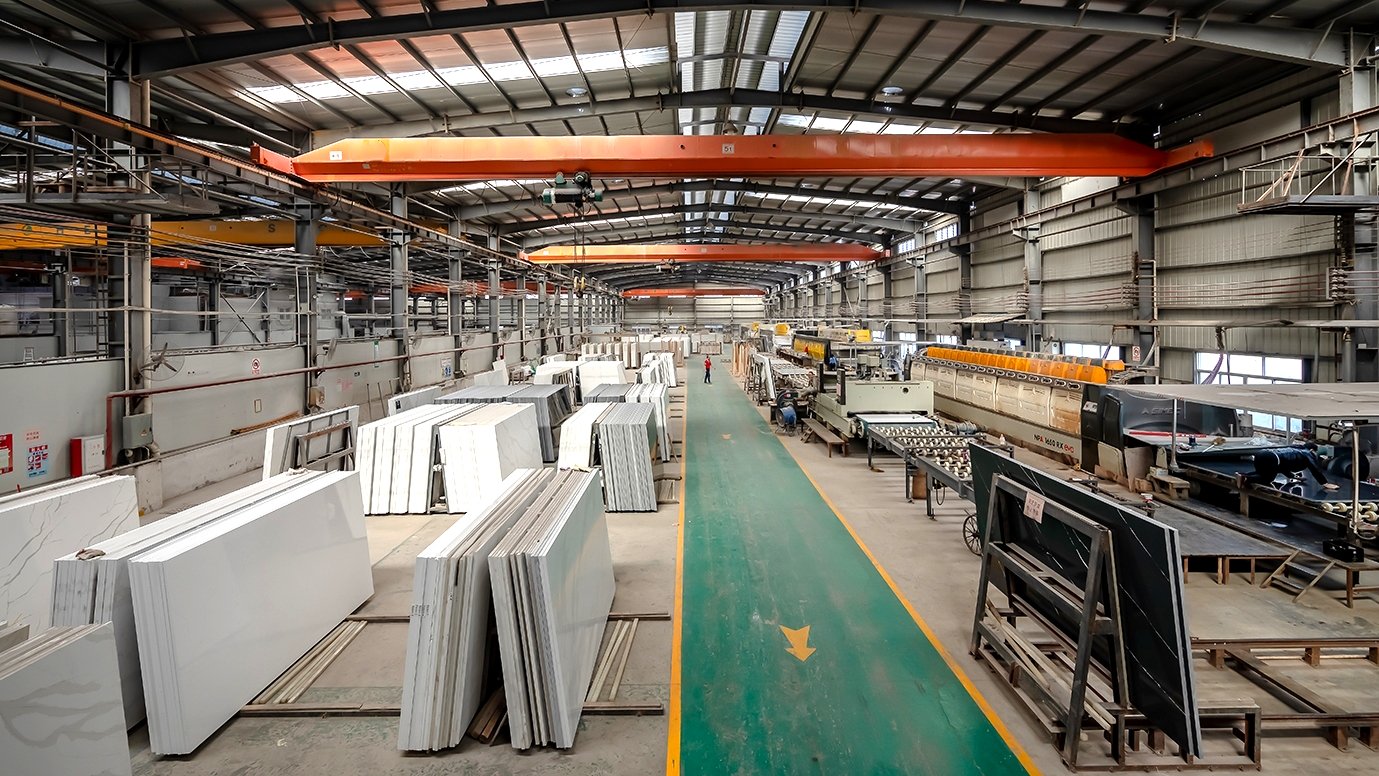
Production hall and slab storage at the Aspire Stone quartz factory in Foshan.


 WhatsApp
 EMAIL