




Building a Durable Working Relationship with a Quartz Factory
A successful partnership with a quartz slab manufacturer is alignment on range, quality, sampling, and communication. It is not created by a slogan, an implied exclusive territory, or a service package that has not been written down. Buyers who agree the product, the reference sample, the commercial terms, and how problems will be handled are better able to place a first order — and to repeat it.
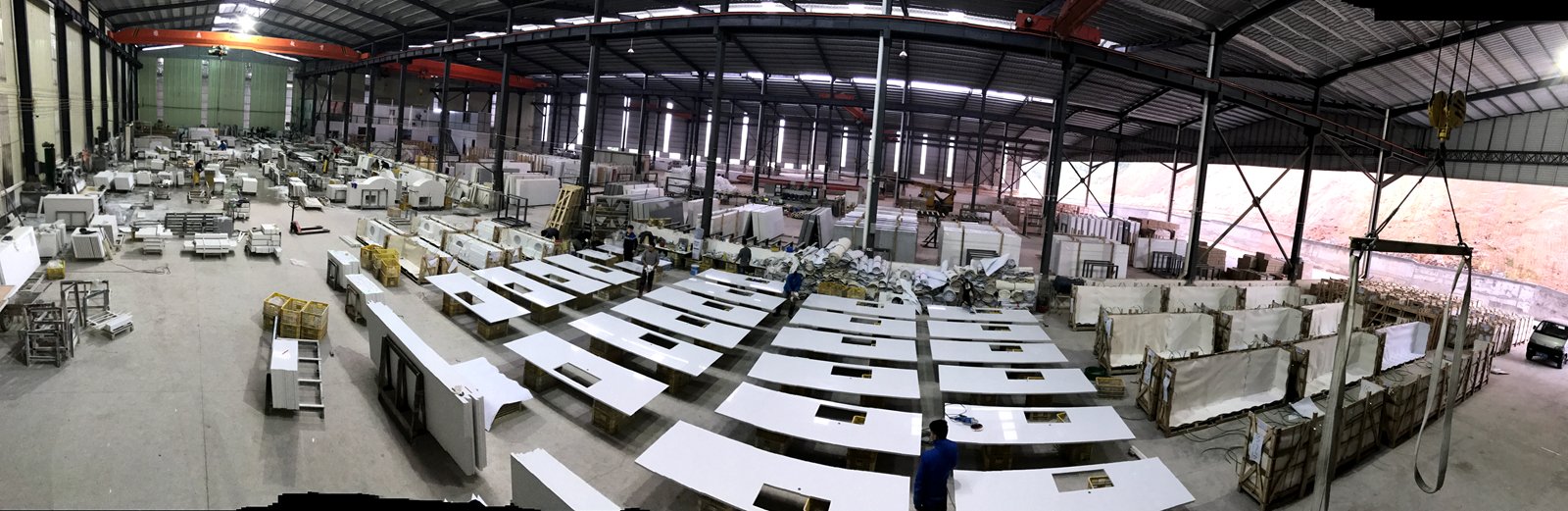
Cut-to-size work in the Aspire Stone workshop in Foshan.
How do you align range, target market, and quality expectations?
Start with the market you will serve and the designs that market actually buys, then find a factory whose published range and production set-up can support that list. A manufacturer that presses a broad series may still be a poor partner if it cannot repeat the two or three colours you need, or if it does not pack and document goods in the way your destination requires. The earlier work of identifying and checking a factory is covered in how to find a reliable quartz slab manufacturer in China.
Quality expectations should be specific. “Good quality” is not a specification. Say whether you need a polished or honed finish, which nominal size and thickness you are buying, how much visual variation you will accept in a veined design, whether later lots must stay close to an approved sample, and what you will inspect before shipment. If cut-to-size pieces are part of the offer, say so at the start, because the factory is then making a finished piece, not only a slab.
Aspire Stone’s About page, checked on 23 November 2026, describes a quartz stone manufacturer in Foshan, founded in 2008, with a factory covering more than 25,000 sq.m, three quartz pressing lines, and production in-house on Italian Simec equipment. The footer name on the site is ASPIRESTONE CO., LTD. The official English legal name of the factory company is not confirmed here and should come from current registration documents. The same page lists Calacatta, printed, and low-silica and silica-free surfaces, including heat-transfer ink full-body designs, and cut-to-size for residential, commercial, hospitality, and multi-unit projects. Treat that wording as a published description of the range, not as a partnership programme or a compliance certificate for a named destination.
How should sampling, specifications, and production planning work?
Approve a physical sample, or a clearly identified production range, before a bulk order is pressed. Photograph the sample, keep a retained piece, and record the colour or model code. If the design is veined or printed, agree whether you are buying a look-alike range or a tighter match, and whether bookmatching or a sequenced pair is required. A specification sheet should sit beside the sample: size, thickness, finish, packing method, and any test reports or composition statements the destination requires.
Forecasts, minimum order quantities, and lead times are commercial terms. They vary by colour, thickness, whether the goods are stocked or made to order, and how full the production schedule is. This article does not state Aspire Stone’s minimum order, capacity, or lead time, because those figures are not used as standing public promises here. Ask for a realistic production window for the actual item, and ask how a reorder will be planned against the approved sample. A short list of questions that usually bring useful answers is in questions to ask a quartz stone supplier before you order.
If you need pieces rather than whole slabs, say so in the same planning conversation. Aspire Stone’s cut-to-size page, checked on 23 November 2026, describes a cut-to-size centre covering 4,000 sq.m, equipped with infrared cutting machines, water jets, and edge polishing machines, and a team of 50 skilled workers handling cutting, polishing, sink-hole cutting, lamination, and mitered edges. Those figures are the workshop figures published on that page, not a whole-factory headcount or a promised turnaround time.
What should be clear in pricing, contracts, payment, and Incoterms?
A usable quotation names the product, the quantity, the packing, the currency, and the Incoterms® rule, including the version and the named place or port. Without those details, two offers cannot be compared. Pricing “transparency” means that extras — frames, special packing, inspection, inland haulage, or document fees — are either inside the price or listed separately, not that a factory must publish a general price list.
The International Chamber of Commerce’s Incoterms® 2020 rules allocate delivery, risk, and certain costs; they do not replace a complete contract. Under EXW, the seller makes the goods available at a named place and, under the rule itself, does not have to load or clear export. FOB and CIF are sea or inland-waterway rules: FOB delivers on board at the named port of shipment; CIF adds carriage to the named destination port and minimum insurance. For containerised cargo handed over at a terminal, FCA or CIP may fit better. State the rule in full, for example “FOB Nansha Incoterms® 2020.”
Payment milestones, currency, and what happens if the exchange rate moves are for the parties to agree. Deposit-and-balance arrangements are common commercial practice, not a rule, and this article does not state Aspire Stone’s payment terms. Write down what happens if production is late, if a batch does not match the sample, or if breakage is found at destination. A partnership is easier to continue when those points are settled before the first container is packed.
How should inspection, claims, and day-to-day communication be handled?
Inspection rights should be in the contract, whether you use your own staff, the factory, or a third party. Agree the checklist and the tolerances in writing. Photograph slabs, labels, and packed frames before the container is closed, and keep those photographs with the shipping file. A claim is much harder to assess if the first evidence appears only after the goods have been moved several times.
Communication should have names, not only a generic sales address. You need a way to raise a specification question, a production update, a packing change, and a quality claim without losing the thread. Response times and escalation paths are contract or service points to agree; they should not be invented as a standard manufacturer promise. When an issue does arise, describe the slab, the batch or colour code, the defect or variation, and the relief you are seeking — replacement, repair, credit, or a revised instruction — and keep the discussion tied to the approved sample and the contract, not to a general impression of the brand.
The factory’s own process, from raw materials to export packing, is easier to discuss once you have seen it, on a visit or in a clearly dated process description. A companion article, from raw materials to export packaging at Aspire Stone, is intended to walk through that sequence in more detail.
How do long-term planning and product development actually work?
A first good shipment is not yet a partnership. Over time, both sides benefit from a short, honest forecast, a record of which designs actually sold, and early notice if a raw material, a printed pattern, or a colour formula will change. New designs can be developed or selected from a factory’s existing development list, but a conversation about a new look is not a commitment to exclusive rights, and it is not evidence that an unreleased idea is already in production.
Market feedback should travel in both directions. If a finish is difficult to fabricate, if a colour is too variable for your customers, or if a destination now asks for a composition report you did not need last year, say so while the next order is still being planned. The manufacturer can only respond to information it receives in time to use.
Nothing in this article describes an Aspire Stone exclusive-distribution programme, a standard non-disclosure agreement, a published service-level promise, or customer testimonials. Those items, if they are needed, have to be negotiated and documented. For the wider commercial context, see market opportunities and challenges in a quartz slab business.
Partnership readiness checklist and a first-order roadmap
The checklist below is a preparation tool. It is not a contract and it does not replace legal or customs advice in your jurisdiction.
| Stage | What to complete | What “ready” looks like |
|---|---|---|
| 1. Scope | Define the destination market, the customer, and whether you are buying slabs, cut-to-size pieces, or both | A short written brief the factory can quote against |
| 2. Identify the seller | Confirm the contracting party, the factory location, and how it relates to the export brand on the documents | Names and addresses that you can compare with later invoices and packing lists |
| 3. Sample and specification | Approve a retained sample or a clearly identified range; record size, thickness, finish, and documents required at destination | A reference you can hold up to the bulk lot |
| 4. Commercial terms | Agree quantity, currency, payment milestones, Incoterms® 2020 rule and named place, packing, inspection rights, and the claims process | A contract or pro forma that can be read without side conversations |
| 5. Production and inspection | Agree a production window for this order, a plan for colour continuity, and who will inspect, against which checklist | Photographs and a written result before the container is sealed |
| 6. First-lot review | Compare the received goods with the sample and the contract; record what should change on the next order | A short written review both sides can use |
FAQ
How do I work with a quartz slab factory?
Describe the product and the destination clearly, approve a sample, agree the contract and the Incoterms rule, then plan production, inspection, packing, and a review of the first lot. Keep a named contact for questions and claims. The sequence is ordinary commercial practice; the details have to be written for your order.
What makes a good manufacturing partner?
A good partner can make the range you actually sell, repeat it against an agreed reference, pack it for export, and communicate when something changes. Legal identity, a factory you can verify, and a clear claims process matter more than a marketing claim of partnership. Exclusivity and formal support packages are optional contract terms, not proof of quality.
How should buyers negotiate MOQ and lead time?
Ask for figures that apply to the specific colour, thickness, and format you are buying, and ask whether the goods are made to order or drawn from existing production. If a minimum is higher than you want to fund, discuss a mixed container, a narrower colour list, or a later top-up, rather than assuming a published exception. Lead time should be a dated production window for that order, not a generic number copied from another enquiry. Aspire Stone’s current minima and lead times are not stated here and should be confirmed on the quotation.
How can suppliers support product development?
They can share current designs, discuss whether a look can be produced as a full-body or printed surface, and work from a sample or a drawing you provide. That support is a development conversation. It does not, by itself, create exclusive rights in a colour, and it should not be described as a finished production capability until the factory has made and approved a production sample.
Does Aspire Stone publish a formal dealer or exclusivity programme?
Not on the pages checked on 23 November 2026. The live site describes the factory, the published series, cut-to-size capability, and a contact path. Territory, exclusivity, inventory programmes, and marketing support would have to be agreed in writing, if they are agreed at all.
Start with a brief and a sample, not with a slogan
If you want to test a manufacturing relationship, send a short brief — destination, designs or series of interest, thickness, finish, and whether you need whole slabs or cut-to-size pieces — and ask for a sample and a quotation under a named Incoterms rule. You can reach Aspire Stone through the Contact page, or at [email protected] (Mr. Lin, +86 135 0025 4616), at No.12, Mingxi Road, Mingcheng Town, Gaoming District, Foshan City, Guangdong, China.


 WhatsApp
 EMAIL