




Quartz vs Marble: A Practical Cost and Maintenance Comparison
Engineered quartz and marble can look similar, especially in Carrara- and Calacatta-inspired designs, but they do not behave the same way. Marble is a calcite-based stone that can etch when household acids touch it. Quartz is a resin-bound manufactured slab with typically very low absorption and no routine sealer, though it is not stain-proof or heat-proof. Cost depends on grade, design, thickness, and fabrication, not on the material name alone.
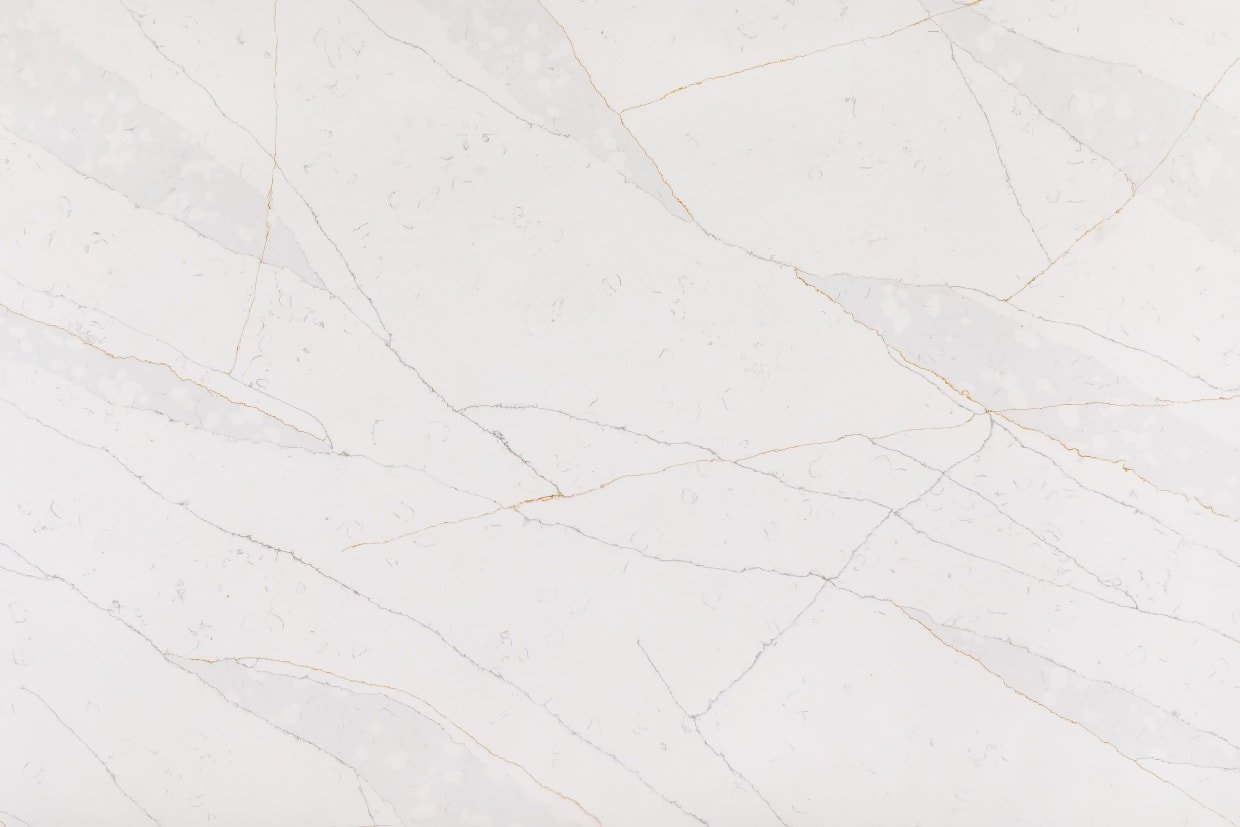
Calacatta Fresh (G047) on a factory-finished surface, showing a white background with grey and gold veining.
What is the difference between engineered quartz and marble?
Engineered quartz is a factory-made agglomerated stone. EN 14618:2009 defines agglomerated stone products as industrial products made mainly from hydraulic cement, resin, or a mixture of both, together with stone and other additions. Kitchen quartz slabs are typically resin-bound. Caesarstone’s technical data manual states that its surfaces “contain up to 90% crushed quartz” plus polyester resins and pigments; Cosentino’s April 2023 Silestone safety data sheet describes that family as 85–95% inorganic mineral fillers, 5–15% polymerized polyester resin, and less than 5% pigments and additives. Those figures are product-specific, not Aspire Stone’s unpublished formula.
Marble is a metamorphic dimension stone. The Natural Stone Institute describes the calcite crystal as the basic building block of true marbles, and notes that calcite is vulnerable to mild acids commonly found in kitchens and bars. A user selecting marble for those applications “should be aware of, and accepting of the maintenance and patina that is to be anticipated.” ASTM C503/C503M is the standard specification used to select marble dimension stone; absorption is tested by ASTM C97. Serpentine is often mistaken for marble but is magnesium-silicate based and, according to the Institute, generally more acid-resistant than true marble. Do not specify it as marble.
A quartz vs granite comparison is the better starting point if the alternative is a siliceous natural stone rather than a calcite marble.
How do appearance, veining, and porosity compare?
Natural marble is valued for unique veining and a soft, depth-rich look that varies from slab to slab. That variation is the design feature, and it is also the specification risk: replacements and later additions may not match. Engineered quartz can imitate Carrara and Calacatta patterning with tighter batch control, but the pattern is designed, not quarried, and veined slabs still need a layout so seams and vein direction stay consistent.
Aspire Stone publishes Calacatta quartz slabs described as a white background with grey or gold veining for kitchen countertops, vanity tops, and commercial interiors, and Carrara and veined quartz slabs for kitchens, vanities, and bar tops. Those pages describe manufactured marble-look options; they are not natural marble. A fuller look at what Calacatta quartz is and what Carrara quartz is helps when a project is choosing among those looks.
Many quartz manufacturers describe their surfaces as non-porous or very low in absorption and say a sealer is not required. Caesarstone states that its quartz “maintains its appearance without sealants or waxes.” Cosentino’s Silestone care manual tells users not to apply repellents, sealants, or polish. Low absorption is not stain-proof. Marble is a natural stone with open crystal boundaries; the Natural Stone Institute notes that impregnating sealers are commonly used to increase stain resistance, but they do not make stone stain-proof, and they do not prevent acid etching.
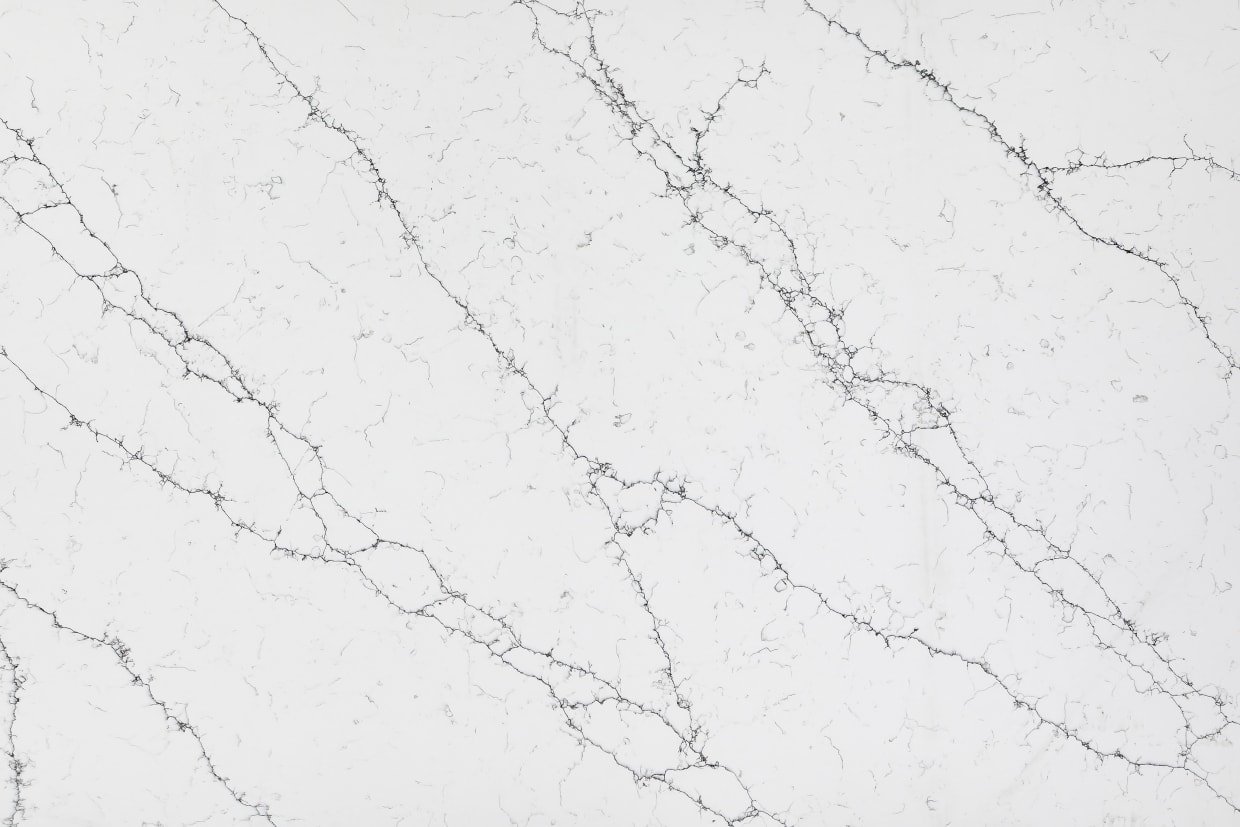
Alaska Bianca Extra (V324), a lightly veined design from the Carrara and Veined series.
Does quartz etch or stain like marble?
Etching and staining are different problems. An etch mark is a chemical dulling of the finish, caused when acid reacts with calcite. The Natural Stone Institute’s stain-removal guidance distinguishes etch marks from stains: some substances etch without staining, others do both. Lemon juice, vinegar, wine, tomato, and many cleaners can leave a dull spot on marble even if the spill is wiped quickly. A penetrating sealer does not stop that reaction.
Engineered quartz does not contain a calcite surface in the way true marble does, so it does not etch from household acids in the same way. That is not a claim that quartz is chemically inert. Silestone’s care manual warns against paint strippers, high-pH products, undiluted bleach or solvent, and hydrofluoric acid, and says accidental spills of those products should be removed at once. Caesarstone likewise warns that prolonged exposure to strong chemicals can damage the surface. Pigmented substances left on quartz can still leave a mark.
Marble can also stain, especially from oils and colored foods, if the liquid enters the stone before it is cleaned. The Institute recommends blotting spills immediately, using a neutral cleaner, and calling a professional for deeper stains or etches that cannot be buffed out with marble polishing powder. Quartz is usually easier to wipe clean, but it is not a substitute for prompt care, and it should not be described as stain-proof.
How do heat, UV, and everyday wear compare?
The polymer binder in engineered quartz is less heat-tolerant than the mineral. Caesarstone’s UK care guidance says the surface should be protected from temperatures above 150°C or 300°F and from sudden temperature changes, and that hot cookware should sit on a trivet. Cosentino’s Silestone manual gives the same practical rule. Heat marks on quartz can be permanent.
The Natural Stone Institute recommends trivets on natural stone as well: “While many stones can withstand heat, the use of trivets or mats is recommended.” Do not treat marble as a cooktop. Calcite is also a relatively soft mineral—Mohs 3 on the U.S. National Park Service hardness scale—so marble is more vulnerable to abrasion than a granite or a quartz composite. That mineral figure is not a scratch-proof or scratch-prone rating for every slab. Use cutting boards on both materials.
Conventional indoor quartz is generally specified for interior use. Silestone’s care manual says not to place the surface outdoors or anywhere exposed to direct UV rays unless the product is documented for that exposure. The Natural Stone Institute notes that acid rain and weathering can affect exterior marble, and that exterior applications are generally limited to white marbles, with some exceptions. For a kitchen with strong sun on the worktop, confirm the specific product’s UV guidance rather than assuming either material is automatically outdoor-safe.
What actually drives cost?
There is no single answer to “is quartz cheaper than marble?” Prices vary by market and date, and they should not be copied from an older article or another country as current figures. What can be compared, without inventing a price list, are the cost drivers.
| Cost factor | Engineered quartz | Natural marble |
|---|---|---|
| Material grade or design | Simple solids often cost less than complex, book-matched, or marble-look designs | Common grades and rare statuary or named quarry stones can sit far apart in price |
| Origin and availability | Manufactured to published sizes and colors; lead time depends on the plant and the color | Depends on the quarry, block yield, and whether matching slabs can still be obtained |
| Thickness and finish | Thicker slabs and non-standard finishes can add cost | Thickness, honed or polished finish, and any filling or resin treatment affect price |
| Fabrication and waste | Veined layouts, mitered edges, and cut-outs add labor; batch control can reduce matching waste | Unique veining can increase waste if the layout must protect a feature or avoid a flaw |
| Installation and aftercare | Usually no routine sealer; damage from heat or chemicals may be hard to refinish | Impregnating sealer, etching risk, and professional refinishing should be budgeted if the stone will be used in a kitchen |
An installed marble top can be less or more expensive than an installed quartz top, depending on the grade and the work. Lifecycle cost should include maintenance time, refinishing, and the difficulty of matching a slab later. A structured kitchen quartz slab buying guide is useful once the project has decided that engineered quartz is the right family.
Which material fits which project priority?
| If the priority is… | Often a better fit | Why, with caveats |
|---|---|---|
| A unique, quarried marble surface and an accepted patina | Natural marble | Etching and staining remain part of kitchen life; plan care and refinishing |
| A Carrara or Calacatta look with lower daily maintenance | Engineered quartz | The look is manufactured; still wipe spills and keep hot pans on trivets |
| Matching many kitchens or later additions | Engineered quartz | Batch control is tighter than quarry stone, though shade lots still need checking |
| A wet-area vanity where etching risk is understood | Either, if specified carefully | The Natural Stone Institute notes that many marbles are used in wet areas; quartz is typically low-absorption and usually needs no sealer |
| Outdoor or strong-UV worktops | Confirm the specific product | Conventional indoor quartz is not automatically outdoor-safe; exterior marble is limited |
FAQ
Is quartz cheaper than marble?
Not always. Mid-range quartz and mid-range marble can overlap, while rare marble and complex quartz designs can both sit at the high end. Compare the installed price for the actual color, thickness, finish, and fabrication, in the market and at the time you are buying. Do not rely on a generic “quartz is cheaper” rule.
Does quartz stain like marble?
Not in the same way. Quartz typically has very low absorption and does not etch from household acids the way calcite marble does. It can still stain or discolor if a pigmented or aggressive substance is left on the surface, and harsh chemicals can damage the resin. Marble can both stain and etch; a sealer helps with stains, not with acid marks.
Can quartz look like Carrara marble?
Yes. Many engineered-quartz designs are made to recall Carrara or Calacatta marble. Aspire Stone publishes Carrara and veined, and Calacatta, series for that kind of look. The pattern is manufactured, so approve the actual slab or a current batch photo, and plan seams if the veins are strong.
Which material is easier to maintain?
Engineered quartz is usually the lower-effort daily surface because it typically does not need a sealer and does not etch like marble. It still needs prompt wiping, the right cleaners, and trivets. Marble in a kitchen requires acceptance of possible etching and patina, a neutral cleaner, and often an impregnating sealer.
Can damaged marble or quartz be repaired?
Light marble etches can sometimes be improved with marble polishing powder; deeper etches and stains often need a professional restorer. Some quartz chips can be filled with a color-matched resin. Heat scorch or chemical damage on quartz is often difficult to reverse. Ask the fabricator what is realistic for the specific surface.
Looking for a marble-look quartz for a kitchen or vanity?
Aspire Stone manufactures engineered quartz in Foshan, China, including Calacatta and Carrara and veined series for indoor kitchens, vanities, and commercial interiors. Browse those series, or send drawings and preferred looks through the contact page for current slab formats and cut-to-size options.
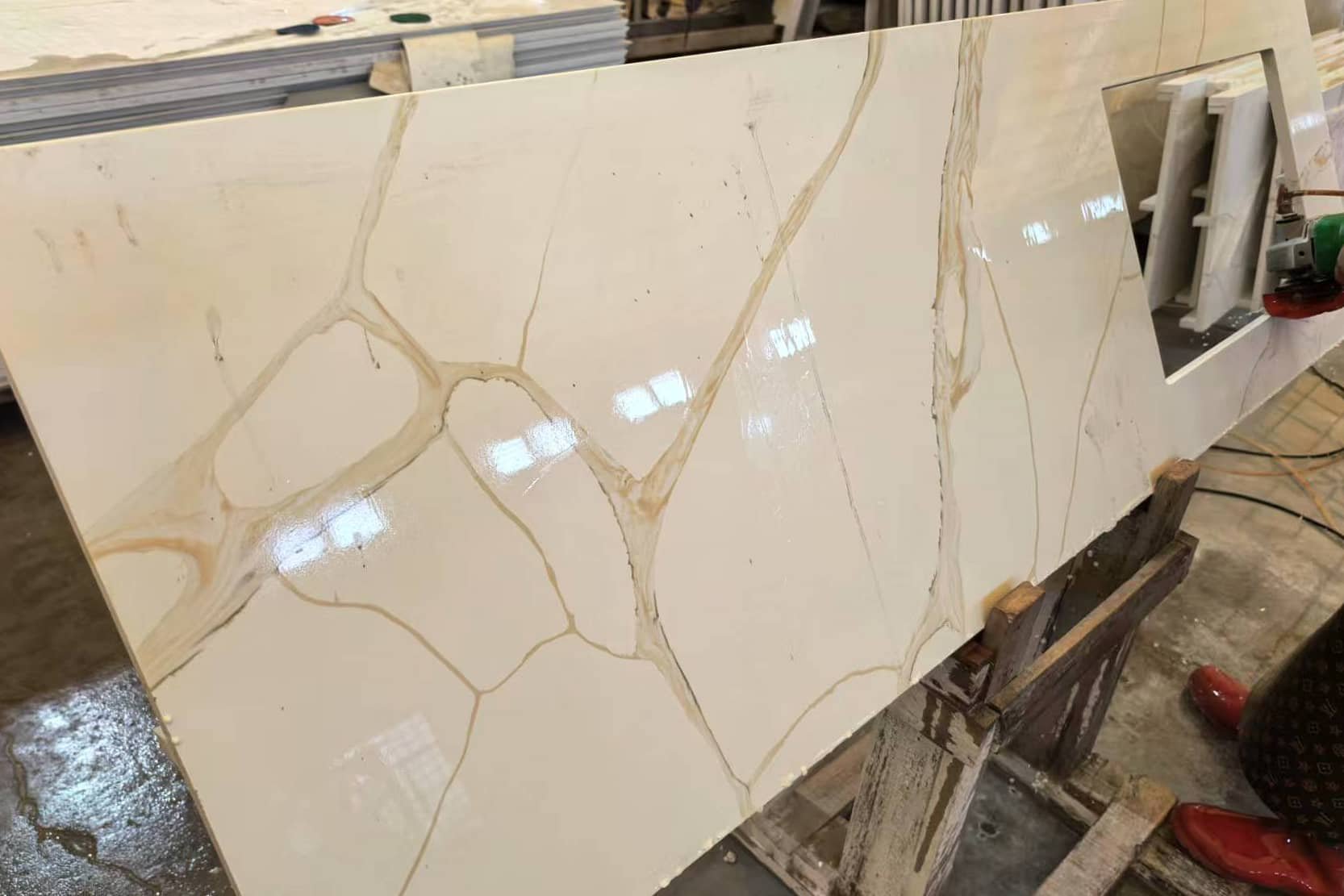
A cut-to-size marble-look quartz piece photographed after fabrication, with a sink opening visible.


 WhatsApp
 EMAIL