




A Buyer’s Guide to Testing Quartz Slabs
Testing a quartz slab is useful only when the result is tied to a named product, a stated test method and an intended use. Hardness, water absorption and stain resistance are different properties, measured by different procedures, and a single number does not describe every color or every condition on site. This guide explains the main test categories, how to read a report, and why laboratory accreditation matters.
Why must a test be tied to a product, a method and a use?
A test result is not a free-standing quality badge. It describes a specimen, prepared and conditioned in a defined way, under a named method. If the report does not identify the color or product, the thickness or finish, the method and edition, and the date, it cannot support a purchase decision.
The intended use also matters. A kitchen countertop, a vanity, a reception desk and a floor see different loads, chemicals and wear. A water-absorption result does not answer a stain question. A stain test on a polished face does not describe a honed face. A result from one color does not automatically apply to another formula in the same series.
Engineered quartz belongs to the family EN 14618:2009 calls agglomerated stone: industrial products made mainly of hydraulic cement, resin, or a mixture of both, together with stone and other additions. Most kitchen slabs use a resin binder. Some widely cited stone methods were written for natural dimension stone, not for this product family. Buyers should check that the method on the report is the method they asked for, and that it actually applies to the specimen.
An internal factory check can be useful process control. It is not the same thing as a third-party test, and a test report is not a product certification. On 23 November 2026, no public Aspire Stone laboratory test report for hardness, water absorption or stain resistance was found on the live site. If those results are required, they should be requested for the named product and placed on the confirmation list until the company provides them.
What test categories are commonly requested?
The table below lists methods that are frequently relevant to engineered quartz or agglomerated stone. Titles and years are taken from the standards-body listings fetched on 23 November 2026. The table is a map, not a testing programme, and it does not include Aspire Stone results.
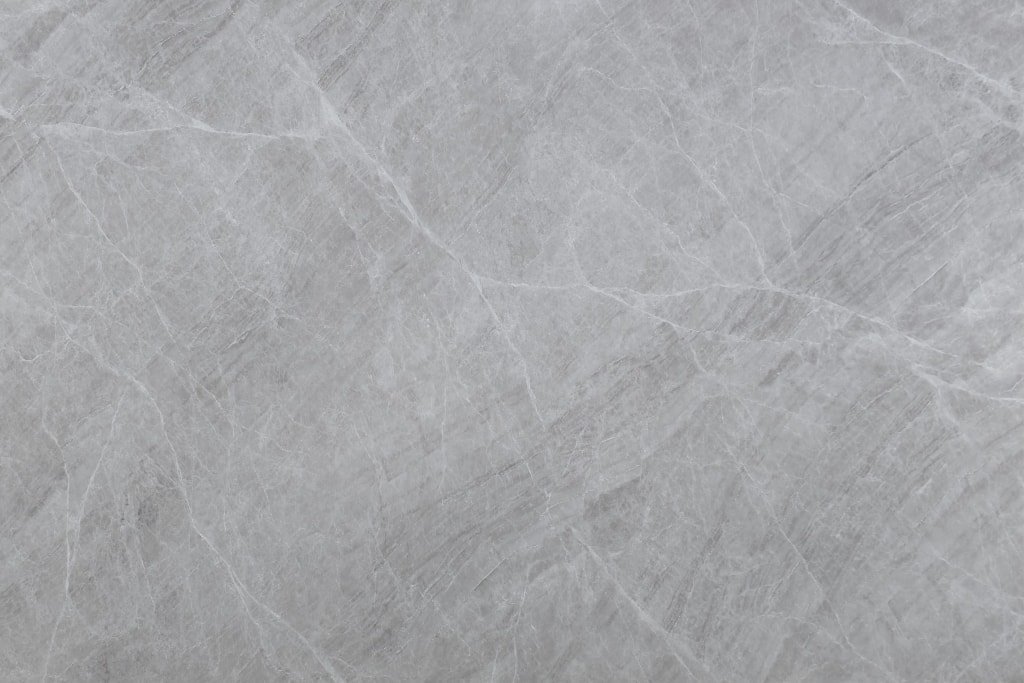
Product photograph of printed model ASP058. This is not laboratory evidence.
| Property | Named method (edition listed) | What the method is for | Buyer caution |
|---|---|---|---|
| Apparent density and water absorption | BS EN 14617-1:2013, Agglomerated stone. Test methods — Determination of apparent density and water absorption | The agglomerated-stone method for density and water absorption | This is the method written for this product family. Ask for the edition used on the report. |
| Absorption and bulk specific gravity | ASTM C97/C97M-26, Standard Test Methods for Absorption and Bulk Specific Gravity of Dimension Stone | Absorption and bulk specific gravity of dimension stone, except slate | This is a dimension-stone method. Some buyers still request it, but it is not an agglomerated-stone standard. Older reports may cite C97/C97M-18 or C97/C97M-25. |
| Flexural strength (bending) | BS EN 14617-2:2016, Determination of flexural strength (bending) | Flexural strength of agglomerated-stone flat products under a concentrated load | Useful for mechanical comparison. Not a substitute for installation design or site conditions. |
| Abrasion resistance | BS EN 14617-4:2012, Determination of the abrasion resistance | Abrasion resistance of agglomerated stone products | More relevant where the face will see wear, such as some flooring uses, than for every countertop discussion. |
| Chemical resistance and stain resistance | BS EN 14617-10:2012, Determination of chemical resistance | BSI Knowledge states that this part specifies a method for chemical resistance and resistance to stains of agglomerated stones with a polished surface after prolonged contact with chemical materials | Applies to a polished surface in the standard’s scope. A honed or textured finish needs its own agreement. The standard also notes that agglomerated stones containing calcium carbonate aggregates are sensitive to acid attack. |
| Mineral hardness (Mohs) | Mohs scale of mineral hardness, described by the U.S. National Park Service as a relative scratch scale used to help identify minerals | The mineral quartz is widely listed at 7 on that scale, including in the University of Minnesota Common Minerals guide | Mohs describes a mineral’s resistance to scratching, not a standardized slab-product test. An engineered slab is a composite of mineral and resin, so a Mohs number quoted for a slab is not an official Aspire Stone result and is not equivalent to EN or ASTM product testing. |
Other parts of EN 14617 exist for properties such as freeze-thaw, thermal shock, impact and compressive strength. Request those only when the intended use makes them relevant. Do not treat a ceramic-tile method, such as ASTM C1378 (stain resistance of ceramic tile), as if it were the agglomerated-stone stain method, unless you have a documented reason to use it and the report says so clearly.
Low water absorption is often cited for engineered quartz, but it does not make a surface stain-proof, scratch-proof or maintenance-free. Some chemicals, especially strong acids or solvents, can still mark a resin-bound face. Polished and honed finishes can also behave differently in service, even when they share a base formula.
How should samples be prepared, tested and interpreted?
A report is only as good as the specimen behind it. Buyers should expect the laboratory, or the sampling instruction, to record:
- Which product, color, thickness and finish were sampled, and from which batch or slab if that is known.
- How the specimen was cut and prepared, and whether the tested face is the finished face.
- Any conditioning required by the method, such as drying or laboratory climate, before the test starts.
- The method title, designation and edition.
- The result, with units, and any deviation from the method.
Water-absorption methods generally compare a dried specimen’s mass with its mass after immersion, and express the absorbed water relative to the dry mass. The exact specimen size, drying and immersion conditions are those in the named standard. They are not interchangeable between EN 14617-1 and ASTM C97, and a buyer should not average or “convert” results from one method into the other.
Stain and chemical tests depend on the agents, the contact time, the surface finish and the cleaning step used afterwards. EN 14617-10 is written for a polished agglomerated-stone surface after prolonged contact. A kitchen spill that is wiped quickly is not the same exposure. A “no stain” comment from a factory demonstration, using an unnamed liquid and an unnamed procedure, is not a test report.
Hardness needs the same caution. A simple scratch comparison can illustrate that mineral quartz is harder than many household metals, but it is not a substitute for a product method, and it can damage a finished face. Do not quote a Mohs figure as if it were an accredited laboratory result for a named Aspire Stone color.
Interpretation should stay inside the report. A result supports comparison with a stated limit only when that limit comes from a specification, a product standard, or a written agreement. The method itself often measures a property; it does not automatically declare pass or fail.
Why do accreditation, repeatability and uncertainty matter?
ISO/IEC 17025:2017 is the international standard for the competence of testing and calibration laboratories. The official ISO page, which notes that this 2017 edition remains current after confirmation in 2023, describes it as the criteria accreditation bodies use to assess laboratories, and as a basis for wider acceptance of results between countries.
A report from a laboratory accredited to ISO/IEC 17025 for the specific method in question is stronger evidence than an unaccredited in-house printout, but only for the items actually tested. Accreditation of a laboratory is not a certification of the factory, and it is not a certificate for every color in a catalogue.
Repeatability and uncertainty matter because small differences can be within the method’s variation. If two reports differ slightly, the first question is whether they used the same method, edition, specimen preparation and product. The second is whether the difference is larger than the laboratory’s stated uncertainty, where uncertainty is reported. A buyer who treats every decimal place as a commercial defect will misread the data.
Pass/fail language should be checked carefully. If a report says “pass,” it should also say against which requirement. If no requirement is stated, the report is a measurement, not a conformity certificate.
What should a buyer’s test-report review include?
Use the checklist below when a supplier sends a report, or when you commission a test. It complements a quality inspection checklist and the factory controls in how manufacturers keep color and quality consistent.
| Check | What “good” looks like | Common problem |
|---|---|---|
| Product identity | Color or code, thickness, finish, and batch or slab if available | A report titled only “quartz slab” with no product name |
| Method and edition | Full designation, such as EN 14617-1:2013 or ASTM C97/C97M-26 | A method number without a year, or a dimension-stone method presented as an agglomerated-stone method without comment |
| Laboratory | Name, address, and accreditation scope if claimed, including the method | A logo used as if it were a product certificate |
| Dates | Date of test and date of issue; sample receipt date if relevant | An undated report, or a report several years old offered as current proof |
| Results | Values with units, or a described visual class, matching the method’s way of reporting | A marketing phrase such as “stain-proof” in place of a result |
| Scope statement | A clear statement that the results relate only to the items tested | One color’s result applied to a whole series, or to a later formula change |
| Limit or acceptance rule | The specification, standard or agreed limit used for any pass/fail decision | Pass/fail with no stated criterion |
| Independence | Third-party testing identified as such; in-house testing labeled as in-house | An internal check described as a certification |
One satisfactory report still does not guarantee every slab, every future batch, or every use condition. What quartz stone is and how it is finished remain part of the specification. If the formula, finish or production line changes, the report should be renewed.
FAQ
How is quartz slab quality tested?
Factories usually combine visual and dimensional inspection of slabs with laboratory tests on samples. Laboratory work may include density, water absorption, flexural strength, abrasion, and chemical or stain resistance, each under a named method. Inspection of the delivered slab and testing of a specimen answer different questions; both may be needed, and neither replaces the other.
What is water absorption testing?
Water absorption testing measures how much water a prepared specimen takes up, usually by comparing dry mass with mass after immersion, as defined in the named method. For agglomerated stone, BS EN 14617-1:2013 is the method written for this product family. ASTM C97/C97M-26 is a dimension-stone method that some buyers still request. Results from the two methods should not be treated as interchangeable.
How do you test stain resistance?
Use a method that matches the product and the finish. BS EN 14617-10:2012 covers chemical resistance and resistance to stains of agglomerated stones with a polished surface after prolonged contact with chemical materials. The agents, contact time and cleaning step must be those in the method, or clearly agreed and reported. A kitchen demonstration with an unnamed liquid is not a substitute for that report.
What should a quartz test report include?
At a minimum: the product identity, the method and edition, the laboratory, relevant dates, the results with units, and a statement that the results apply only to the items tested. If pass or fail is stated, the acceptance rule should be named. Accreditation, where claimed, should match the method actually used.
Does one test result cover all colors and uses?
No. A result belongs to the specimen tested. Other colors, thicknesses, finishes, batches or later formula changes need their own evidence if the property is important to the order. The intended use should also guide which tests are commissioned.
Requesting results for the product you are buying
If a project specification requires testing, ask for a current report that names the product, the method and the laboratory, rather than a general brochure claim. A public Aspire Stone test report for these properties was not found on the live site on 23 November 2026; request current documents from the company if you need them. Contact Mr. Lin at +86 135 0025 4616 or [email protected], or use the Contact page, and state the color, thickness, finish and methods you require.


 WhatsApp
 EMAIL