




What Is Quartz Stone? Engineered Quartz Explained for Buyers
In the surfacing trade, “quartz stone” usually means engineered quartz: a factory-made slab in which mineral aggregates—most often crushed quartz—are bound with a polymer resin, then formed, cured, and finished. It is not a quarry-cut piece of the mineral quartz, and it is not natural quartzite. Composition, format, and performance vary by brand and product line.
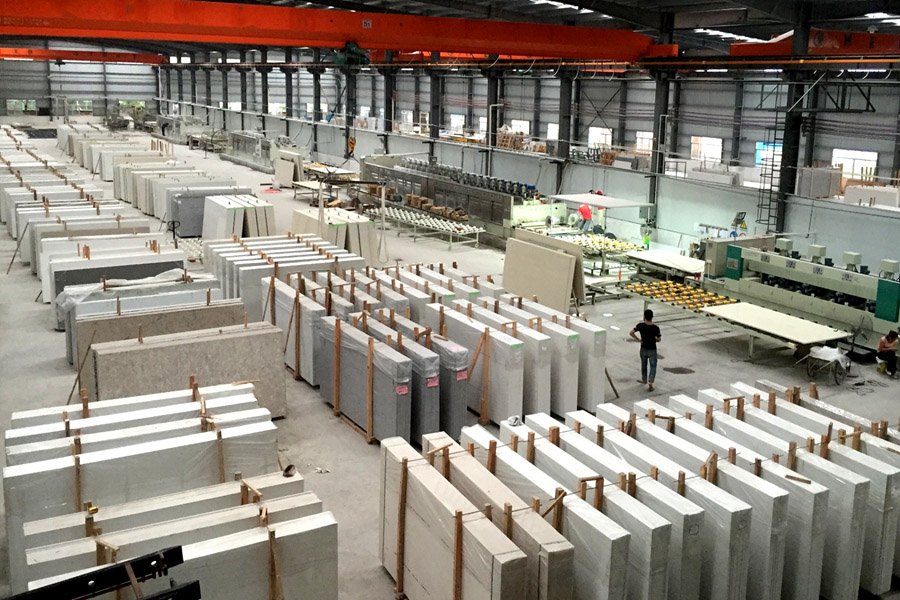
Finished engineered quartz slabs stored vertically at the Aspire Stone factory in Foshan.
Engineered quartz is not the mineral, and it is not quartzite
Three different things share the word “quartz.”
The mineral quartz is silicon dioxide (SiO2), one of the most common minerals in the Earth’s crust, according to the U.S. Geological Survey. On the Mohs hardness scale, quartz is the index mineral for hardness 7, as shown by the U.S. National Park Service. That figure describes the mineral, not every point on a finished worktop.
Natural quartzite is a dimension stone. The Natural Stone Institute describes it as a metamorphic rock formed from sandstone. It is quarried and cut into slabs, not pressed with a polymer binder. A longer comparison of quartz stone and natural quartz is useful when the two names are used interchangeably.
Engineered quartz—also called engineered stone, quartz surfacing, or, in European standards language, a form of agglomerated stone—is an industrial product. EN 14618:2009 defines agglomerated stone products as industrial products made mainly from hydraulic cement, resin, or a mixture of both, together with stone and other additions, and manufactured by moulding at fixed plants. They are classified by binder and by aggregate type (silica, carbonate, or mixed). Kitchen “quartz” slabs are typically resin-bound with silica-nature aggregates, but that is not a single recipe.
In March 2026 ISO published ISO 19947:2026, Engineered stone — Vocabulary, under ISO/TC 328. In this article, “engineered quartz” means resin-bound quartz surfacing.
Typical composition, and why formulas differ
A typical slab combines mineral aggregates (often crushed natural quartz, sometimes with silica sand, cristobalite, glass, or other minerals); a polymer binder, commonly a polyester resin; pigments; and other additives.
Those proportions are not universal, and they are not Aspire Stone’s unpublished formula. Caesarstone’s technical data manual states that its surfaces “contain up to 90% crushed quartz (silicon dioxide – SiO2)” combined with polyester resins and pigments. Cosentino’s April 2023 Silestone safety data sheet describes that product family as 85–95% inorganic mineral fillers, 5–15% polymerized polyester resin, and less than 5% pigments and additives. A joint OSHA–NIOSH hazard alert notes that crystalline silica “can comprise up to 95% of the material in engineered stone,” while some formulas contain less than 50%, and that typical content spans a wide range (<0.2–95% in the alert’s table).
“About 90% quartz plus resin” is therefore useful shorthand for many conventional products, not a specification for every slab. Low-silica and silica-free formulations are also not the same thing. A lower crystalline-silica content is not automatically silica-free, and it does not make fabrication risk-free. Aspire Stone publishes low-silica and silica-free quartz surfaces. Request any silica percentage, test method, or safety data sheet for the specific product.
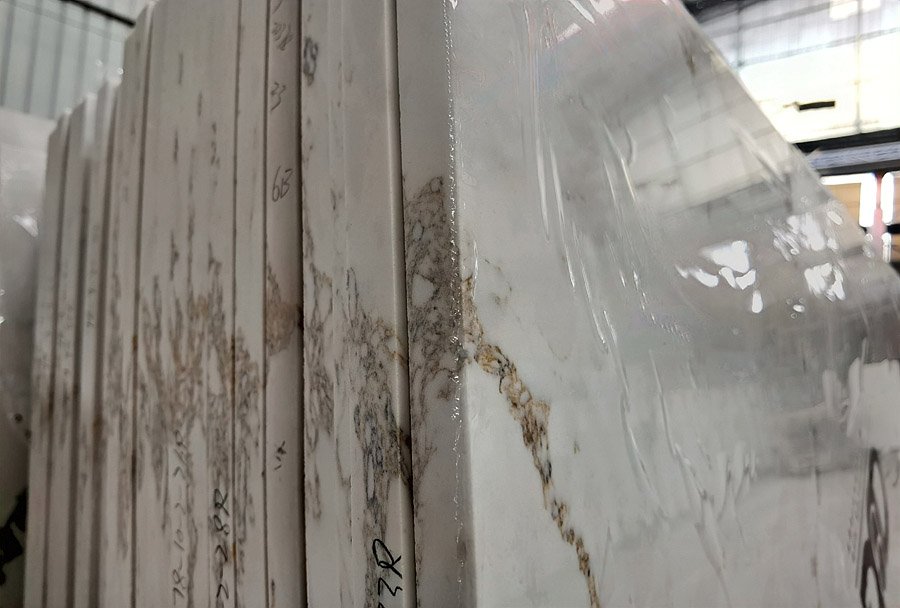
Stacked slab faces and cut edges, showing a veined pattern on a factory-finished surface.
How quartz slabs are made
Most plants follow the same broad sequence, which is explained further in this guide to how quartz slabs are made. Pressures, temperatures, cycle times, and mix designs are not a single industry standard.
- Batching. Aggregates are prepared and weighed with the binder, pigments, and additives.
- Mixing. The binder wets the mineral particles. Veined or printed designs may use more than one mix, a veining step, or a surface decoration process.
- Forming. The mix is placed in a mould and compacted. A widely used method is vibro-compression under vacuum, which Breton describes as the core of its BretonStone process. Other suppliers also build pressing lines.
- Curing. The polymer binder is hardened into a solid matrix.
- Finishing. Slabs are typically calibrated to thickness, then polished, honed, textured, or otherwise finished.
- Inspection. Thickness, appearance, and visible defects are checked before packing.
Aspire Stone, a quartz stone manufacturer in Foshan, China, founded in 2008, states that its factory covers more than 25,000 sq.m and has three quartz pressing lines, with in-house production on Italian Simec equipment.
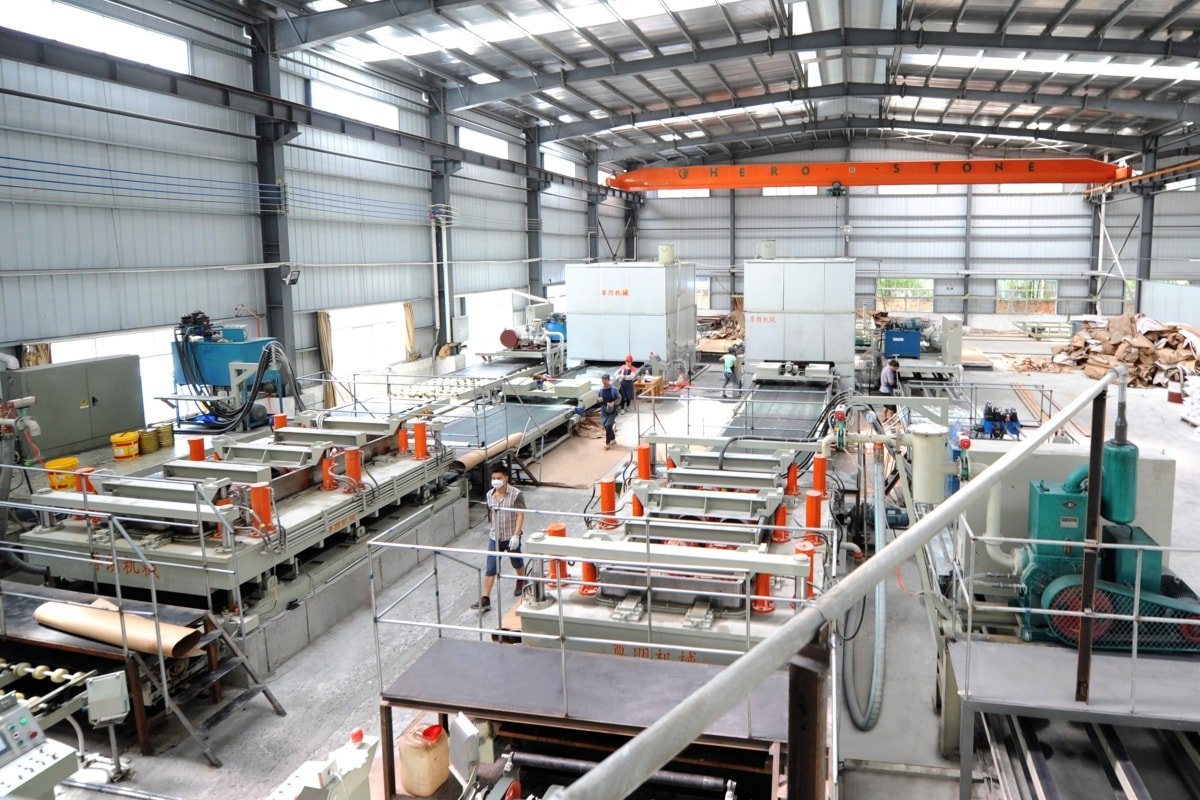
Pressing equipment on the production line, from Aspire Stone’s live “Pressing Machine” photograph.
Formats, finishes, and where it is used
There is no single global slab size or thickness. This overview of quartz slab sizes, thicknesses and finishes goes into the format choices in more detail. Caesarstone, as one published example, lists a standard slab of 120 × 56½ in (305 × 144 cm), a jumbo slab of 131½ × 64½ in (334 × 164 cm), and thicknesses including 2 cm and 3 cm. Breton cites possible sizes from 140 × 300 cm to 210 × 360 cm and thicknesses from 7 mm to 30 mm. Aspire Stone’s Super Jumbo quartz slabs page describes regular slabs as commonly around 120 × 56 in, jumbo around 128 × 63 in, and Super Jumbo as 138 × 78 in—the company’s published description, not an industry standard.
Finishes commonly include polished, honed or matt, and textured looks; honed and textured finishes can show marks more readily than a polished face.
Typical uses include kitchen countertops, islands, bathroom vanity tops, bar and reception counters, and some interior cladding; a fuller list of quartz slab applications is covered separately. Aspire Stone also supplies cut-to-size quartz slabs for residential, commercial, and hospitality projects. Standard resin-bound quartz is generally specified for indoor use unless a product is designed and warranted for outdoor exposure.
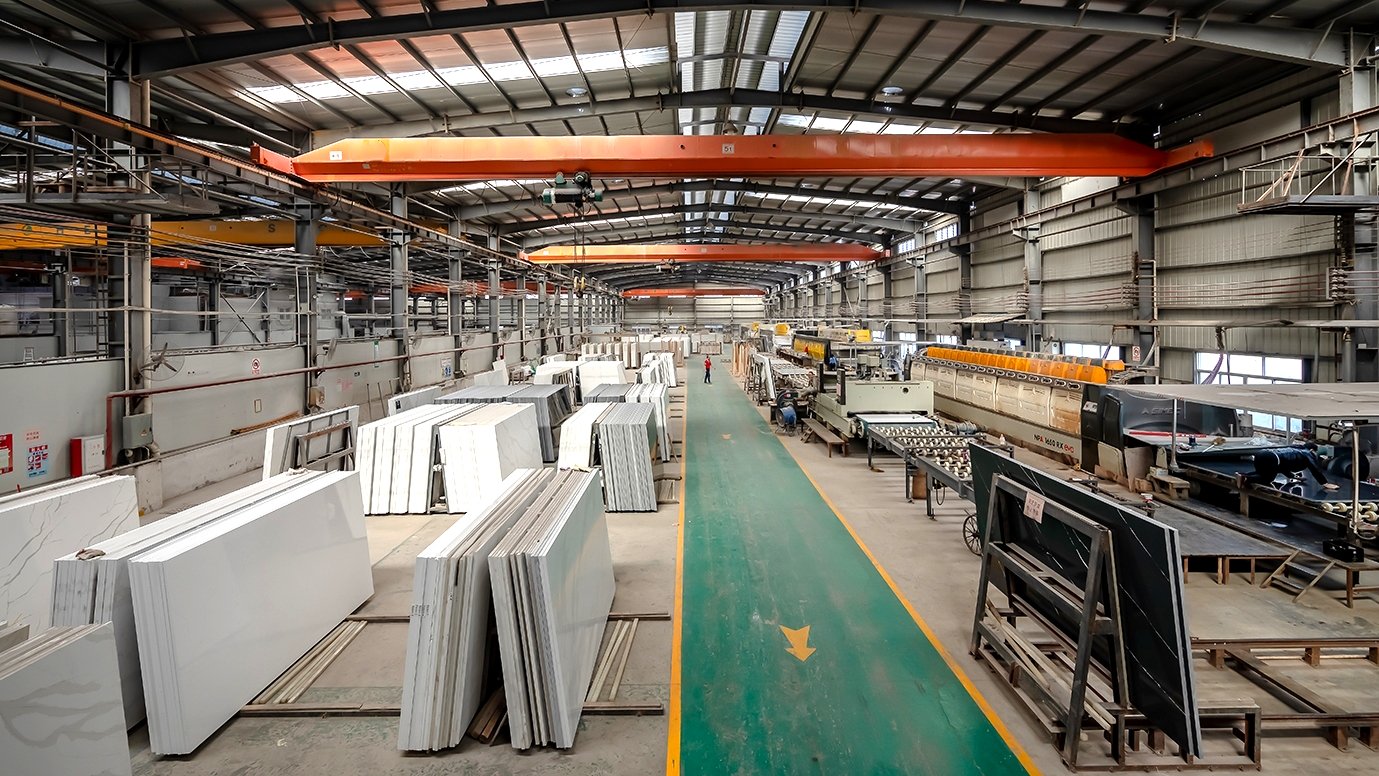
Large-format engineered quartz slabs stored beside the production line at the Aspire Stone factory.
Performance characteristics—and the limits that matter
Read performance from the product’s own technical data. Common methods include the EN 14617 series for agglomerated stone and, in some data sheets, ASTM methods such as ASTM C97.
Porosity and staining. Many manufacturers describe quartz as non-porous or very low in absorption and say sealing is not required. Caesarstone states that its quartz “maintains its appearance without sealants or waxes.” That is product-specific, not stain-proof. Strong chemicals, high-pH cleaners, solvents, or prolonged contact with staining agents can still cause damage.
Heat. The polymer binder is less heat-tolerant than the mineral. Caesarstone’s UK care guidance says the surface should be protected from temperatures above 150°C or 300°F and from sudden temperature changes, and that hot cookware should sit on a trivet. Heat marks can be permanent. “Heat-resistant” is not heat-proof.
UV and outdoor exposure. The resin in conventional indoor quartz can be affected by prolonged ultraviolet light. Unless a product is documented for outdoor use, treat engineered quartz as an interior material.
Scratches, chips, and repair. Quartz the mineral is Mohs 7, but the resin between grains is softer. Use cutting boards and take care at edges and cut-outs. Some chips can be repaired by a skilled fabricator; heat or chemical damage is often permanent.
Seams. Slab size is finite, so long runs and large islands often need joints. Veined and marble-look designs make seam placement more visible if it is not planned.
Fabrication and crystalline silica. Cutting, grinding, drilling, and polishing can release respirable crystalline silica dust. OSHA and NIOSH have identified that exposure as a workplace hazard in U.S. manufacturing, finishing, and installation. Occupational rules differ by country and should not be mixed together. A low-silica slab is not a substitute for those controls.
Engineered quartz compared with other surfaces
| Topic | Engineered quartz | Natural granite or marble | Natural quartzite | Porcelain or sintered surfaces |
|---|---|---|---|---|
| Origin | Factory-made; mineral aggregate plus polymer resin | Quarried and cut into slabs | Quarried metamorphic rock from sandstone | Typically fired or sintered mineral surfaces |
| Porosity and sealing | Often low; many makers say no sealing; not stain-proof | Often sealed in service. Marble can etch with acids | Varies; follow the actual stone | Typically very low absorption |
| Heat and UV | Resin is the usual weak point; indoor quartz is not automatically outdoor-safe | Generally better cookware-heat tolerance than resin quartz | Often chosen for heat tolerance; still specify the slab | Use that product’s data, not quartz data |
| Seams and repair | Joints limited by slab size; some chips repairable | Natural-stone practice; match varies | Similar; hardness affects tooling | Methods differ by product |
Porcelain and sintered surfaces are a different manufactured family. Cosentino’s Dekton technical manual describes a mineral mixture that reacts at high temperature and “does not contain resins or organic additives.” Heat and UV behavior should not be assumed to match engineered quartz. Buyers who are weighing natural stone often start with a quartz vs granite comparison.
Aspire Stone’s published range is engineered quartz, including Calacatta, printed, low-silica and silica-free, Carrara and veined, solid color, sparkling, and super-jumbo series, listed in its quartz slab series, plus cut-to-size work.
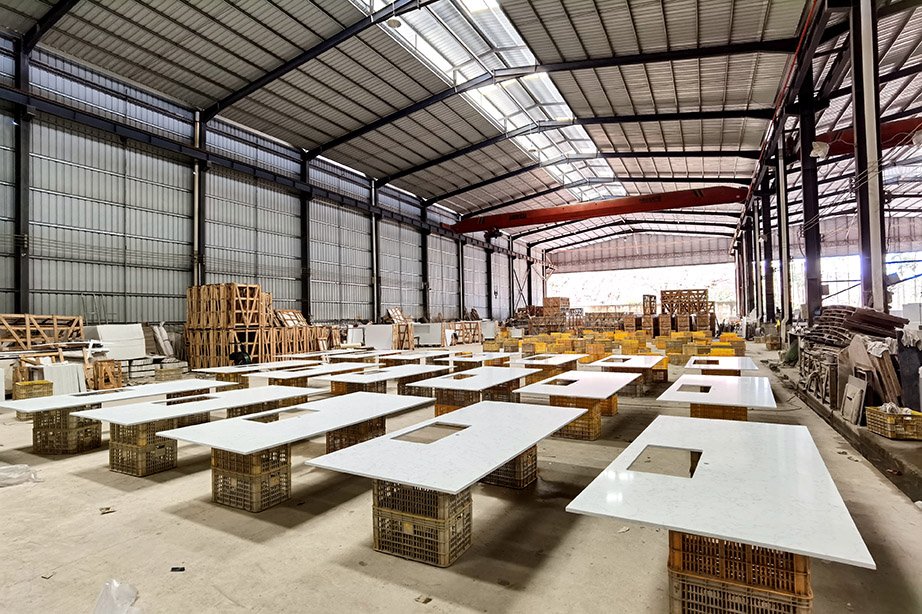
Kitchen countertops fabricated as cut-to-size pieces in the Aspire Stone workshop.
A buyer checklist for quartz slabs
Ask for documents that attach to the actual product.
- Composition disclosure. Request the ingredients statement and, where available, a safety data sheet for the specific color. If crystalline silica content matters for fabrication, ask for the range, method, and date. Do not treat “low-silica” as “silica-free.”
- Technical data. Ask for thickness tolerance, absorption, flexural strength, abrasion, chemical resistance, and any heat data, each with the standard used (for example, EN 14617 or a stated ASTM method).
- Samples and shade control. For veined and printed designs, request a recent slab photo or a viewing of the current batch, and confirm how shade lots are identified.
- Format, thickness, and finish. Confirm the current size, thickness, and finish for that color, including jumbo or super-jumbo availability if you need fewer seams.
- Batch consistency and inspection. Ask how color and pattern are controlled between batches and what is checked before packing.
- Fabrication guidance. Obtain cutting, support, seam, and indoor/outdoor guidance. If you need pieces rather than full slabs, confirm cut-to-size capability, drawings, and packing.
FAQ
What exactly is engineered quartz?
A factory-made composite slab of mineral aggregates—usually crushed quartz—bound with a polymer resin, plus pigments and additives, then formed, cured, and finished. It is not sawn from a quartz quarry.
Is quartz stone natural or man-made?
The quartz grains in many formulas are natural; the slab itself is manufactured. Natural quartzite is a different, quarried stone and should be specified under its own name.
What materials are used to make quartz slabs?
Most products combine mineral fillers, a polymer binder (often polyester resin), pigments, and other additives. Formulas vary, so ask for the product’s own disclosure.
Where is engineered quartz commonly used?
Most often for indoor kitchen countertops, islands, vanity tops, and bar or reception counters, and sometimes for interior cladding. Limit outdoor use to products designed and documented for that exposure.
What should buyers check before purchasing?
Composition disclosure, technical data with named test methods, samples or batch photos, sizes and finishes, shade-lot policy, and fabrication guidance. If the slab will be cut in a workshop, obtain crystalline-silica information and follow the rules that apply there.
Looking at slabs, data, or cut-to-size pieces?
If you are comparing series or need current product data, Aspire Stone can share slab options and cut-to-size details from its Foshan factory. Browse the quartz slab series, or send project notes through the contact page.
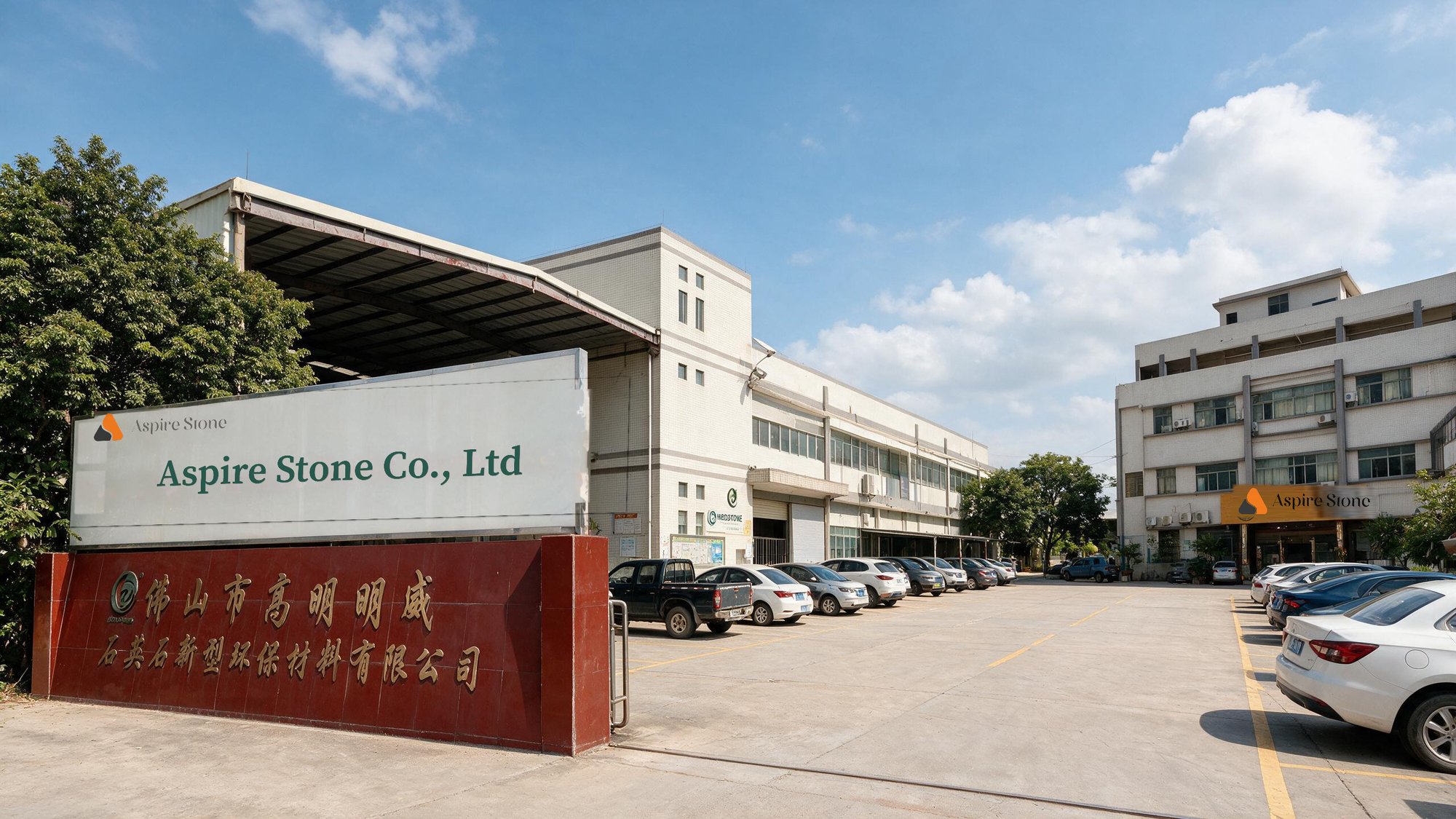
Factory courtyard in Gaoming, Foshan, with the Mingwei company name on the entrance wall.


 WhatsApp
 EMAIL