




Quartz Bathroom Vanity Tops: Thickness, Sinks, Finish and Care
Engineered quartz is widely specified for bathroom vanity tops because it is a low-absorption, non-porous surfacing material that can be fabricated around sinks and used in wet rooms. That does not make it stain-proof, waterproof at the joints, or maintenance-free. The right vanity specification covers color and finish, thickness, sink cut-outs, support, water management, and a cleaning method that suits cosmetics and bathroom cleaners.
What conditions does a bathroom vanity have to handle?
A vanity top sees standing water, toothpaste, soaps, cosmetics, hair products, and regular cleaning. Some of those substances, especially hair dye, nail products, and strong bathroom cleaners, can mark a surface if they are left to sit. Industry manufacturer care guides, including Caesarstone’s, advise wiping spills promptly, keeping the surface dry, and treating prolonged contact with strong acids or alkalis as a risk — guidance that applies at least as much in a bathroom as in a kitchen.
ISFA 3-01 (2013) describes quartz surfacing as a hard, non-porous material used in residential and commercial bathrooms as well as kitchens and food-preparation areas, and it notes typical wet-area uses such as vanity bowls, tub and shower walls, and other wet applications. That is a material-category description. It is not a promise that every slab, every cut-out, or every silicone joint will be immune to moisture problems. Joints, overflow paths, and the cabinet below still have to be designed and installed correctly.
For how vanity tops sit among other slab uses, see the main applications of quartz slabs. Color-family points that also apply to bathrooms are covered in best quartz countertop colors for modern kitchens and in how to choose the right quartz slab for a kitchen.
How do you choose color and finish for a vanity top?
Color on a vanity is about light, adjacent cabinetry, and how visible everyday marks will be. Very dark, high-gloss surfaces can show toothpaste spray, hard-water spots, and fingerprints more clearly; very busy veins can make a small top look crowded, especially once a basin and tap are cut in. Lighter, quieter designs often keep a compact bathroom calmer, while a bolder Calacatta-style vein can work on a wider double vanity if the pattern is reviewed at slab scale.
Finish changes both appearance and day-to-day care. A polished surface sheds water more readily and is usually easier to wipe. Manufacturer care guidance, again including Caesarstone’s, notes that honed and other lower-sheen finishes have more exposed surface area and can show metal marks, fingerprints, and signs of use more readily than a polished finish. Aspire Stone product pages commonly list polished and honed among the finishes; other textures named on those pages should be confirmed for the specific model. For a fuller comparison, see polished versus honed quartz.
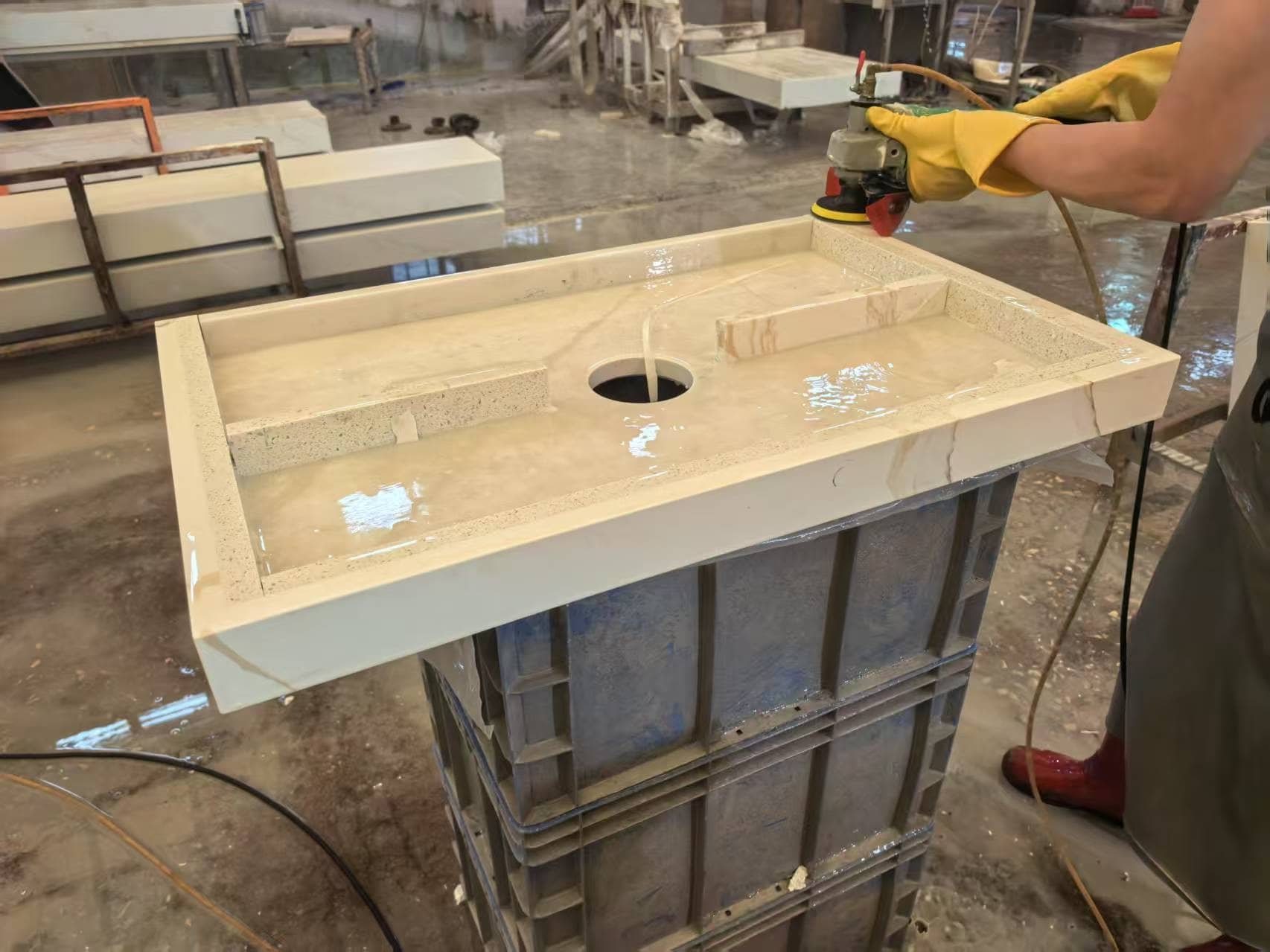
A quartz vanity or integrated-sink piece being wet-polished in the Aspire Stone workshop.
What thickness and edge should a vanity top use?
Aspire Stone Calacatta, solid color, Carrara and veined, sparkling, and exotic series pages fetched on 23 November 2026 list slabs at 3200×1600 mm, in 20 mm or 30 mm. Those are published listing specifications, not a rule that every vanity must use one of those two thicknesses. ISFA 3-01 describes 2 cm and 3 cm as typical nominal thicknesses for quartz countertops generally, with shaped or laminated edges possible.
On a vanity, 20 mm can look refined and reduce weight, especially on a wall-hung cabinet, but the visible edge, the support, and the sink type all have to be designed together. A 30 mm top, or a laminated or mitered edge built from a thinner slab, gives a thicker profile if that is the design intent. Aspire Stone’s cut-to-size page states that the workshop handles cutting, polishing, sink-hole cutting, lamination, and mitered edges. Specific decorative profiles beyond those published capabilities should be confirmed rather than assumed. The structural adequacy of a given thickness, edge, and cabinet is a fabrication and installation issue, not a color choice.
How should sinks, cut-outs and backsplashes be planned?
The sink is the detail that most often goes wrong. Undermount, drop-in, vessel, and wall-mounted basins load the top differently and need different cut-out sizes, edge finishes, and support. An undermount bowl requires a clean, polished cut-out and a reliable bond; a vessel bowl may need only a tap hole but still needs a stable, well-supported deck; a double vanity needs enough deck between bowls for taps, spacing, and strength.
Aspire Stone’s cut-to-size page includes vanity-top categories described as Vanity, Single Bowl, Single Rectangle Bowl, Double Bowl, and Double Rectangle Bowl, and a separate sink category. Those headings confirm that vanity and bowl work is part of the published service. They do not, by themselves, specify whether a given job uses an undermount basin, an integrated bowl, or another system. The sink model, cut-out drawing, overflow, and installer method should be agreed before the top is cut.
Inside corners of cut-outs are a common stress point in quartz fabrication. Manufacturer fabrication manuals typically call for a radiused inside corner rather than a sharp one; the exact radius belongs in the fabricator’s method statement, not as an invented universal number here. A small upstand or backsplash can protect the wall behind the taps, but the joint at the wall still has to be sealed and maintained. Leave space in the drawing for tap holes, overflow hardware, and any soap or accessory cut-outs so they are not added as an afterthought.
What about seams, support and water management?
A short single vanity can often be cut from one piece with no seam. A long double vanity, a makeup counter, or a hotel run may need a seam; if so, keep it away from the sink cut-out and from the area that stays wet. Support must continue under the bowl, under any seam, and at the cabinet ends. A wide basin cut-out removes a lot of material; the cabinet and any additional framing have to carry that load.
Water management is as important as the slab itself. Quartz’s low absorption does not protect an unsealed joint, an open tap hole, or a cabinet that sits in standing water. The installer should provide a continuous, maintainable seal at the sink, at the backsplash, and at any penetration, and the owner should treat failed sealant as a maintenance item. The cut-to-size page says every countertop and vanity top is “cleaned, sealed, labeled, and packed.” That wording is ambiguous — it may refer to packing rather than a stone sealer — and should not be read as a claim that the surface requires, or has received, a penetrating sealer.
How do you clean bathroom quartz?
Daily care is usually a soft cloth, warm water, and a mild detergent, then a rinse and a dry wipe so residue and limescale do not build up. Wipe cosmetics, hair dye, nail-polish remover, and strong cleaners as soon as they are noticed. Caesarstone advises against oven and grill cleaners, toilet-bowl cleaners, floor strippers, oil soaps, drain products, and cleaners made specifically for natural stone, and it recommends rinsing immediately if a damaging product contacts the surface. Cosentino’s Silestone care manuals similarly recommend regular cleaning with a suitable mild or pH-balanced cleaner and caution against harsh or highly alkaline products.
These are manufacturer care methods for those brands, not a laboratory result for every Aspire Stone color, and they are not a substitute for the care sheet that belongs with the installed top. Do not assume that a bathroom disinfectant, bleach cream, or abrasive pad is automatically suitable. For general aftercare, see how to maintain and clean quartz countertops.
Vanity project specification checklist
| Item | What to confirm |
|---|---|
| Model name and code | The exact series and color, not only “white quartz” or “Calacatta.” |
| Finish | Polished, honed, or another confirmed finish, judged in the bathroom’s lighting. |
| Thickness and edge | 20 mm, 30 mm, or a laminated or mitered build-up, plus the visible edge detail the fabricator will actually supply. |
| Sink type and drawing | Undermount, drop-in, vessel, or another system; bowl size; tap holes; overflow; and who supplies the basin. |
| Cut-out method | Radiused inside corners, polished cut-out edges, and any support around the bowl. |
| Seams and layout | Whether the top can be cut in one piece, and where any seam will fall relative to the sinks. |
| Cabinet support | Level, stable carcass; support under cut-outs and seams; suitability for a wall-hung vanity if that is the design. |
| Backsplash and seals | Upstand height, wall joint, and a maintainable seal at every penetration. |
| Quantity and batch | Especially for hotel or multi-unit bathrooms that must match from room to room. |
| Care instructions | A written cleaning method that covers cosmetics, hair dye, and bathroom cleaners. |
FAQ
Is quartz good for bathroom vanities?
Yes, engineered quartz is commonly used for vanity tops because it is a low-absorption, non-porous surface that can be cut for basins and wiped clean as part of ordinary care. It is still possible to mark the surface with harsh chemicals or long-standing stains, and joints and cabinets still need proper water management. It should be specified as engineered quartz, not as natural stone or quartzite.
Can quartz be used around bathroom sinks?
Yes. Vanity tops are routinely fabricated with sink cut-outs, and Aspire Stone’s cut-to-size service includes sink-hole cutting and published single- and double-bowl vanity categories. The sink type, cut-out drawing, support, and sealant details must still be agreed for the actual basin and installer. A well-cut slab will not compensate for a failed joint.
What thickness is best for a vanity top?
There is no single best thickness. Twenty millimetre and 30 mm are the gauges Aspire Stone publishes on the series pages checked for this article, and both appear in ordinary vanity work. The better choice depends on the cabinet, the sink, the visible edge, and the support. A thinner slab can still present a thicker edge if it is laminated or mitered, provided the fabricator designs that build-up correctly.
How do you clean bathroom quartz?
Wipe the top with a soft cloth, warm water, and a mild detergent, then rinse and dry. Clean up cosmetics, hair dye, and strong cleaners promptly. Avoid abrasive pads and harsh bathroom products unless they are approved in the manufacturer’s care instructions. If a care sheet is supplied with the top, follow that document first.
Send the vanity drawing, not only the color name
If you are specifying vanity tops, start with the color and finish, then add the sink drawing, thickness, edge, and quantity. Aspire Stone publishes cut-to-size vanity and sink work on its cut-to-size page, including single- and double-bowl categories, and the factory can be contacted with dimensions for a quote. For hotel or multi-room bathrooms, also see quartz surfaces for hotels, restaurants and commercial interiors.


 WhatsApp
 EMAIL