




Quartz vs Solid Surface for Commercial Interiors
Quartz and solid surface are both manufactured commercial materials, but they solve different problems. Quartz is a resin-bound mineral slab with a stone-like look and typically very low absorption. Solid surface is a homogeneous, renewable sheet that can be seamed inconspicuously and, in many acrylic formulations, thermoformed into curves. The better choice depends on seams, repair, shape, heat, and how the space will be used—not on a “commercial grade” label.
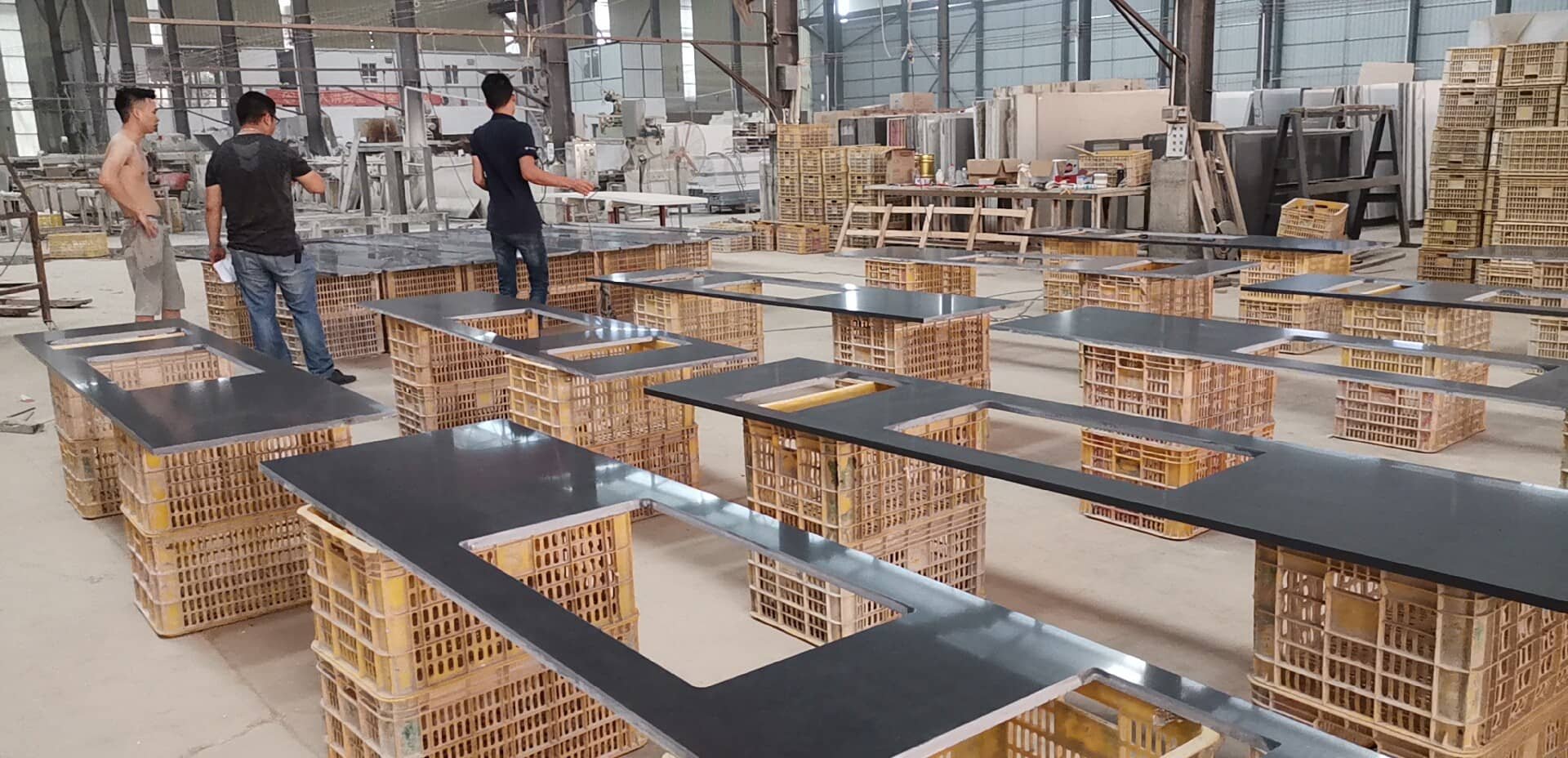
Cut-to-size quartz countertops photographed after fabrication in the workshop.
What is the difference between quartz and solid surface?
ISFA 2-01 (2013) defines solid surface materials as generally consisting of reacted monomers and resins, mineral fillers, and pigments, manufactured in sheets of specific calipers. It describes them as solid, non-porous, homogeneous, and renewable, and, when applicable, able to feature inconspicuous seams. They are free from conspicuous internal strengthening fibers. The standard also notes that many solid surface products can be thermoformed with little or no significant change to their performance properties, and that inconspicuous seams allow built-up edges and hard-to-detect joints.
Formulas vary by brand. DuPont’s Corian Solid Surface product overview describes Corian sheet as about one-third acrylic resin (PMMA) and about two-thirds natural minerals, specifically alumina trihydrate (ATH) derived from bauxite. It also notes that Corian sinks and lavatories use an acrylic-modified polyester resin, so even one brand is not a single recipe. Acrylic, polyester, and blended resins do not thermoform or repair identically. Do not treat every solid surface as if it were Corian, and do not treat every quartz color as if it shared one data sheet.
Engineered quartz is an agglomerated stone. EN 14618:2009 defines agglomerated stone as an industrial product made mainly from hydraulic cement, resin, or a mixture of both, together with stone and other additions. Kitchen and commercial quartz is typically a mineral aggregate bound with a polymer resin. Caesarstone’s technical data manual states that its surfaces “contain up to 90% crushed quartz” plus polyester resins and pigments. Cosentino’s April 2023 Silestone safety data sheet describes that family as 85–95% inorganic mineral fillers, 5–15% polymerized polyester resin, and less than 5% pigments and additives. Those figures are not Aspire Stone’s unpublished formula. If the commercial alternative is a ceramic slab rather than solid surface, see quartz vs porcelain slabs and quartz vs sintered stone.
How do seams, repair, and thermoforming compare?
Seams are often the deciding commercial issue. ISFA 2-01 highlights the ability to join solid surface sheets in an inconspicuous manner. Color runs through the sheet, so a well-executed joint can be difficult to see and remains cleanable. That is why solid surface is widely used for long reception desks, nurse stations, and counters that must look continuous. Engineered quartz can be seamed with color-matched adhesive, but a joint in a veined or large-particle design is usually more visible than a solid-surface joint. Slab size still limits how far a quartz run can go without a seam.
Repair is the second structural difference. ISFA 2-01 describes solid surface as renewable. DuPont states that Corian can be restored with mild abrasive cleaners and a scouring pad, that cigarette burns can often be removed that way, and that deeper cuts or impact damage can usually be repaired on site by an authorized fabricator without replacing the whole top. Minor scratches on some solid surfaces can be sanded and blended. Quartz chips can sometimes be filled with a color-matched resin by a skilled fabricator, but heat scorch, chemical damage, or a broken corner may be harder to hide and may require a section to be replaced. Quartz is not typically renewed by sanding through the thickness in the same way as a homogeneous solid-surface sheet, especially on designs whose pattern is stronger at the face.
Thermoforming is available on many acrylic solid surfaces and more limited on polyester formulations. DuPont describes Corian sheets as thermoformable in wooden or metal molds at controlled temperatures. SolidSurface.com’s fabrication guidance, based on manufacturer practice, notes that acrylic is generally the most flexible when heated, blends are next, and all-polyester material is the least flexible. Engineered quartz is not thermoformed into tight reception curves in that way. Curved quartz work is usually a segmented or built-up construction, not a heated bend.
How do scratch, heat, stain, and chemical behavior compare?
Read the product’s own data. ISFA 2-01 includes boiling-water and high-temperature resistance tests, based on NEMA LD 3 methods, with a “no effect” requirement after a specified cleaning procedure. That is a standard for solid surface as a class, not a license to park a catering pan on the counter. Quartz care guides are stricter on cookware heat. Caesarstone’s UK guidance says the surface should be protected from temperatures above 150°C or 300°F and from sudden temperature changes, and that hot cookware should sit on a trivet. Cosentino’s Silestone manual gives the same practical rule. Heat marks on quartz can be permanent; some heat or burn marks on solid surface can be sanded out, depending on the product and the damage.
On scratches, solid surface is generally easier to refresh but also easier to mark, because it is designed to be machined and renewed. Engineered quartz is typically harder at the surface, though it is not scratch-proof, and the resin between grains is softer than the mineral. Use cutting boards and avoid sharp impact on both. For stains and chemicals, both families are often described as non-porous or very low in absorption. They still have limits. Silestone’s manual warns against paint strippers, high-pH products, and hydrofluoric acid. Corian’s overview emphasizes cleanability and, with proper cleaning, a surface that does not promote mold, mildew, and bacteria growth. Commercial cleaners and disinfectants should be checked against the manufacturer’s chemical-resistance list, not assumed to be safe because the space is a hotel or a clinic.
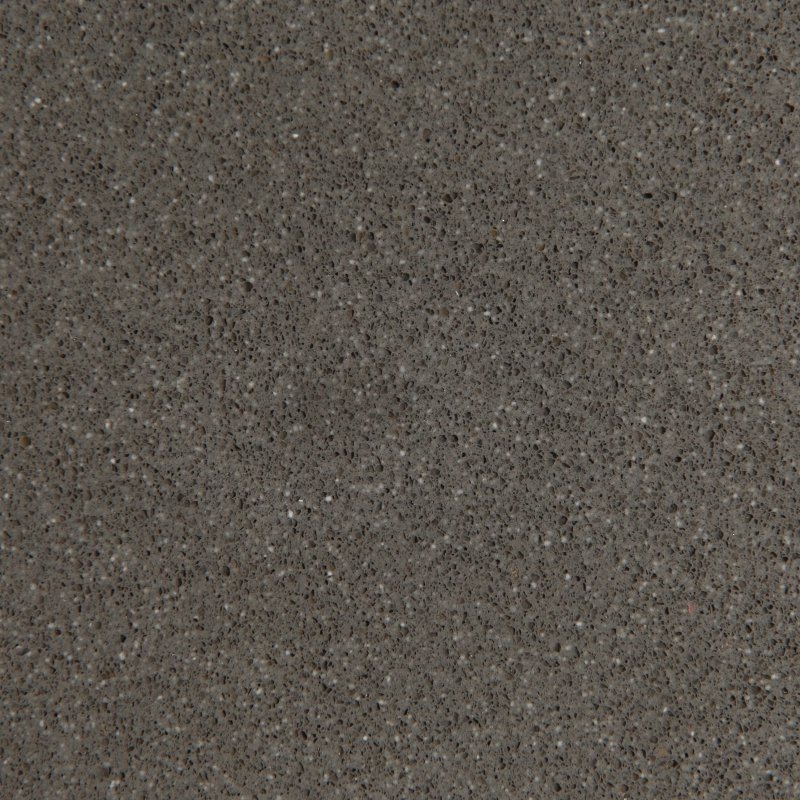
Concrete Gris (P029), a solid-colour engineered quartz design used on commercial and interior worktops.
Which material fits which commercial space?
| Application | Often leans toward solid surface | Often leans toward engineered quartz |
|---|---|---|
| Reception desks and curved feature counters | Inconspicuous seams, thermoformed shapes, and on-site repair | When a stone-like look is required and curves can be built in segments |
| Hotel bathrooms and vanity runs | Integrated bowls and long, cleanable joints | A harder, stone-look top, often with a separate basin, and tighter batch control than natural stone |
| Food-service counters and back-of-house worktops | Sanitary, renewable surfaces and integrated sinks, if the brand is approved for that use | A harder work surface with a natural-stone appearance, if heat and chemicals are managed |
| High-traffic horizontal tops with heavy objects | Easier to refinish, but may mark sooner | Typically more resistant to everyday abrasion, though chips at edges remain a risk |
| Healthcare or other hygiene-led interiors | Widely specified for cleanable, renewable, inconspicuously seamed surfaces | Used where a stone-look, low-absorption top is preferred; confirm cleaners and details |
A longer look at quartz in hotels, restaurants, and commercial interiors is useful once the material family is chosen. For kitchen-like commercial pantries and staff rooms, the same heat and trivet rules that apply in a kitchen quartz specification still apply.
What should a commercial specification check?
- Shape and seams. If the design needs tight curves, coved upstands, or nearly invisible joints, solid surface—especially a thermoformable acrylic grade—is usually the more direct route.
- Repair during the building’s life. Ask how a burn, scratch, or chip will be repaired in situ, and whether the material can be renewed or must be sectioned.
- Heat, chemicals, and food contact. Collect the care guide and any food-contact or chemical-resistance documentation for the exact color. Do not assume a reception-desk product is automatically a commercial-kitchen product.
- Appearance and batch control. Quartz offers a wide stone-look range. Solid surface offers more homogeneous colors and patterns that hide joints. Approve samples under the project lighting.
- Fabrication skill. Solid surface and quartz are different trades. Name the fabricator, the adhesive system, and the edge or sink detail in the specification.
- Support and thickness. Follow the manufacturer’s support rules. Some solid surface sheets need a continuous substrate; quartz spans and overhangs depend on thickness and fabrication.
Aspire Stone manufactures engineered quartz and supplies cut-to-size quartz slabs for commercial projects, including hospitality and multi-unit work, from its Foshan factory. Its published range is quartz, not solid surface. Specify each material on its own merits.
FAQ
What is the difference between quartz and solid surface?
Engineered quartz is a resin-bound mineral slab with a stone-like appearance and typically very low absorption. Solid surface is a homogeneous sheet of resin, mineral filler, and pigments that can be seamed inconspicuously and, in many formulations, repaired or thermoformed. They are different commercial products, not two names for the same material.
Can solid surface be repaired?
Often, yes. ISFA 2-01 describes solid surface as renewable. Many brands can have scratches, some burns, and certain chips sanded or repaired on site. The quality of the repair depends on the resin type, the color, and the fabricator. Quartz repairs are usually more limited.
Which is better for reception counters?
Solid surface is often the more practical choice when the desk must look seamless, include curves, or be repaired in place over years of public use. Engineered quartz is a strong option when the design needs a stone-like surface and the geometry can be built from slabs and seams. Many lobbies use both, in different parts of the desk.
Which material has less visible seams?
Solid surface, when fabricated well, generally has the less visible seam because the material is homogeneous and is joined to be inconspicuous. Quartz seams can be neat and color-matched, but they are more likely to read, especially in veined designs.
Which material handles heat better in a commercial pantry?
Neither should be treated as a cooktop. Quartz care guides typically require trivets and warn that high or sudden heat can leave a permanent mark. Some solid-surface burns can be renewed, but high-temperature abuse is still poor practice. Follow the product’s care guide and the catering equipment layout.
Specifying quartz for a commercial interior?
If the project needs a stone-look, cut-to-size quartz surface for a hotel, restaurant, office, or multi-unit building, Aspire Stone can review drawings and current colors. Send the application and preferred finishes through the contact page.
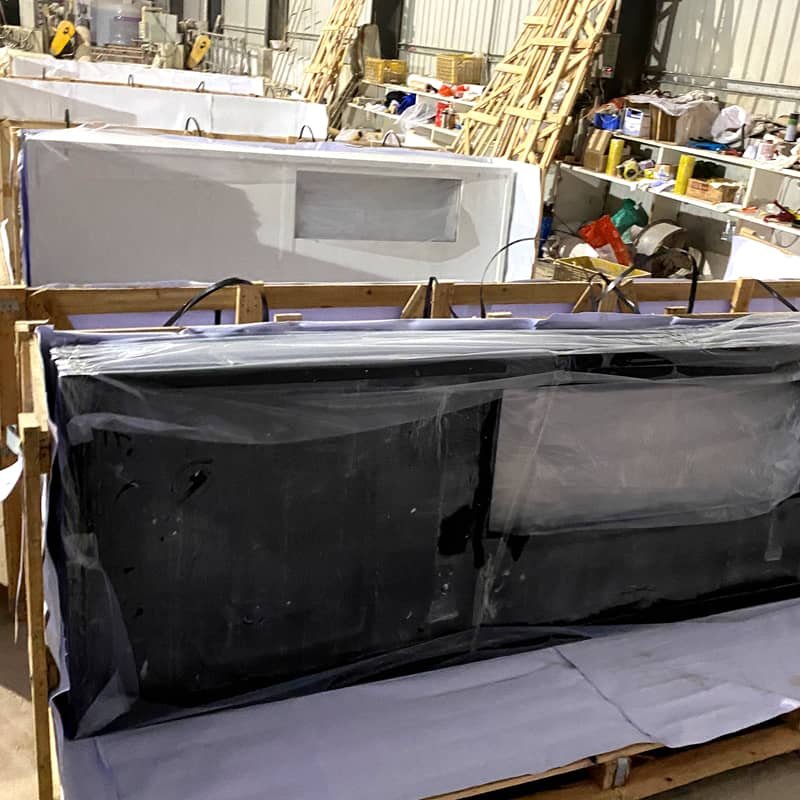
Cut-to-size quartz pieces packed in timber crates at the Foshan workshop.


 WhatsApp
 EMAIL