




Reducing Material Waste in Large Quartz Countertop Projects
Waste in a large quartz countertop project usually comes from layout, undetected defects, cut-outs, forced vein direction, and remnants that are never reused. It is not a single percentage that can be promised in advance. The practical controls are early design coordination, careful nesting on the real slab format, remnant tracking, and, where it helps, a larger sheet or factory pre-cutting. This article sets those controls out in order.
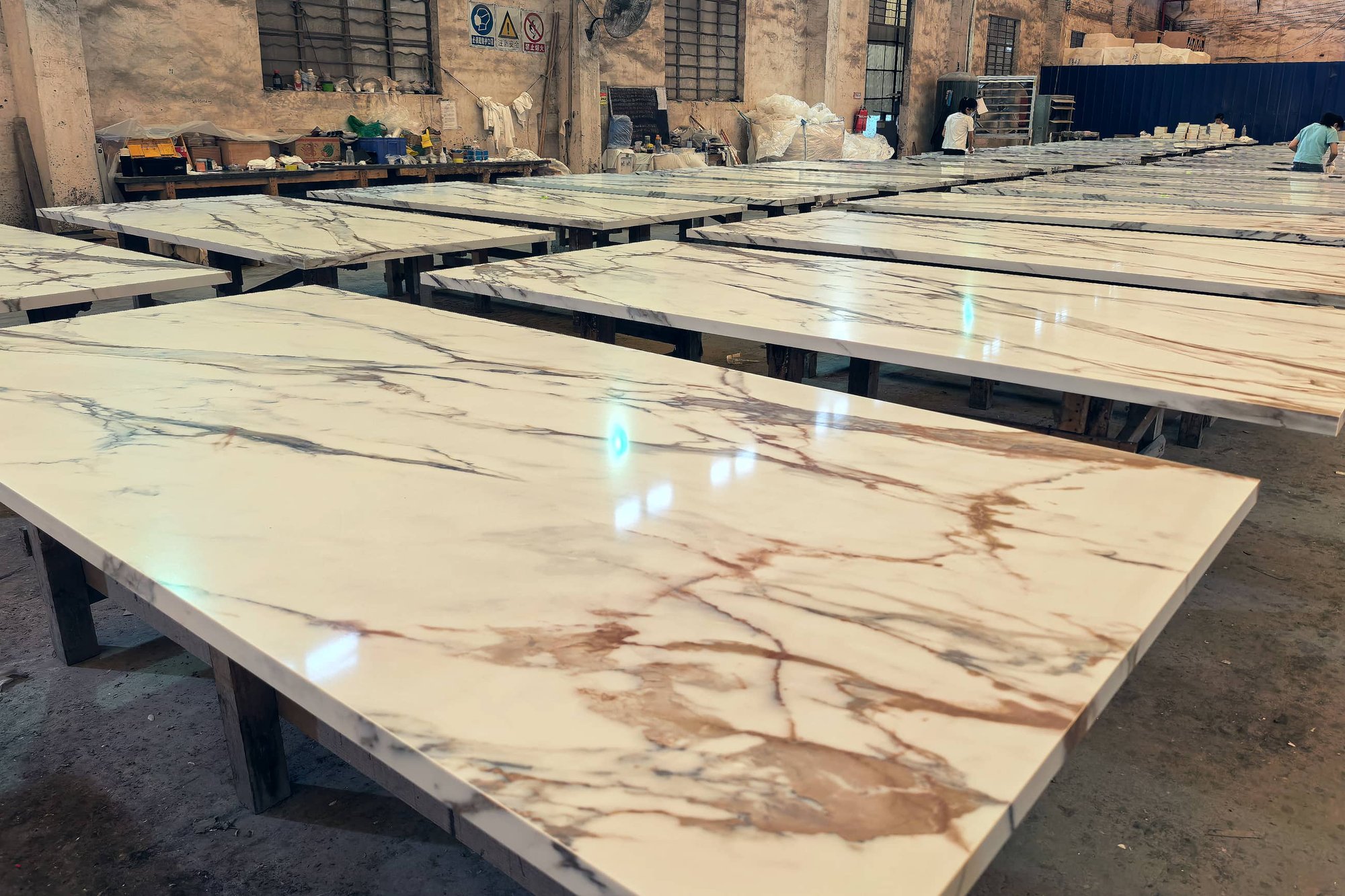
Full slabs laid out in the workshop, the kind of format used when planning cuts.
The notes are for fabrication shops, project purchasers, and cabinet companies. They complement how to measure and calculate quartz slabs, which already includes a hypothetical kitchen example and explains why an area total is not a slab count. This article does not add a new yield figure, and it does not promise a fixed saving.
Where does waste come from on large quartz projects?
Most waste is planned into the job, or missed at inspection, rather than created at the saw by accident.
| Source | What happens | Practical control |
|---|---|---|
| Layout and format | Pieces do not nest on the real slab, even when the total area looks sufficient | Draw the nest on the actual format before the order is placed |
| Factory edge and squaring | A small perimeter band is removed to straighten the slab | Allow for usable size, not only the nominal face |
| Defects and inspection | A pit, crack, gloss mark, or a poor visual match is found after a piece is already cut | Inspect slabs before layout; keep defect areas out of visible faces |
| Cut-outs | Sink, hob, or basin openings destroy a large central area that cannot become another major piece | Place cut-outs so offcuts remain usable where the design allows; do not treat the offcut as a second worktop by default |
| Vein direction and bookmatching | Rotation is locked, or two faces must be cut as a planned pair | Agree pattern rules early; do not optimise the nest in a way that breaks the agreed direction |
| Edges and waterfalls | Laminated edges and mitered waterfall ends need extra strips | Include those strips in the take-off, not as an afterthought |
| Remnants | Usable offcuts are unlabelled, mixed, or forgotten | Measure, label, and inventory remnants against the parent batch |
| Late design changes | An added waterfall, a different sink, or a tighter seam rule invalidates the nest | Recalculate the slab count; do not apply a blanket mark-up |
Caesarstone’s August 2023 Fabrication & Installation Guide, used here as one manufacturer example, tells fabricators to plan rectangular pieces where possible in order to minimise wastage, to allow for a small amount of the outer perimeter to be removed to straighten the edges, and to plan the arrangement of pieces on the slab before cutting. The same guide recommends keeping ends cut from adjoining sections of the same slab butted together, so colour and pattern match at the seam. That advice can increase waste if a more “efficient” nest would rotate a piece against the agreed vein. Appearance and yield have to be balanced in the layout, not after the saw has run.
How do nesting, digital templating, and early design coordination help?
Nesting is the arrangement of finished pieces, including edge strips, on a real slab, with allowance for the blade kerf, for clamping or edge clearance, and for any locked rotation. The only reliable test is a drawing on the actual format. Digital templating helps when the file that goes to the saw is the file that was checked on site, so the nest is not built on assumed square corners. It does not, by itself, reduce waste if the design still forces awkward shapes.
Early coordination is often worth more than a later software pass. The project team can still decide, before the stone is ordered, whether an island should be shortened to avoid a seam, whether a waterfall is required, whether a vein must run in one direction, and whether several typical units can share one nest. On a multi-unit package, repeating a well-nested typical kitchen is more efficient than allowing each unit a slightly different island.
Cross-job nesting — placing a vanity or a splash from another unit on the leftover of a kitchen slab — can use material that would otherwise be remnant, but only if the colour, thickness, finish, and batch match, and only if the vein direction is acceptable. Do not force a mismatch to “use up” a leftover.
Article 27’s hypothetical kitchen shows why the nest matters more than the area sum. In that example, the plan-view area of an L-shaped kitchen plus an island is 6.28 m², which is less than the nominal face of one Super Jumbo slab as described on Aspire Stone’s Super Jumbo page, yet the pieces do not necessarily fit without a seam or a second slab. Adding two mitered waterfall ends then increases the finished faces further and can change the slab count again. Use that worked example rather than a new yield number invented here.
The wider fabrication sequence, including layout before cutting, is described in how to fabricate quartz countertops.
When do jumbo and Super Jumbo formats reduce waste — and when do they not?
A larger slab can reduce waste when a long run or a wide island would otherwise need a seam or a second sheet, or when two major pieces can sit side by side on the extra width. It does not automatically reduce waste. If the leftover is the wrong shape — too narrow for a return, too short for a run, or locked out by vein direction — the extra area is not usable.
Aspire Stone’s Super Jumbo page, fetched 23 November 2026 (Asia/Shanghai), describes regular slabs as commonly around 120 × 56 in, jumbo around 128 × 63 in, and Super Jumbo at 138 × 78 in. Those are that page’s published examples, not an industry-wide standard, and they should not be mixed with other size lines published on product pages without labelling the source. Format choice, and the kinds of island or commercial top that can benefit, are discussed in jumbo and Super Jumbo quartz slabs.
Choose the format from the nest, not from the name. A typical vanity may come from a remnant or from a regular slab. A long reception top or a large island may justify a jumbo or Super Jumbo sheet. A mixed package should be nested before the format mix is frozen, especially on bulk slab supply for multi-unit developments, where one poor format choice is multiplied by the unit count.

Large-format slabs in the factory hall, the kind of format used when a nest is planned to reduce seams or leftover strips.
How should remnants be inventoried and reused?
A remnant is only an asset if someone can find it and trust it. After a nest is cut, record each usable offcut with:
- Length, width, and thickness, measured, not guessed.
- Colour or model code, finish, and parent batch or slab identity.
- A photograph, if pattern direction matters.
- A unique label, kept on the piece and in the inventory.
Reuse remnants first on pieces that can accept them: smaller vanities, upstands, splashes, repair pieces, or samples, provided the batch and the appearance still match. Do not use a remnant from a different batch on a seam that will be seen next to the original work. Do not use a narrow leftover for a structural rail if the manufacturer’s fabrication guide would not allow it.
Set a simple policy: remnants are offered to the next matching job before a new slab is opened, and remnants that cannot be matched within an agreed period are reclassified rather than left to clutter the rack. A policy of that kind is a control, not a promised recovery rate.
How can a supplier or a pre-cut service help?
A slab manufacturer that also cuts to size can help in three practical ways, none of which should be confused with a guaranteed waste saving:
- Commenting on the nest before the slab format and quantity are frozen.
- Offering a format — regular, jumbo, or Super Jumbo — that actually fits the pieces, as published for that range.
- Pre-cutting repeated pieces so that typical units are cut from a planned layout rather than recut on site, where access and dust control are harder.
Aspire Stone’s cut-to-size page, fetched the same day, describes a workshop that both presses and cuts slabs, and it invites buyers to send dimensions for a quote. Factory pre-cutting can reduce site offcuts. It does not eliminate nesting waste; it moves the layout decision into the workshop, where it still has to be done well. The site measure and the final check against cabinets remain the project team’s responsibility.
Project waste-reduction checklist
| Check | What “done” looks like |
|---|---|
| Design freeze | Island size, waterfalls, edges, sinks, and seam rules are agreed before the take-off is frozen. |
| Real format | The nest is drawn on the actual slab size, not only as an area total. |
| Pattern rules | Vein direction and any bookmatching are marked, and the nest respects them. |
| Inspection before cut | Slabs are checked for defects and for visual batch match under agreed lighting. |
| Cut-out planning | Openings are placed with usable offcuts in mind, without forcing a bad pattern match. |
| Remnant inventory | Offcuts are measured, labelled, batched, and offered to the next matching piece. |
| Format choice | Jumbo or Super Jumbo is used where the nest benefits, not by default. |
| Change control | A design change triggers a new nest and a new slab count, not a round percentage. |
| Pre-cut, if used | Factory cutting follows the approved nest; the site still checks the pieces before installation. |
There is no honest universal waste percentage to add at the bottom of this list. Simple rectangular work may need only a small allowance for squaring and handling. Veined, mitered, or tightly constrained layouts need more, sometimes a whole extra slab, as the kitchen example in article 27 illustrates.
FAQ
How can fabricators reduce quartz waste?
By freezing the design early, nesting on the real slab format, inspecting slabs before cutting, locking vein direction only where the design needs it, and labelling remnants so they can be reused on matching pieces. Software can help with the nest; it cannot fix a late waterfall or an uninspected defect.
Does a larger slab reduce waste?
Sometimes. A larger format helps when a long or wide piece would otherwise need a second slab, or when two major pieces will sit side by side. It does not help when the leftover is the wrong shape or the vein direction blocks the leftover. Decide from the nest.
How do you plan slab nesting?
Place the largest constrained pieces first, allow for kerf and edge squaring, lock rotation where veins or bookmatching require it, and test whether remnants will be usable. Then check the layout against support and seam rules. The output should be a drawing, not only a utilisation figure.
Can quartz remnants be reused?
Yes, when they are large enough for the next piece and when the model, thickness, finish, and batch still match. Typical uses are smaller vanities, splashes, and repair pieces. A remnant from a different batch, or one that forces the vein the wrong way, should not be used only to avoid opening a new slab.
Should waste be written as a fixed percentage in the quotation?
No. State the nest, the assumed format, and the allowance as a set of assumptions. If the design changes, recalculate. A single percentage that is honest for a straight run will be misleading for a mitered, veined island.
Does factory pre-cutting eliminate waste?
No. It can reduce unplanned site offcuts and improve the nest for repeated units, but the material still has to be laid out on a real slab. Waste is controlled by that layout, whether the saw is in the factory or in a local shop.
Planning a layout to keep waste under control?
If you have drawings for a typical unit, a commercial package, or a multi-unit take-off, Aspire Stone can review the nest for slab supply or for cut-to-size preparation. Send the drawings through the contact page and say which slab format you intend to use. The workshop can cut from a confirmed layout; it cannot honestly promise a fixed waste-saving percentage.


 WhatsApp
 EMAIL