




Quartz vs Sintered Stone: Composition, Tests and Fabrication
Sintered stone is not engineered quartz. Quartz countertops are resin-bound agglomerated stone. Sintered stone is a market term for large mineral slabs formed by heat and pressure, usually without a polymer resin binder, and often tested with ceramic methods. The two families differ in composition, fabrication, heat and UV behavior, and the standards used to report performance. Compare the actual product’s test data, not the category name.
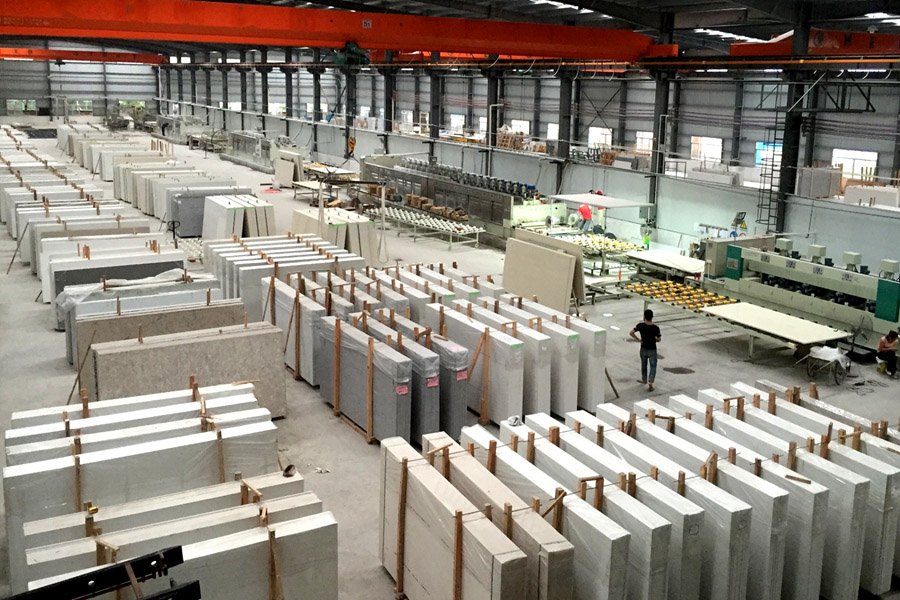
Finished engineered quartz slabs stored vertically at the Aspire Stone factory in Foshan.
Is sintered stone the same as quartz, or the same as porcelain?
No. Engineered quartz is an agglomerated stone. EN 14618:2009 defines agglomerated stone products as industrial products made mainly from hydraulic cement, resin, or a mixture of both, together with stone and other additions, and manufactured by moulding at fixed plants. Kitchen quartz is typically a silica-nature aggregate bound with a polymer resin, then pressed, cured, and finished. Caesarstone’s technical data manual states that its surfaces “contain up to 90% crushed quartz” plus polyester resins and pigments. Cosentino’s April 2023 Silestone safety data sheet describes that family as 85–95% inorganic mineral fillers, 5–15% polymerized polyester resin, and less than 5% pigments and additives. Those figures are product-specific, not Aspire Stone’s formula.
Sintered stone, sometimes sold as ultra-compact surface or, in some markets, as 岩板, is made from mineral raw materials compacted and fired or sintered at high temperature. Cosentino’s Dekton technical manual describes a mineral mixture that reacts at high temperature and “does not contain resins or organic additives.” That statement belongs to Dekton, but it illustrates the binder difference that matters: a resin matrix versus a ceramic, sintered body.
The word “sintered” is not a single ISO product class. Many of these slabs are tested to ceramic methods and may be classified as porcelain Group BIa under ISO 13006 or EN 14411 when water absorption, measured by ISO 10545-3, is 0.5% or less. Laminam’s environmental product declaration, for example, places its ceramic slabs in Group BIa. A quartz vs porcelain slab comparison covers that ceramic terminology in more detail. Neither sintered stone nor porcelain is a resin-bound quartz slab.
Which test methods should buyers compare?
Engineered quartz is commonly reported against the EN 14617 series for agglomerated stone (including water absorption, flexural strength, abrasion, thermal shock, impact, and chemical resistance) and, on some data sheets, against ASTM methods such as ASTM C97. ISFA 3-01 is a quartz-surfacing performance standard that references ISFA and NEMA methods for cleanability, light resistance, boiling-water resistance, and high-temperature resistance, among other properties.
Sintered and porcelain slabs are commonly reported against the ISO 10545 ceramic series and classified under ISO 13006 or EN 14411. Typical methods include ISO 10545-3 (water absorption), ISO 10545-4 (modulus of rupture and breaking strength), ISO 10545-9 (thermal shock), ISO 10545-12 (frost), ISO 10545-13 (chemicals), and ISO 10545-14 (stains). Cosentino’s Dekton technical data sheet is explicitly written to EN 14411, ISO 13006, ANSI A137.1, and ANSI A326.3, and it states that the figures come from periodic tests on representative products in accredited external laboratories.
Do not treat a number from one standard as if it were measured by the other. Flexural strength by EN 14617-2 and flexural resistance by ISO 10545-4 are both useful, but they are not automatically the same test. Ask for the standard, the thickness, the finish, and the date of the report that belongs to the color you are buying.
How do heat, UV, absorption, and “strength” compare?
Heat and UV. The resin in engineered quartz is the usual weak point. Caesarstone’s UK care guidance says the surface should be protected from temperatures above 150°C or 300°F and from sudden temperature changes, and that hot cookware should sit on a trivet. Cosentino’s Silestone manual says not to place recently heated objects directly on the surface, and not to install it outdoors or in direct UV. Cosentino’s Dekton countertop care guide says recipients such as frying pans and saucepans from domestic use can be placed directly on the work surface, except that 8 mm Dekton requires protection against hot objects, and open flame or intense radiation should still be avoided. Dekton’s data sheet also reports a pass, with no damage, in EN ISO 10545-9 thermal-shock testing and EN ISO 10545-12 frost testing for the families listed. Those results are Dekton’s published data, not a guarantee for every sintered slab.
Water absorption. Cosentino’s Dekton sheet reports 0.1% water absorption (Ev) by EN ISO 10545-3 for the families in that document, with 0.2% open porosity. Laminam reports E ≤ 0.1% by EN ISO 10545-3 for the thicknesses in its 2022 EPD. Quartz absorption, when published, is typically reported by EN 14617-1 or ASTM C97 and should be read from the quartz product’s own sheet. Low absorption is not stain-proof in either family.
“Which material is stronger?” Strength is not a single number. Hardness, flexural strength, breaking strength, and impact toughness describe different behaviors. Cosentino’s Dekton data sheet reports flexural resistance around 48–55 N/mm² (MPa) by EN ISO 10545-4, depending on family and thickness, with breaking strength rising in thicker formats. As a quartz example, Santa Margherita publishes 40–60 MPa flexural strength by EN 14617-2 for its SM Quartz Caledonia range, and a Vicostone environmental product declaration reports flexural strength greater than 40 MPa by EN 14617-2 for that family. Those figures cannot be ranked as a universal “sintered is stronger than quartz” result, because the products, thicknesses, and methods differ. Sintered and porcelain slabs can also be more brittle at sharp edges and in thin gauges, which is a toughness issue rather than a flexural-strength issue.
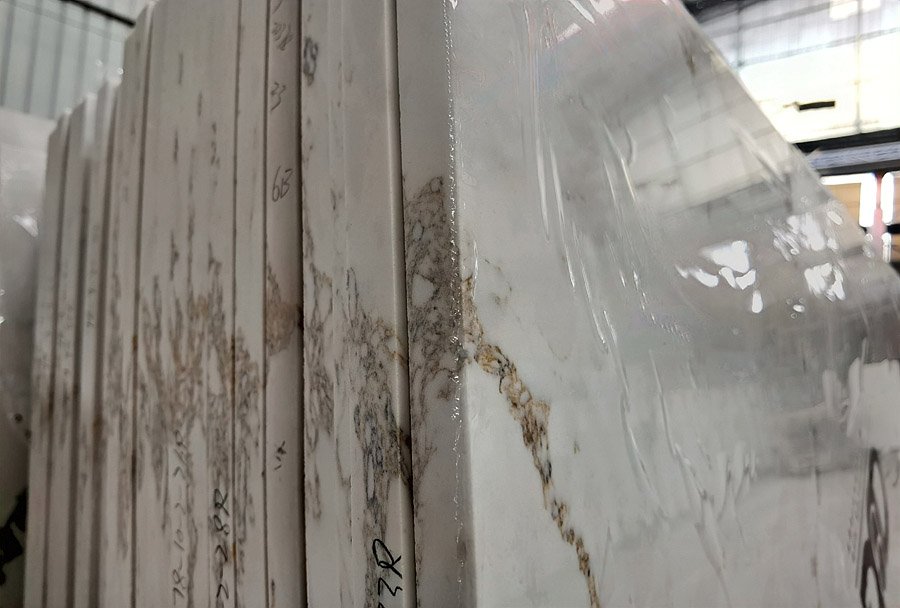
Close-up of a factory-finished slab face and cut edge.
Which material is easier to cut, drill, and polish?
Engineered quartz is usually the more familiar material in a stone workshop. It can be cut with stone tooling, and edges can be profiled and polished to the finished looks common on kitchen countertops. Cut-outs, seams, and laminated edges follow established quartz practice, with the usual caveats about support and silica-dust controls.
Sintered and porcelain slabs generally need product-specific diamond tooling, lower feed rates, continuous support, and careful handling. Laminam’s fabrication guidance calls for suitable porcelain tools, water cooling, a flat, vibration-free support, and test cuts on samples. Sharp edges are a known chip risk; Laminam recommends a minimum 2 mm bevel, and Cosentino’s Dekton worktop guidance favors relieved or rounded exposed edges. Drilling and cut-outs are possible, but they are easier to get wrong in thin formats. Polishing a ceramic edge to a traditional stone profile is not the same operation as polishing resin-bound quartz.
If the project needs many shaped edges, a waterfall, or a fabricator who mainly processes quartz and granite, that constraint belongs in the decision. If the project needs outdoor panels or a very heat-tolerant worktop, the extra fabrication discipline may be justified. For commercial interiors that also consider solid surface, see quartz vs solid surface.
A buyer checklist by project type
| Project type | Questions to settle before choosing | Often leans toward |
|---|---|---|
| Indoor kitchen with profiled stone edges | Who will fabricate the edges, and is a trivet policy acceptable? | Engineered quartz, if interior use is confirmed |
| Outdoor kitchen, facade, or strong UV | Is there frost, UV, and system data for this exact product? | A documented sintered or porcelain slab |
| Heavy cookware heat on the worktop | What does that brand’s care guide allow at the chosen thickness? | Often sintered or porcelain, subject to the care guide |
| Thin, very large wall or furniture panels | What thicknesses and handling rules are published? | Often a large-format sintered or porcelain slab |
| Replacement of an existing quartz kitchen | Do seams, thickness, and edge style need to match the current work? | Engineered quartz, if the original details should be repeated |
- Name the product, not only the category. “Sintered stone” and “quartz” are families. Ask for the brand, color, thickness, and finish.
- Collect the right standards. For quartz, request EN 14617 or the stated ASTM / ISFA methods. For sintered or porcelain slabs, request ISO 10545 results and the ISO 13006 or EN 14411 group, if claimed.
- Read the care guide for heat and UV. Do not copy one brand’s hot-pan rule onto another product.
- Confirm who can fabricate it. Ask the shop about tooling, edge details, breakage allowance, and previous work in that material.
- Match the application. Interior kitchens, outdoor kitchens, and commercial counters have different priorities. A kitchen quartz slab buying guide is useful if quartz is the chosen family.
Aspire Stone’s published catalog is engineered quartz, including the series in its quartz slab series. The company does not present sintered stone as a public product line on the pages fetched for this article. Specify quartz on its own data, and specify sintered slabs on theirs.
FAQ
Is sintered stone the same as quartz?
No. Engineered quartz is a resin-bound agglomerated stone. Sintered stone is a heat-and-pressure mineral slab, usually without a polymer resin binder, and it is often tested as a ceramic product. They should be specified under their own names and their own test methods.
Which material is stronger?
It depends on the property, the thickness, and the product. Flexural values published for some sintered slabs and some quartz slabs can overlap, but the test methods are not automatically the same. Sintered and porcelain slabs may be very hard and still chip at sharp edges. Ask for named test results rather than a slogan about strength.
Can sintered stone withstand heat?
Many sintered or porcelain worktops are documented for higher domestic heat than resin-bound quartz. Dekton’s care guide allows many hot utensils on the surface, except 8 mm material, and still warns against open flame and intense radiation. That is product-specific. Conventional quartz still needs a trivet.
Which is easier to cut and polish?
For most stone workshops, engineered quartz is easier to cut, profile, and polish with familiar stone tooling. Sintered slabs can be cut and finished, but they usually need ceramic-specific tools, handling, and edge details. The easier material is the one the assigned fabricator can process reliably.
Can sintered stone and quartz be mixed in one project?
Yes, if the uses are planned—for example, a quartz indoor kitchen and a documented sintered surface on an outdoor counter. Treat them as different materials for fabrication, care, thickness, and seams, and approve each from its own samples and data.
Need data for an engineered quartz specification?
If the indoor project is leaning toward quartz, Aspire Stone can share current colors and cut-to-size options from its Foshan factory. Send the application, thickness, and any test methods you need listed through the contact page.
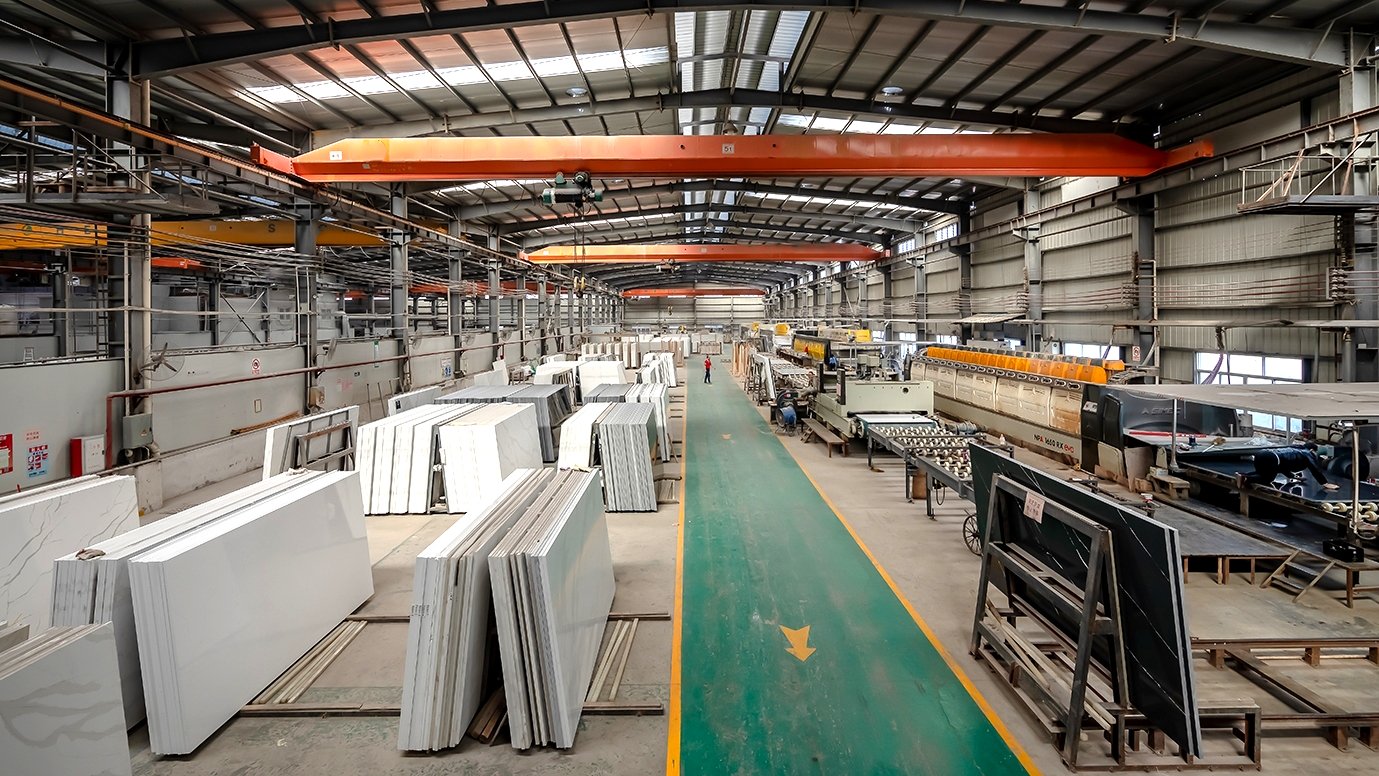
Slab storage and handling beside the production line at the Aspire Stone factory.


 WhatsApp
 EMAIL