




Specifying Quartz Surfaces for Hotels, Restaurants and Commercial Interiors
The best quartz surface for a hotel, restaurant, or other commercial interior is the one that can be repeated, cleaned, and documented for that use — not a single “best” color. Reception desks, guest vanities, bar tops, and back-of-house counters have different wear and compliance needs. Food-contact, fire, and building-code requirements apply only where they are verified for the exact product and jurisdiction.
What do hospitality and commercial interiors actually require?
Commercial work rewards surfaces that look the same from one floor, guest room, or fit-out package to the next, and that can be maintained by a housekeeping or facilities team rather than by a specialist polisher. Design consistency, cleanability, resistance to ordinary impact and traffic, and a clear replacement path matter as much as the initial look. A feature pattern that is charming in a private kitchen can become a matching problem when fifty vanities have to read as one design.
ISFA 3-01 (2013) describes quartz surfacing as used in commercial bathrooms and food-preparation areas as well as residential kitchens and baths, and it characterizes the material as hard and non-porous, with simple cleaning for a wide range of potential stains. That is a category description. It does not make every commercial cleaner suitable, and it does not replace project specifications, mock-ups, or current test reports.
Aspire Stone’s About page states that the company supplies cut-to-size quartz for residential, commercial, hospitality, and multi-unit projects, and lists typical uses as kitchen countertops, vanity tops, bar tops, and kitchen islands. The cut-to-size page says the factory supplies developers, contractors, fabricators, and installers for villas, hotels, apartments, and school dormitories. Those are published customer and application types, not named hotel case studies.
Where is quartz typically used in hotels, restaurants and retail?
In hotels, quartz is commonly considered for reception and concierge desks, guest-room and public-washroom vanities, bar and breakfast-counter tops, and selected back-of-house worktops. In restaurants and cafés, it may be used for service counters, bar tops, wait stations, and, where the specification requires it, food-related work surfaces that have been checked against the relevant listing or code. In retail and office interiors, it appears on reception desks, display counters, and washroom vanities.
Each location should be specified on its own terms. A guest vanity is closer to the bathroom conditions described in how to choose quartz countertops for bathroom vanities. A bar top may see alcohol, citrus, and heavy glass traffic. A restaurant prep surface may trigger food-equipment rules that a lobby desk does not. For the wider application map, see the main applications of quartz slabs. Hotel-development planning is also covered in choosing quartz slabs for hotel and hospitality developments, and larger residential packages in how to specify quartz surfaces for large residential projects.
Color choice in public spaces often favors a mid-contrast design that hides ordinary wear without looking dirty when a vein is interrupted by a cut-out. Very dark, high-gloss tops can show smears under downlights; very white, open fields can show every cup ring if housekeeping is inconsistent. Those are practical design observations, not stain-proof claims. Color-family shortlisting can follow the same method used in best quartz countertop colors for modern kitchens. For material comparisons in commercial work, see quartz versus solid surface for commercial projects.
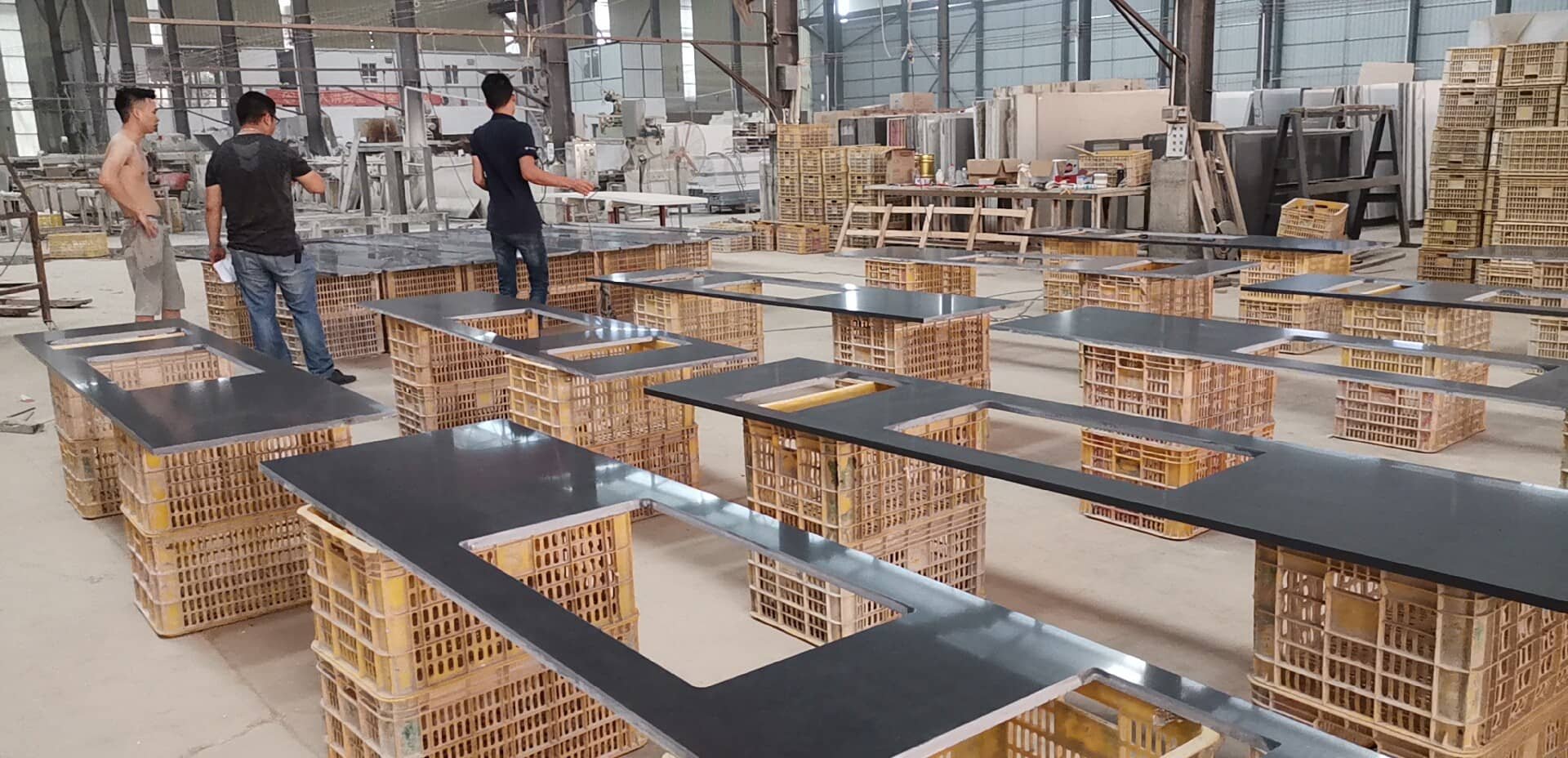
Cut-to-size quartz worktops in the Aspire Stone workshop.
How do consistency, cleaning, chemicals and traffic affect the specification?
Repeatability starts with a named model and a batch plan, not with a generic color description. Engineered quartz is generally more consistent than natural stone, but shade and pattern can still vary between lots. On a multi-floor hotel or a restaurant chain, agree whether later phases must match the first delivery, and keep an approved retain sample and lot photographs.
Cleaning chemicals are a frequent source of damage in commercial buildings. Caesarstone’s care guidance warns against prolonged contact with high- or low-pH products and lists oven cleaners, floor strippers, toilet-bowl cleaners, oil soaps, and drain products among the products to avoid, with immediate rinsing if contact occurs. Cosentino’s Silestone care manuals similarly recommend mild or pH-balanced routine cleaning and caution against harsh or highly alkaline products. Facilities teams should be given a written method and a short approved-cleaner list, and they should test any new product in an inconspicuous area first. Housekeeping should not assume that a disinfectant used on ceramic or stainless steel is automatically suitable for quartz.
Impact and point loads still matter. Quartz is a hard, brittle surfacing material; an unsupported overhang, a badly placed seam, or a heavy settlement at a bar rail can crack a top that would otherwise clean well. Traffic itself is usually a question of edges, corners, and how often hard objects are set down, not of “wearing through” the slab like a soft floor finish.
When do food-contact and fire or building-code requirements apply?
They apply when the project or the jurisdiction says they do, and they apply to a specific listed product — not to engineered quartz as a class, and not automatically to every color from a factory.
NSF/ANSI 51 is the standard commonly used in North America for food-equipment materials. NSF explains, in industry guidance associated with that standard, that materials may be listed for a food zone, a splash zone, or a non-food zone, and that a food-zone listing is the relevant one for surfaces intended for direct food contact. The only official source for current listings is NSF’s online listing directory. A product that is merely described as non-porous is not, by that fact, NSF/ANSI 51 listed. Aspire Stone product and series pages fetched on 23 November 2026 do not publish an NSF/ANSI 51 listing. If a restaurant or hotel kitchen specification requires one, the buyer should check the current official NSF listings for the exact product and conditions of use, or specify a product that is already listed and provide that documentation.
Fire and building-code requirements are equally product- and jurisdiction-specific. Reaction-to-fire or flame-spread evidence, where it is required, is typically provided as a current test report for a named product and a defined use (for example, a wall lining versus a horizontal worktop). Common test frameworks include ASTM E84 and EN 13501-1, but a classification from one method, or from another manufacturer’s data sheet, cannot be borrowed. Aspire Stone pages fetched on the same date do not publish a fire classification. This article does not assign one.
Local health, accessibility, and building rules still sit above a catalog page. The specification should name the intended use, the documents required, and the party responsible for checking them.
What should bulk buyers request before production?
Commercial orders go more smoothly when the packet is complete before slabs are pressed or allocated. That packet usually includes the model name and code, finish, thickness, quantities by area (reception, typical guest vanity, public washroom, bar, and so on), drawings or templates for cut-to-size pieces, a mock-up or first-article approval, a batch-matching rule for later phases, packing and labeling requirements, and the test reports the project actually needs.
Aspire Stone’s cut-to-size page describes a 4,000 sq.m workshop with infrared cutting, water jet, and edge polishing, and a team of 50 skilled workers handling cutting, polishing, sink-hole cutting, lamination, and mitered edges. The company also presses the slabs. That combination can shorten coordination on hospitality packages, but lead time, capacity, and a project-specific quality plan still have to be agreed. Custom pieces from drawings are discussed further in custom quartz countertops from drawings to delivery.
Commercial project selection checklist
| Item | What to confirm |
|---|---|
| Use by location | Reception, guest vanity, public washroom, bar, restaurant service, or back-of-house — each with its own wear and compliance needs. |
| Named model and finish | Exact series, color code, and finish, approved from a retain sample and current lot photographs. |
| Quantity and phasing | Piece counts by room type, spare tops if required, and whether later phases must match the first lot. |
| Drawings and mock-up | A typical vanity, desk, or bar as a first-article approval before the full run is cut. |
| Seams, edges and support | Seam locations, edge build-up, and cabinet or steel support for long desks and bar tops. |
| Cleaning method | A written housekeeping method and a short list of approved cleaners, tested on a sample. |
| Food-contact documents | Only if the use requires them: a current official listing for the exact product, such as NSF/ANSI 51 food zone where that standard applies. |
| Fire or building-code documents | Only if the use or jurisdiction requires them: a current test report for the exact product and intended installation. |
| Packing and identification | Labels that keep room types, floors, and batches identifiable on site. |
| Replacement path | How a damaged top will be remade and whether a small hold-back quantity is needed. |
FAQ
Is quartz suitable for hotel countertops?
Yes, engineered quartz is commonly specified for hotel desks, vanities, and bar tops because it can be supplied in a repeatable design and cleaned as part of ordinary housekeeping, provided the model, batch, and care method are agreed. Suitability still depends on the location, the support and fabrication details, and any project-specific documents. Aspire Stone lists hotels among the customer types it supplies, but that is not a named project reference.
What surfaces work for restaurant counters?
Service counters and bar tops often use engineered quartz for appearance and cleanability. Surfaces intended for direct food preparation may need a current food-equipment materials listing, such as NSF/ANSI 51 food-zone listing where that standard is specified. Non-porosity alone does not create that listing. Confirm the intended use of each counter before copying a front-of-house color into a prep line.
How do you specify stone for a hotel project?
Name the use by room type, then lock the model, finish, thickness, quantities, drawings, a mock-up, a batch-matching rule, packing labels, and only those compliance documents the project actually requires. Approve a typical guest vanity or desk before the full quantity is cut. Keep a retain sample so later replacements or phases can be matched as closely as the material allows.
What should bulk buyers request?
They should request current lot photographs, a retain sample, a first-article or mock-up approval, a written batch plan, fabrication drawings, packing and labeling details, and copies of any test reports or listings required by the specification. They should also agree how damage replacements will be handled. Price and lead time should be taken from a quotation, not from a catalog page.
Specify the use, then the surface
If you are planning a hotel, restaurant, or other commercial package, start with the room-by-room uses, then shortlist a named quartz model that can be supplied consistently. Aspire Stone publishes hospitality and multi-unit cut-to-size work on its cut-to-size and About pages, and the factory can be contacted with drawings and quantities. For the next level of hotel briefing, continue with choosing quartz slabs for hotel and hospitality developments.


 WhatsApp
 EMAIL