




Quartz vs Porcelain Slabs: A Practical Selection Guide
Engineered quartz and porcelain slabs are both manufactured work surfaces, but they are not the same material. Quartz is a resin-bound agglomerated stone, typically used indoors, with a familiar stone-shop fabrication route. Porcelain slabs are fully vitrified ceramic surfaces, often chosen where heat, UV, or outdoor exposure matters more. “Sintered stone” is a related market term, not a synonym for quartz, and it should be defined before it is specified.
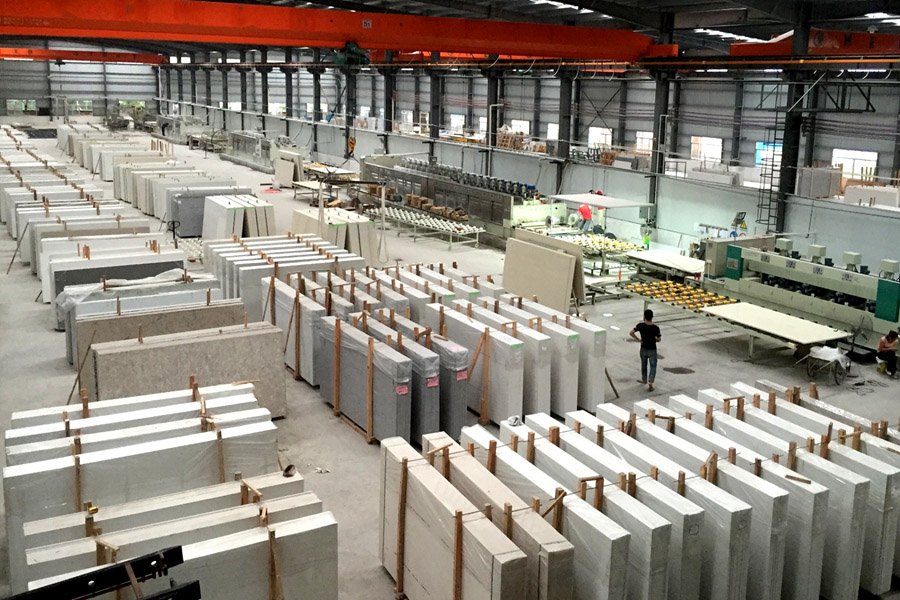
Finished engineered quartz slabs stored vertically at the Aspire Stone factory in Foshan.
What is a porcelain slab, and how does it differ from sintered stone?
ISO 13006 defines a ceramic tile as a thin slab made from clays and/or other inorganic raw materials, usually shaped and then fired. It defines porcelain tile as a fully vitrified tile with a water absorption coefficient less than or equal to 0.5% by mass, belonging to groups AIa and BIa. Water absorption is measured by ISO 10545-3. Dry-pressed tiles with absorption of 0.5% or less are Group BIa. Large-format “porcelain slabs” used as worktops are typically specified in that porcelain group, but the classification belongs to the tested product, not to the marketing name.
“Sintered stone” is widely used as a trade name for large mineral slabs formed under heat and pressure without a polymer resin binder. Some brands describe their products as sintered, ultra-compact, or porcelain stoneware. Environmental declarations for products such as Laminam’s ceramic slabs place them in Group BIa of EN 14411 / ISO 13006. Cosentino’s Dekton data sheet is written to EN 14411, ISO 13006, and related ceramic test methods. The terms overlap in the market; they are not interchangeable with engineered quartz. A deeper comparison of quartz and sintered stone follows this article. If the alternative is natural stone, start with quartz vs granite.
How are engineered quartz and porcelain slabs made?
Engineered quartz is an agglomerated stone. EN 14618:2009 defines agglomerated stone products as industrial products made mainly from hydraulic cement, resin, or a mixture of both, together with stone and other additions, and manufactured by moulding at fixed plants. Kitchen quartz is typically a mineral aggregate—often crushed quartz—bound with a polymer resin, then pressed, cured, and finished. Caesarstone’s technical data manual states that its surfaces “contain up to 90% crushed quartz” plus polyester resins and pigments. Cosentino’s April 2023 Silestone safety data sheet describes that family as 85–95% inorganic mineral fillers, 5–15% polymerized polyester resin, and less than 5% pigments and additives. Those figures are not Aspire Stone’s unpublished formula.
Porcelain slabs are ceramic: a mineral body is formed, usually by dry pressing, then fired at high temperature until it vitrifies. There is no polyester resin binder in a true porcelain body. Decorative veins or graphic designs may sit in the body or in a surface layer, depending on the product. Because the binder systems differ, heat, UV, and edge-finishing behavior should not be copied from one family to the other.
How do heat, UV, stains, and impact compare?
Compare published test methods and care guides for the actual product. Do not infer one brand’s results from the material category alone.
Heat. The resin in engineered quartz is the usual weak point. Caesarstone’s UK care guidance says the surface should be protected from temperatures above 150°C or 300°F and from sudden temperature changes, and that hot cookware should sit on a trivet. Cosentino’s Silestone manual gives the same practical rule. By contrast, Cosentino’s Dekton countertop care guide says frying pans, saucepans, and similar utensils from domestic use can be placed directly on the work surface, except that 8 mm Dekton needs protection against hot objects, and open flame or intense radiation should still be avoided. That is Dekton’s published guidance, not a rule for every porcelain slab. Ask for the care document that belongs to the slab you are specifying.
UV and outdoor use. Silestone’s care manual says not to place that quartz surface outdoors or anywhere exposed to direct UV rays. Unless a quartz product is designed and warranted for outdoor exposure, treat it as an interior material. Porcelain classified in Group BIa is a low-absorption ceramic; ISO 10545-12 is the frost-resistance test often cited for outdoor ceramic use. Manufacturers of large porcelain or sintered slabs commonly document facade, terrace, or outdoor-kitchen uses. Confirm frost, UV, and installation details for the specific product and climate.
Water absorption and stains. Methods differ by family. Agglomerated stone is often tested to EN 14617-1; ceramic slabs are tested to ISO 10545-3, with stain resistance under ISO 10545-14 and chemical resistance under ISO 10545-13. Laminam’s environmental product declaration reports average water absorption of E ≤ 0.1% by EN ISO 10545-3 for the Laminam thicknesses listed there, within Group BIa. Cosentino’s Dekton technical data sheet reports 0.1% water absorption by EN ISO 10545-3 for the families in that sheet. Quartz data sheets that publish EN 14617-1 or ASTM C97 figures should be read the same way: as that product’s results. Low absorption is not stain-proof on either surface.
Impact and edges. Hard, thin ceramic slabs can chip at sharp edges if they are struck. Laminam’s furnishing technical guide recommends a minimum 2 mm bevel to improve impact behavior at the edge. Cosentino’s Dekton worktop design guidance likewise favors relieved or rounded exposed edges rather than a sharp, unprotected arris. Engineered quartz can also chip at corners, cut-outs, and thin overhangs. Neither material is impact-proof.
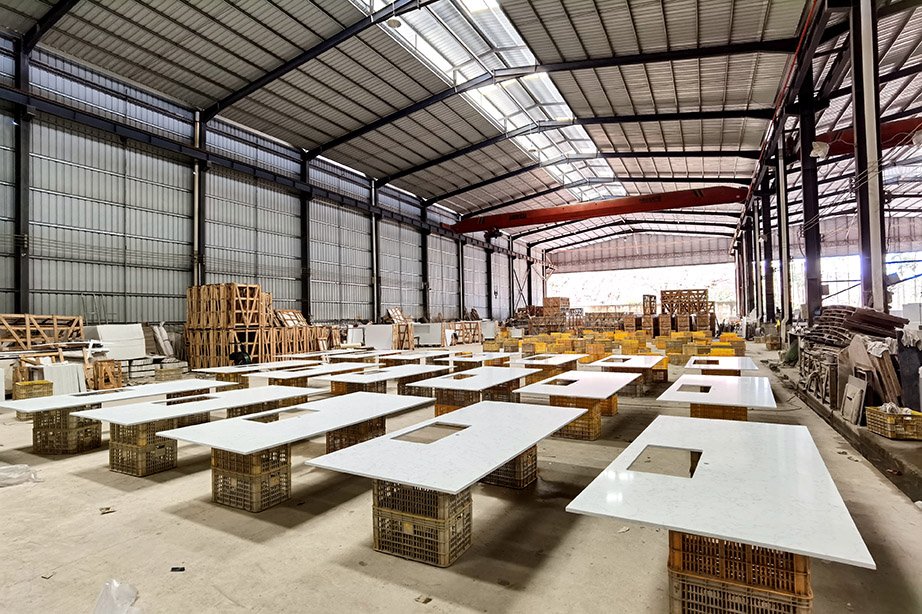
Kitchen countertops photographed after cut-to-size work in the Aspire Stone workshop.
Which is easier to fabricate, and how do sizes differ?
Most stone workshops already cut, polish, and seam engineered quartz with bridge saws, CNC tools, waterjets, and edge polishers used for other stone. Edges can be profiled and polished to a finished look that is familiar on kitchen countertops. That familiarity is a practical advantage, not a claim that quartz is effortless. Cut-outs still need support, and crystalline-silica controls still apply when the slab is cut.
Porcelain and sintered slabs usually need product-specific tooling, lower feed rates, continuous support, and careful handling, especially in thinner gauges. Laminam’s fabrication guidance calls for suitable porcelain tools, water cooling, a flat, vibration-free support, and test cuts on samples. Edge building, mitered corners, and cut-outs are possible, but they are a different skill set than polishing a resin-bound quartz edge. If a project needs many complex edges or a local shop has little porcelain-slab experience, fabrication risk and lead time should be priced honestly.
Formats also differ by brand. Ceramic slabs are often offered in large, relatively thin sheets (including 6 mm, 12 mm, and 20 mm ranges, depending on the maker). Engineered quartz for kitchens is commonly supplied around 20 mm and 30 mm, though other gauges exist. ISFA 3-01 notes that quartz surfacing is generally available in 1.2 cm, 1.5 cm, 2 cm, and 3 cm thicknesses, among others. Confirm the current size and thickness for the product, not a category average. A companion article on quartz slab sizes, thicknesses, and finishes covers quartz formats in more detail.
Which surface should you specify?
| Project need | Often leans toward engineered quartz | Often leans toward porcelain slabs |
|---|---|---|
| Indoor kitchen with familiar stone-shop fabrication and polished edges | Yes, if heat is managed with trivets and the product is specified for interior use | Possible, if the fabricator is experienced with ceramic slabs |
| Outdoor, facade, or strong-UV worktop | Only if that quartz product is documented for outdoor use | Often a better starting point, subject to the product’s frost, UV, and installation data |
| Frequent hot pans or adjacent cooking heat | Use trivets; resin can be marked by high or sudden heat | Often more heat-tolerant; still follow that product’s care guide |
| Thick, traditional stone-edge profiles | Usually easier in 20 mm or 30 mm quartz | Possible with laminated or mitered edges; requires ceramic-slab skill |
| Very large, thin panels or some wall and furniture uses | Depends on the quartz format offered | Large thin ceramic slabs are widely documented for these uses |
Aspire Stone’s published range is engineered quartz, including the series listed in its quartz slab series, plus cut-to-size quartz slabs for kitchens, vanities, and commercial interiors. The company does not present porcelain or sintered slabs as part of that public catalog. A kitchen quartz slab buying guide is the next step if quartz is the chosen family.
FAQ
Is porcelain better than quartz?
Not for every project. Porcelain slabs often have an advantage where heat, UV, or outdoor use is the deciding factor, provided the product’s data supports that use. Engineered quartz is often easier for a stone workshop to edge and seam, and it is widely used for indoor kitchens. Choose from the actual product data and the fabrication plan, not from the category name.
Which is more heat resistant?
Fired or sintered ceramic surfaces are generally more tolerant of domestic cookware heat than resin-bound quartz, but the limit is product-specific. Caesarstone advises protecting its quartz from temperatures above 150°C or 300°F and from sudden temperature change. Dekton’s care guide allows many hot utensils on the surface, except 8 mm material, and still warns against open flame. Ask for the care guide that belongs to the slab.
Can porcelain slabs be used outdoors?
Many porcelain and sintered slabs are documented for outdoor or facade use when they meet low-absorption and frost-resistance tests such as ISO 10545-12. That is not automatic for every ceramic slab or every installation system. Conventional indoor quartz should not be assumed to be outdoor-safe.
Which is easier to fabricate?
For most stone workshops, engineered quartz is the more familiar material to cut, polish, and seam. Porcelain slabs can be fabricated well, but they usually need product-specific tools, handling, and edge details. Experience, tooling, and the complexity of the edges matter more than a slogan about which material is “easier.”
Is sintered stone the same as porcelain?
Not exactly, and neither is quartz. Many sintered or ultra-compact slabs are tested and classified with ceramic methods and may fall in porcelain Group BIa, but the marketing names are not a standard classification. Ask how the product is classified (for example, ISO 13006 / EN 14411 group) and which tests were run.
Specifying an indoor quartz surface?
If the project is an interior kitchen, vanity, or commercial counter, Aspire Stone can share current engineered-quartz colors and cut-to-size options from its Foshan factory. Send drawings and performance questions through the contact page.
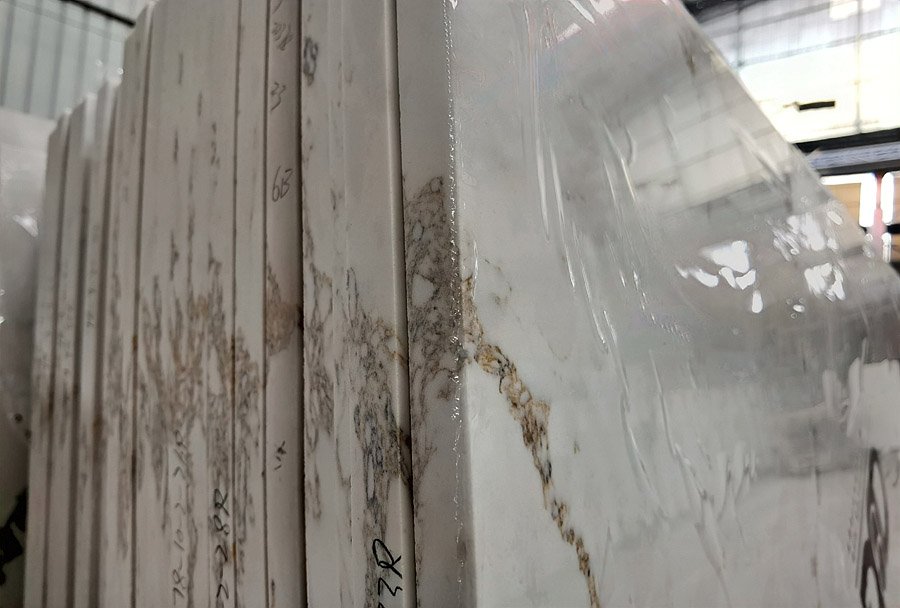
Factory-finished slab faces and cut edges after production.


 WhatsApp
 EMAIL