




What Is the Difference Between Quartz Stone and Natural Quartz?
In the surface trade, “quartz stone” usually means an engineered slab made from crushed mineral aggregate bound with resin. Natural quartz is a mineral — silicon dioxide — that occurs as crystals, veins and a constituent of many rocks. They share an ingredient, not a product category. Quartzite, a natural metamorphic rock, is a third material and should not be treated as either of the first two.
What is natural quartz, the mineral?
The U.S. Geological Survey defines a mineral as a naturally occurring inorganic element or compound with an orderly internal structure and characteristic chemical composition, crystal form and physical properties. Quartz is one of the common minerals it names, alongside feldspar, mica and calcite.
The University of Minnesota’s Common Minerals guide describes quartz as silicon dioxide (SiO2), with a Mohs hardness of 7 and a specific gravity of about 2.6 to 2.65. It is usually clear or white, though impurities can produce colors such as amethyst, rose quartz or smoky quartz. Quartz is abundant in the Earth’s crust: it is a significant component of many granites, hydrothermal veins and sandstones, and it is chemically and physically stable at surface conditions.
That geological meaning is precise. A quartz crystal, a vein of milky quartz, or the quartz grains in a sandstone are all natural quartz. They are not, by themselves, the large finished sheets sold for kitchen worktops.
What is engineered quartz stone?
Engineered quartz, also called engineered stone or, in European standards language, a type of agglomerated stone, is a manufactured surface. Factories combine crushed mineral aggregate — often ground quartz — with a polymer resin, pigments and additives, then form, compact, cure and finish the mix into a slab. How quartz slabs are made covers that process in more detail. The finished product is a composite: it contains natural mineral particles, but the slab itself is made in a plant, not sawn from a single geological mass.
European standard EN 14618 describes agglomerated stone as an industrial product made mainly of hydraulic cement, resin, or a mixture of both, together with stone and other additions, and moulded in geometrical shapes at a fixed plant. Most quartz kitchen slabs use a resin binder.
This is why engineered quartz is not a natural stone in the sense used for granite, marble or quartzite. It may contain a high proportion of natural mineral by weight, but the binder, pigments and factory process make it a manufactured product. For a fuller definition of the category, see what quartz stone is.
Aspire Stone produces engineered quartz slabs, including Calacatta and Carrara and veined designs, as well as solid colors and printed surfaces. Those pages describe manufactured quartz slabs for interiors, not mineral specimens and not quarried quartzite.
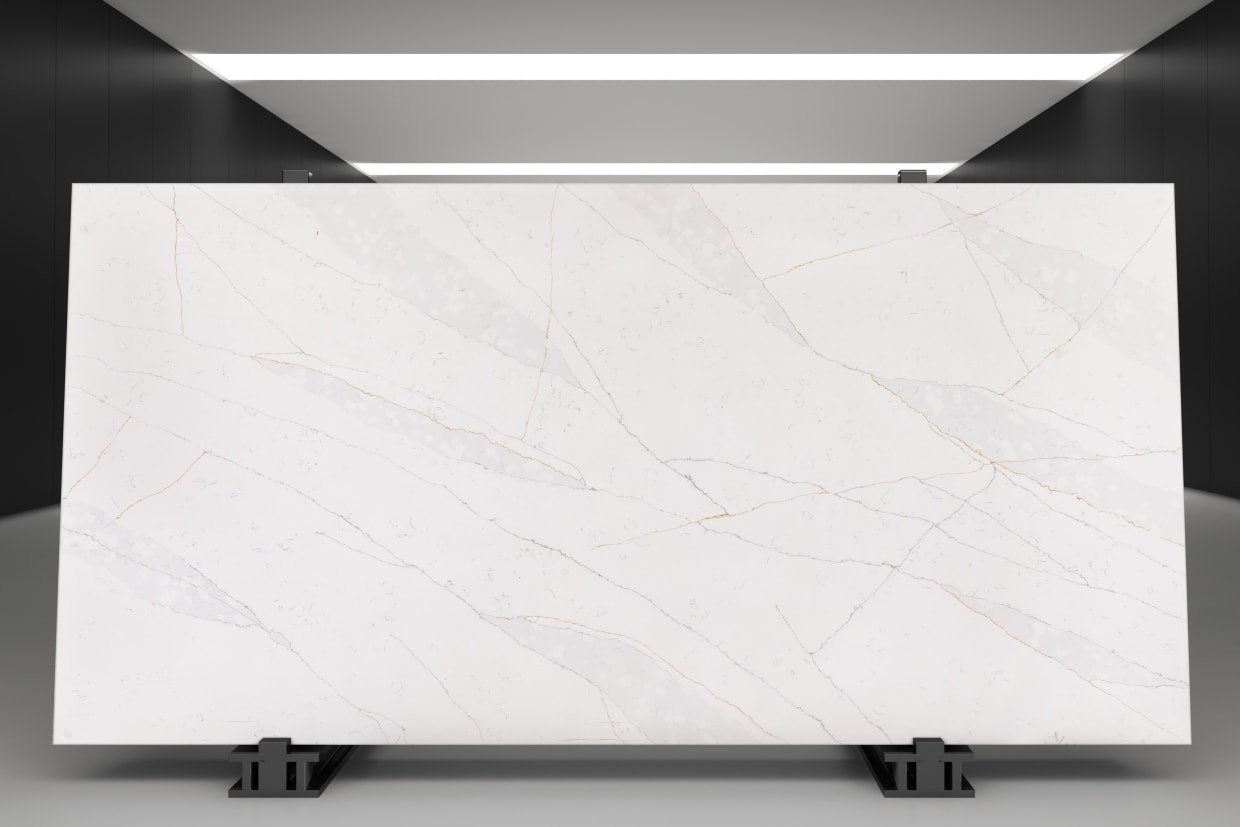
A Calacatta-look slab such as Calacatta Fresh (G047) is an engineered quartz design, not mineral quartz or natural marble.
How do mineral specimens differ from engineered slabs?
The difference becomes clear when you compare format and use.
Natural quartz is commonly sold as crystals, clusters, tumbled stones or decorative specimens. It also occurs as a component inside rocks that are later quarried. Engineered quartz is supplied as large, relatively thin slabs in factory-set lengths, widths and thicknesses, ready to be cut into countertops, vanities and similar interior surfaces.
Appearance is controlled in different ways. The look of a mineral specimen depends on crystal growth and geological impurities. The look of an engineered slab is designed in the factory, through pigment, aggregate selection, veining or printing. That is why a Calacatta-look quartz slab can be repeated across a production run in a way that a unique crystal or a unique natural-stone block cannot.
Hardness figures can also be misread. Mineral quartz ranks 7 on the Mohs scale, but an engineered slab is a composite of hard particles in a resin matrix. The finished surface can be durable in kitchen use, yet it is not identical to a solid piece of mineral quartz, and it is not scratch-proof.
What is the difference between quartz, quartzite and granite?
Three similar names cause most of the confusion.
Quartz, in the geological sense, is the mineral described above.
Quartzite is a rock, not a mineral. The USGS thesaurus defines quartzite as a granoblastic metamorphic rock consisting mainly of quartz and formed by recrystallization of sandstone or chert through regional or thermal metamorphism. In other words, quartz-rich sedimentary rock was buried, heated and recrystallized into a new, interlocking stone. Use Natural Stone, the Natural Stone Institute’s educational campaign, stresses that quartzite is 100% natural and is often incorrectly used as a synonym for engineered quartz. The two materials are not interchangeable. Quartzite is quarried and sawn into slabs. Engineered quartz is manufactured. Many quartzite slabs can be used outdoors; conventional resin-bound quartz generally cannot, a point taken up later in this series when applications are discussed.
Granite is also a rock. The USGS describes a rock as an aggregate of one or more minerals, and names granite among common rocks. Commercial granite used for countertops is a natural igneous (or commercially similar) stone that typically contains quartz together with feldspar and other minerals. It is quarried, not mixed with resin in a factory. For a practical worktop comparison, see quartz vs granite.
Marble is different again: a metamorphic carbonate rock, not a quartz-rich silicate. Marble-look engineered quartz is a design category, not a piece of marble. That distinction is covered in quartz vs marble and in what Carrara quartz is.
Why is engineered quartz called quartz?
The trade name comes from the main mineral aggregate used in many formulas, not from the idea that the finished sheet is a quarried block of pure quartz. Manufacturers and plant suppliers describe slabs as being made largely of crushed quartz or other mineral aggregates bound with polyester resin. The word “quartz” on a product label is therefore a shorthand for an engineered surface that typically contains that mineral, not a claim that the slab is a natural quartz crystal or a quartzite block.
This shorthand is useful when everyone in the conversation already knows the category. It is misleading when a buyer hears “quartz” and assumes the sheet is either a natural stone slab or a solid mineral specimen. The safer reading is: engineered quartz is a manufactured agglomerated surface whose principal aggregate is often the mineral quartz.
Other product names can add to the mix-up. “Calacatta quartz” and “Carrara quartz” refer to marble-look designs in engineered quartz, not to Italian marble blocks. “Low-silica” and “silica-free” describe formulation goals related to crystalline silica content; they are not synonyms for natural quartz, and a low-silica product is not automatically a silica-free product.
How should buyers read product descriptions?
The table below is a practical terminology check for quotations, data sheets and sample labels.
| Term you may see | What it usually means | What it does not mean |
|---|---|---|
| Natural quartz / mineral quartz | The mineral SiO2, often as crystals, veins or a component of rocks | A factory-made kitchen slab |
| Quartz stone / engineered quartz / engineered stone | A manufactured slab of mineral aggregate bound with resin (or, in some agglomerated products, cement) | A quarried block of pure quartz, or quartzite |
| Quartzite | A natural metamorphic rock made mainly of recrystallized quartz | Engineered quartz; a mineral specimen |
| Granite | A natural rock aggregate, typically containing quartz plus other minerals | An engineered quartz surface |
| Calacatta / Carrara quartz | Engineered quartz designs that recall those marble looks | Natural Calacatta or Carrara marble |
| Low-silica / silica-free quartz surface | An engineered surface specified with a reduced, or claimed-zero, crystalline silica content | A natural mineral, or proof that fabrication risk has disappeared |
When a specification or a sample is unclear, ask the supplier to state the product category in plain terms: engineered quartz, natural quartzite, granite, marble, porcelain or another named material. Then confirm composition claims, test methods and intended interior or exterior use against that category.
If you are reviewing Aspire Stone products, start from the product categories and treat each series as engineered quartz unless a page clearly states a different material. For design shortlists, the Calacatta series and Carrara and veined series are manufactured marble-look slabs, not natural marble or mineral quartz crystals.
FAQ
Is quartz stone the same as natural quartz?
No. In trade use, quartz stone usually means an engineered slab. Natural quartz is the mineral silicon dioxide. Engineered slabs often contain crushed natural quartz, but the finished sheet is a manufactured composite, not a mineral specimen.
Is engineered quartz a natural stone?
No. It is a factory-made agglomerated surface. It can contain a high proportion of natural mineral aggregate by weight, but the resin binder, pigments and moulding process place it outside the natural-stone category used for granite, marble and quartzite.
What is the difference between quartz and quartzite?
Quartz is a mineral. Quartzite is a natural metamorphic rock made mainly of quartz that has been recrystallized from sandstone or chert. Engineered quartz is a third category: a manufactured resin-bound slab. The three terms should not be used interchangeably.
Why is engineered quartz called quartz?
Because many formulas use crushed quartz as the main aggregate. The name describes a typical ingredient, not a claim that the slab is a quarried piece of solid mineral quartz or a quartzite block.
Can a kitchen “quartz slab” be a natural quartz crystal?
Not in any normal commercial sense. Mineral quartz is supplied as crystals, veins or a constituent of rocks. The large sheets sold for kitchens are engineered surfaces, or, if they are natural stone, they are more likely to be quartzite, granite or another quarried rock — and those should be named as such.


 WhatsApp
 EMAIL