




What Drives the Wholesale Price of Quartz Slabs?
The wholesale price of a quartz slab is not one industry figure. It moves with the design and formulation, the thickness and format, the finish, the order quantity, packing and freight, the Incoterms rule, duties where they apply, and the currency of the quotation. This article explains those cost drivers qualitatively. It does not publish an industry average or an Aspire Stone price list.
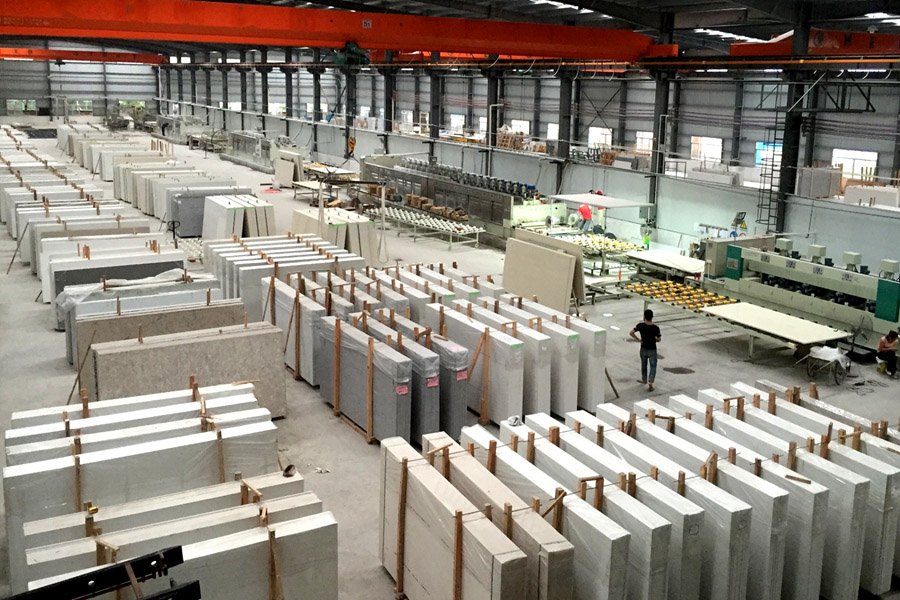
Several quartz designs and formats stored together at the Aspire Stone factory. No prices or stock counts are shown.
Why do quartz slab prices vary so widely?
Engineered quartz is a manufactured product, but it is not a commodity with a single benchmark price. Two slabs can share a thickness and still differ in the complexity of the design, the raw-material mix, the amount of inspection and packing required, and the commercial terms attached to the quotation. A useful comparison starts by holding those variables constant. Sizes, thicknesses, and finishes are summarised in quartz slab sizes, thicknesses, and finishes.
Which product factors move the price?
Raw materials are the first group of drivers. A typical engineered-quartz slab is made from mineral aggregate bound with a polymer resin, plus pigments and, in some designs, decorative glass or other inclusions. The exact formula is a factory matter and is not published here as an Aspire Stone composition. What a buyer can observe is that more demanding visual designs, tighter colour control, or special aggregates usually cost more to produce than a simple solid colour, because they use more process steps or more carefully selected inputs.
Design and manufacturing complexity sit next to the formula. A large-scale Calacatta-style vein, a printed or heat-transfer design, or a full-body pattern that must remain consistent through the thickness is a different production task from a uniform field colour. That does not make one type “better” in every project, but it does help explain why quotations for different series are not interchangeable.
Thickness and format affect both the factory cost and the landed cost. A thicker slab uses more material and weighs more, so freight and handling rise with it. A larger sheet can reduce seams on an island or a commercial top, but it can also change packing, container planning, and the risk of handling damage. Published jumbo and super jumbo examples, and why those labels are not one industry size, are discussed in jumbo and super jumbo quartz slabs. Confirm the actual size and thickness on the quotation, rather than assuming a catalogue label.
Finish also matters. A polished face, a honed face, or a textured finish is a different process and a different visual standard. Honed or textured surfaces can show marks differently in use; that is a specification choice, not automatically a reason for a lower or higher price, but it should be named in the quote so you are not comparing different products.
Custom work adds its own costs. Cut-to-size tops, sink openings, laminated or mitered edges, and special packing for finished pieces require workshop time and create a different waste and risk profile from whole slabs. Inspection intensity, whether in-house or by a third party, is another cost that should appear in the commercial terms rather than being assumed.
How do order volume, packing, freight, and currency come into the price?
Order quantity often changes the factory’s production and packing plan. A larger run of one colour can be more efficient to press, finish, and load than many small mixed colours. That is a qualitative statement only. This article does not publish a minimum order quantity, a volume discount table, or an Aspire Stone threshold, because those figures are commercial and have not been confirmed for publication.
Packing and freight are a large part of what an importer actually pays. Slabs ship in A-frames or crates whose packed weight includes timber, steel, protection, and dunnage as well as the stone. Ocean freight is usually constrained by container payload and by how the frames fit, not only by a unit price per square metre. A method for planning that load, without a fixed piece count, is in how to calculate a quartz slab container load. Insurance follows the allocation of risk in the contract.
Currency and payment terms affect the cash cost even when the quoted unit price is unchanged. A quotation in one currency, a delayed shipment, or a deposit-and-balance structure all change the importer’s effective cost. Those items should be visible in the quote, not left as verbal side agreements.
What do EXW, FOB, CIF, and related Incoterms change in a quotation?
Incoterms® 2020, published by the International Chamber of Commerce, allocate delivery, risk, and certain costs. They do not set the price, and they do not replace a complete sales contract. The same factory slab can be quoted on different terms and look like a different product if you compare the numbers without reading the rule.
| Rule (Incoterms® 2020) | Typical effect on what the quoted price includes | Buyer caution |
|---|---|---|
| EXW (named place) | The seller makes the goods available at a named place, often the factory. Loading and export clearance are not, under the rule itself, the seller’s obligations. | The buyer should budget inland haulage, export formalities, and loading risk, or agree a different rule such as FCA if the seller will load. |
| FCA (named place) | The seller delivers to the carrier, and loads if delivery is at the seller’s premises. Export clearance is the seller’s task where it applies. | Often a better fit than FOB when goods are handed over at a container terminal. |
| FOB (named port of shipment) | The seller delivers on board at the named port of shipment and clears for export. Risk transfers on board. This rule is for sea or inland waterway transport. | The ICC notes that FOB is not the best fit when goods are handed to a carrier before they are on board, which is common in container trade. |
| CFR / CIF (named port of destination) | The seller contracts for carriage to the named destination port. Under CIF, the seller also provides minimum insurance; Institute Cargo Clauses (C) is the CIF default. Risk still transfers on board at shipment. | CIF insurance is limited unless the parties agree a higher cover. Freight and insurance in the price do not mean the seller bears transit risk all the way to arrival. |
| CPT / CIP (named place of destination) | Rules for any mode, including container movements to an inland place. CIP requires a higher default level of insurance cover than CIF (Institute Cargo Clauses (A) or similar). | Name the place precisely. “CIP warehouse” without an address leaves costs and risk unclear. |
Always write the rule, the version, and the named place or port on the quotation, for example “FOB Nansha Incoterms® 2020.” A price that says only “FOB” or “CIF” without a place is incomplete. The official ICC page and the U.S. International Trade Administration’s Incoterms overview are starting points; they are not a substitute for the rule text the parties adopt in the contract.
How do duties and taxes affect the landed cost?
Import duty, any safeguard or trade-remedy duty, and destination taxes such as VAT, GST, or HST are part of the importer’s landed cost even when they do not appear on the factory invoice. Classification, rates, and additional measures vary by destination and by date. Illustrations for selected jurisdictions, checked on 23 November 2026, are in how to import quartz slabs from China. This article does not repeat those figures as a price, and it does not invent an “average duty” or a single landed-cost percentage.
How should you compare like-for-like quotations?
Place quotations side by side only when the following items match, or when you have adjusted for the differences in writing:
- Colour or sample reference, and whether the quote is for a specific batch range
- Nominal length, width, and thickness, and any stated tolerances
- Finish
- Quantity, and whether the goods are whole slabs or cut-to-size pieces
- Packing method
- Incoterms® rule, version, and named place or port
- Currency, payment terms, and validity of the quote
- Inspection, claims, and documents included
If one supplier quotes EXW and another quotes CIF, the lower number is not automatically the better offer. Convert both to a comparable basis, or ask both parties to requote on the same rule, before you decide.
What should a request for quotation include?
A complete brief produces a price you can use. At a minimum, send the colour or a sample reference; the length, width, and thickness; the finish; the quantity; the destination port; and the Incoterms rule and version you want quoted. Add whether you need whole slabs or cut-to-size pieces, any inspection requirement, and the documents your market will need. The table below is an editorial RFQ checklist, not an Aspire Stone form.
| Information to send | Why it changes the quotation |
|---|---|
| Colour or sample reference | Design complexity and raw-material choices differ by colour and series. |
| Size and thickness | Material content, weight, packing, and container planning all change. |
| Finish | Polished, honed, or other finishes are different process items. |
| Quantity and product form | Whole slabs and cut-to-size pieces are priced and packed differently. |
| Destination port | Freight, insurance, and later duty or tax calculations depend on the route. |
| Incoterms rule, version, and named place | These decide which costs are inside the quoted price. |
| Inspection and documents | Third-party inspection, special packing, or extra documents add cost and time. |
FAQ
How much do quartz slabs cost wholesale?
There is no single verified wholesale price that can be published here. Any useful figure has to be tied to a colour, size, thickness, finish, quantity, destination, Incoterms rule, and date. If you need a number, request a quotation with those details, rather than relying on an undated “industry average.”
Why do quartz slab prices vary?
They vary because the product, the commercial terms, and the logistics vary. Design, thickness, format, finish, order mix, packing, freight, insurance, duties, currency, and the Incoterms rule all move the figure the importer eventually pays.
Does thickness affect price?
Usually, yes. A thicker slab uses more material and is heavier to pack and ship, so both the factory price and the freight can rise. The difference is not a fixed percentage, and it should be read from a like-for-like quotation rather than assumed.
What is included in a quartz slab quotation?
Only what the quotation and the named Incoterms rule say is included. Check whether packing, inland haulage, export clearance, ocean freight, insurance, and inspection are inside the price or extra, and whether the goods are whole slabs or cut-to-size pieces.
Can I compare two quotes on unit price alone?
Not reliably. A lower unit price on different terms, a different thickness, or a different packing specification is not a saving until you have restated both offers on the same basis.
Request a like-for-like quotation
To obtain a quotation from Aspire Stone, send the colour, size, thickness, quantity, destination port, and Incoterms rule, together with the finish and whether you need whole slabs or cut-to-size pieces. Use the Contact page, or write to [email protected] (Mr. Lin, +86 135 0025 4616).


 WhatsApp
 EMAIL