




Australia’s Engineered Stone Ban: Definitions, Import Controls and Buyer Checks
Australia prohibits the manufacture, supply, processing, and installation of engineered-stone benchtops, panels, and slabs, and it prohibits importing those goods except in narrowly defined cases. The legal definition, the 1% crystalline-silica threshold, and the split between work health and safety duties and customs controls must be read in the current official text. This article summarises sources fetched on 23 November 2026. It is not legal advice and not medical advice.
What is the legal framework, and when did it take effect?
On 13 December 2023, work health and safety ministers agreed to ban the use, supply, and manufacture of engineered stone from 1 July 2024. Safe Work Australia’s official ban page states that, on that date, the Commonwealth and all states and territories implemented amendments making it an offence for a person conducting a business or undertaking (PCBU) to carry out, or to direct or allow a worker to carry out, work involving the manufacture, supply, processing, or installation of engineered stone benchtops, panels, or slabs.
Safe Work Australia is a national policy body, not the workplace regulator in each jurisdiction. Its page states that implementation may vary slightly from place to place. Buyers should confirm the position with the WHS regulator in the state or territory where the work will be done.
Separately, from 1 January 2025, engineered stone benchtops, panels, and slabs became prohibited imports under regulation 5M of the Customs (Prohibited Imports) Regulations 1956. That regulation remained in force in Compilation No. 147, compilation date 13 July 2026, authorised version F2026C00751, fetched on 23 November 2026. The WHS prohibition and the import control are complementary; satisfying one does not automatically satisfy the other.
Safe Work Australia’s July 2025 review (PDF posted December 2025) concluded that, at that early stage, the prohibition was operating as intended. It recommended nationally recognised testing criteria, among other actions. An implementation plan last updated in September 2026 records those follow-up actions as ongoing.
What is banned under Australia’s engineered stone rules?
The ban, as described by Safe Work Australia, applies only to engineered stone benchtops, panels, or slabs. A product must be in one of those forms and must meet the legal definition. For the purposes of the model WHS Regulations, Safe Work Australia states that engineered stone is an artificial product that:
- contains at least 1% crystalline silica as a weight/weight concentration, and
- is created by combining natural stone materials with other chemical constituents (such as water, resins, or pigments), and
- becomes hardened.
The August 2025 definition fact sheet uses the equivalent wording “contains 1% or more crystalline silica, determined as a weight/weight (w/w) concentration.” A result of exactly 1% should not be treated as a loophole. Engineered stone, on the same official pages, does not include:
- concrete and cement products
- bricks, pavers, and other similar blocks
- ceramic wall and floor tiles
- sintered stone (provided it does not contain resin)
- porcelain products (provided they do not contain resin)
- roof tiles
- grout, mortar, and render
- plasterboard
The fact sheet also states that natural stone benchtops, panels, or slabs (for example, a granite benchtop) are not prohibited. Safe Work Australia’s examples of products that are not prohibited include an artificial stone benchtop, panel, or slab that contains less than 1% crystalline silica; a porcelain or sintered stone benchtop, panel, or slab that does not contain resin; and finished products such as garden ornaments, sculptures, or kitchen sinks, because they are not benchtops, panels, or slabs and are not intended to be further processed for use or installation.
A trade name such as “porcelain,” “sintered stone,” “low-silica,” or “silica-free” is not a classification. If a product contains resin, or otherwise meets all three parts of the definition, the exclusion may not apply. Official wording is not identical on every government page: a Department of Employment and Workplace Relations page fetched on the same day still describes the porcelain and sintered-stone exclusion without the resin proviso and still describes the import ban in prospective language, even though regulation 5M has commenced. Importers should prefer the current legislation and the current Safe Work Australia explanation, and should ask the relevant regulator if a product sits near a boundary.
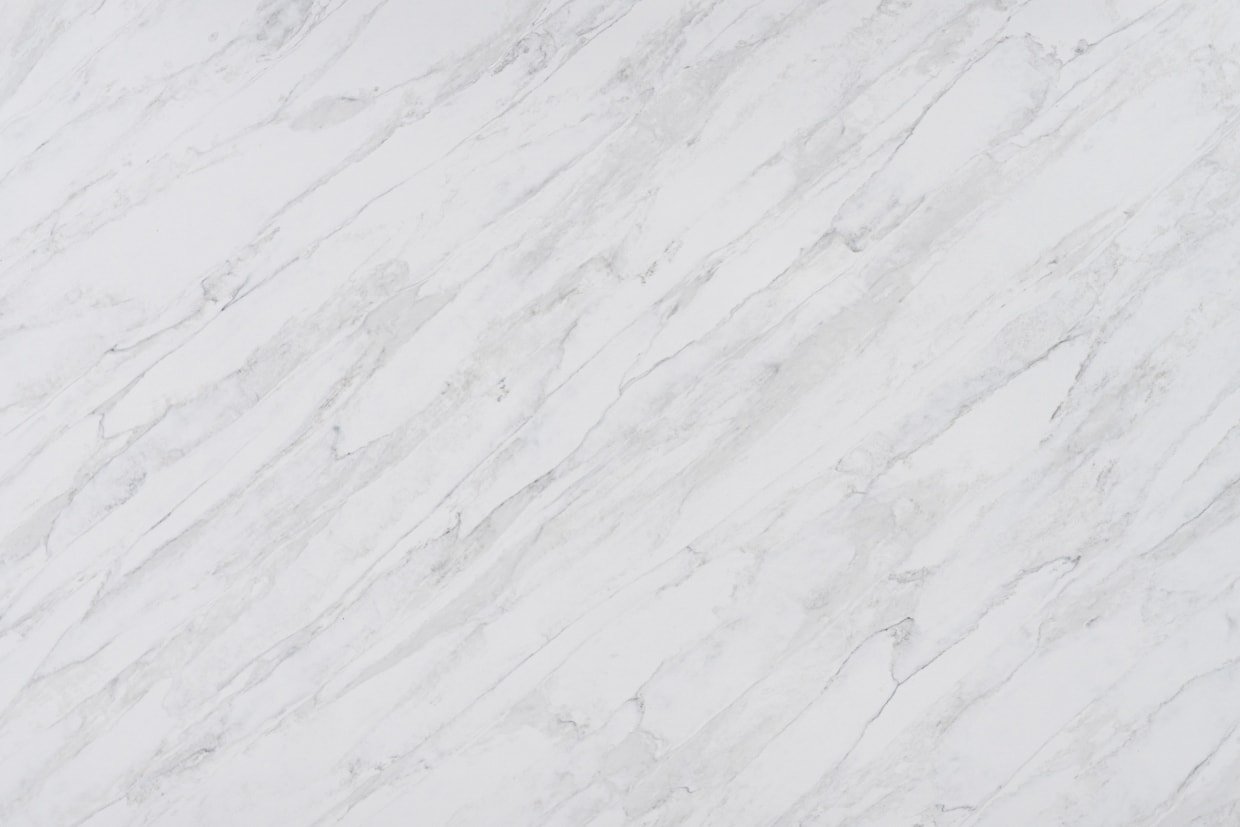
Bianca Gloria, a named model from Aspire Stone’s live series pages. The caption is the model name only and is not a compliance or silica-content claim.
How do manufacture, supply, processing, and installation differ from import controls?
The WHS prohibition is about work: manufacture, supply, processing, or installation of engineered stone benchtops, panels, or slabs. Limited legacy work, and some research and sampling work, are treated separately below.
The import prohibition is about bringing goods across the border. Regulation 5M prohibits importation of engineered stone in the form of benchtops, panels, or slabs unless one of the following applies, and the relevant document is produced to a Collector on request at or before importation:
- the Work Health and Safety Minister or an authorised person has granted permission in writing
- Comcare has confirmed in writing that the proposed use is for genuine research and analysis, or to sample and identify engineered stone, and is permitted under the Work Health and Safety Act 2011 (Cth)
- a state or territory authority, in the jurisdiction where the goods are to be used, has confirmed in writing that the proposed use is for one of those same research or sampling purposes
- the importation is of a kind of benchtops, panels, or slabs that is the subject of an exemption granted under the Commonwealth WHS Regulations or a corresponding WHS law
A permission under the first path may be granted only if the minister or authorised person is satisfied that the importation is for genuine research and analysis, or to sample and identify engineered stone, or that there are exceptional circumstances that justify the importation. Australian Border Force Customs Notice 2024/45 states that an application is not a guarantee of approval, and that goods must not be shipped until approval is obtained. Regulation 5M adopts the meaning of “engineered stone” in the Work Health and Safety Regulations 2011.
The notice also states that a declaration, by itself, is not considered evidence, and that goods may be labelled “crystalline silica free” even when the content exceeds the threshold. Where composition is unknown, it recommends testing before importation, with documentation linking the sample to the batch, using methods such as petrographic analysis and X-ray diffraction, preferably at a laboratory accredited by the National Association of Testing Authorities (NATA) or similar, with sampling by a competent person. The same notice uses “at least 1%” in the definition and “more than 1%” in a later paragraph. The model definition used by Safe Work Australia is “at least 1%” (or “1% or more”). Buyers should not treat a result of exactly 1% as if it were outside the definition.
How are low-silica, silica-free, porcelain, and other products treated?
If a slab still contains at least 1% crystalline silica, is an artificial product made by combining natural stone materials with other chemical constituents, becomes hardened, and is a benchtop, panel, or slab, it can be engineered stone even if it is marketed as low-silica. Safe Work Australia’s example of a product that is not prohibited is an artificial stone benchtop, panel, or slab that contains less than 1% crystalline silica. That is a legal-definition point, not a finding that the product is safe to process without controls, and not a finding about any named manufacturer.
“Silica-free” is a commercial claim, not a grade defined on the official ban page. Australian Border Force has warned that such labels may be unreliable. Safe Work Australia’s July 2025 review recorded stakeholder concern that some recycled-glass products are marketed as “silica free” despite containing amorphous silica, which can lead workers to assume that the dust is not hazardous. The review recommended nationally recognised testing criteria, which may involve more than one laboratory technique; the September 2026 implementation plan expected publication in 2027, subject to approval. Until then, buyers should still obtain a current accredited report, but they should not assume that one method will be accepted in every case.
Porcelain and sintered stone are excluded from the Safe Work Australia definition provided they do not contain resin. They can still contain crystalline silica, and processing them can still generate dust that must be controlled. From 1 September 2024, Safe Work Australia states, model WHS amendments provide for stronger regulation of work with all materials containing at least 1% crystalline silica. Exclusion depends on what the slab actually is, not on the catalogue heading. See how silica-free surface claims are explained and limited and what buyers should verify before purchasing low-silica or silica-free surfaces.
This article does not classify any Aspire Stone product as inside or outside the Australian definition, as importable, or as ban-compliant. The live low-silica and silica-free series page groups those designs and publishes no percentages. It is a catalogue, not a test report.
What work with legacy stone is still allowed?
Safe Work Australia describes legacy engineered stone as including any engineered stone benchtop, panel, or slab that is already installed and, for disposal, material whether installed or not (such as a stockpile). Processing of legacy material is still allowed for removal, repair, minor modification, or disposal of installed engineered stone, and for disposal whether or not the material is installed. A PCBU proposing that work must, on the model rules, notify the WHS regulator beforehand and ensure that any processing is controlled. In Victoria, Safe Work Australia notes, employers are not required to notify the regulator, but controlled processing is still required. Research, analysis, and sampling work is still allowed; on the model rules it does not require notification, but any processing must still be controlled.
Re-installation is a known boundary issue. Safe Work Australia’s ban page states that the model prohibition applies to installation, including re-installation even if no processing is required, and that members have agreed this is an unintended consequence. As an interim solution, exemptions to permit re-installation in specific circumstances have been granted in all jurisdictions; readers are directed to their WHS regulator. The September 2026 implementation plan said amendments to model WHS Regulations 529E and 529F were expected to be finalised and published in 2026, but the live ban page fetched on 23 November 2026 still described the interim-exemption position. This article does not treat those amendments as already in force. A WHS regulator may also exempt a type of engineered stone if satisfied that the exemption will result in a health and safety standard at least equivalent to the standard without the exemption. An exemption is not a general licence to import or sell prohibited goods.
What should Australian buyers check?
Before committing to a shipment, a buyer should read the current Safe Work Australia ban page and the WHS law where the goods will be processed or installed; read regulation 5M and current Border Force guidance, and not ship prohibited goods in the hope of obtaining a permit later; obtain a laboratory report that states the method, date, sample identity, and crystalline-silica result, linked to the batch; treat marketing names, safety data sheets, and supplier declarations as supporting information, not proof; ask whether a product presented as porcelain or sintered stone contains resin; and confirm any legacy, notification, or exemption issue with the local WHS regulator. Dust controls should remain in place for any material that can generate hazardous dust, including materials that are not prohibited.
Aspire Stone can discuss composition statements, laboratory reports, and related paperwork through its contact page. This article has not verified any such file, and no Aspire Stone product is presented here as lawful to import into Australia. See also engineered stone regulations for importers and fabricators and how to select compliant stone surfaces for international projects.
FAQ
What is banned under Australia’s engineered stone rules?
The manufacture, supply, processing, and installation of engineered-stone benchtops, panels, and slabs, as defined in the applicable WHS laws, and, from 1 January 2025, the importation of engineered stone in those forms unless a stated permission, confirmation, or exemption is produced to customs. The definition turns on form, a crystalline-silica content of at least 1% w/w, how the artificial product is made, and listed exclusions.
Can low-silica engineered stone be imported into Australia?
Not on the strength of the name. If the product still meets the legal definition, including the at-least-1% threshold, it remains engineered stone under the model definition. A current, batch-linked report showing less than 1% crystalline silica is, in Safe Work Australia’s example, a reason the product would not be prohibited under that definition. Classification of a real shipment is for the importer, the Border Force, and Australian advisers. This article does not classify Aspire Stone products.
Are porcelain slabs included?
Safe Work Australia states that porcelain products are not engineered stone provided they do not contain resin. A slab sold as porcelain still has to match that description in fact. Processing it can still create dust subject to workplace silica duties.
What should Australian buyers check?
The current official definition, regulation 5M, a laboratory report linked to the batch, any resin or binder issue, and the WHS duties that apply to processing, installation, repair, or disposal. A supplier declaration alone is not evidence.


 WhatsApp
 EMAIL