




A Distributor's Guide to a Competitive Quartz Slab Range
A competitive quartz portfolio is a planned mix, not the longest catalogue on the wall. Distributors who segment by price band, style, application, and customer can fund a core range, keep a shorter trend list, and use samples or special orders for the rest. The aim is availability and a clear offer, not exclusive territory or marketing support that has not been written into a contract.
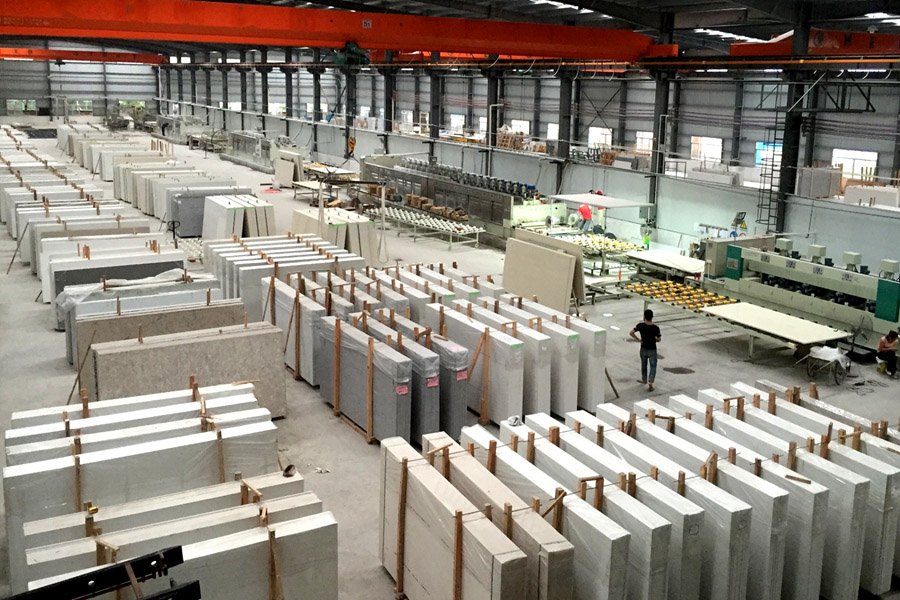
Several published designs stored together at the Aspire Stone factory. No price bands or exclusivity labels are shown.
Why does a segmented portfolio outperform a long, unplanned list?
Every slab you hold occupies cash, rack space, and a packing frame. A range that tries to copy every design in the market will usually include colours that turn slowly, while the few colours your fabricators actually repeat may go out of stock. Segmentation is a way of deciding, in advance, which designs earn a place in the warehouse, which belong on a sample board, and which are ordered against a project.
The starting point is the customer, not the factory catalogue. A kitchen fabricator, a hospitality contractor, and a showroom serving homeowners do not need the same depth in every style. Once you know who you serve, you can borrow the way manufacturers group products — Calacatta looks, quieter veined designs, solids, sparkling or exotic surfaces, printed designs, lower-silica options, and large formats — and decide how much of each group to stock. For capital and risk, see whether selling quartz slabs is a profitable business.
How should you segment by price band, style, application, and customer?
Price band is a commercial label you apply after you see a quotation, not a published Aspire Stone price list. In practice, distributors often keep a workhorse group that can be replenished easily, a mid group with more distinctive veining, and a smaller upper group for feature islands or project statements. Keep thickness, finish, and format consistent within a band, so a 20 mm solid colour is not compared with a 30 mm jumbo pair as if they were the same product.
Style is the part customers see first. A practical split is: quiet solids and soft neutrals; white backgrounds with grey or gold veining, including Calacatta-look designs; softer Carrara and other veined looks; bolder or exotic patterns; sparkling surfaces; and printed designs where a repeatable pattern is the point. Application then cuts across style: kitchen worktops and islands, bathroom vanities, bars and reception desks, and occasional wall or commercial surfaces. A colour that works on a small vanity may be awkward on a long island if the movement is busy or the slab is too small to avoid a seam.
Customer type should decide depth. Trade fabricators usually want a short list they can repurchase with confidence. Showrooms often need a wider visual story, but not necessarily a full slab of every story. Project accounts may need a locked colour, a reserve, or a later replacement plan more than they need a large display. If you try to be equally deep for every customer, the warehouse will fill with exceptions.
| Portfolio layer | What belongs in it | How it is usually held |
|---|---|---|
| Core stock | A small number of proven solids and widely used marble-look or veined designs, in the thicknesses your market actually buys | Warehouse slabs plus a display piece, with a planned reorder point |
| Feature or mid range | More distinctive veining, a short exotic or sparkling group, and one or two large-format options for islands | Limited slab stock and a clear rule for colour holds |
| Trend or seasonal looks | Newer designs that are selling in your market but are not yet proven as repeat stock | Samples first; slabs only when a sales record or a project justifies them |
| Special order | Printed matches, uncommon colours, unusual thicknesses, or jumbo and Super Jumbo formats you do not keep on the floor | Ordered against an approved sample or a named project, not as open stock |
| Documented options | Low-silica or silica-free designs, where customers or fabricators ask for a lower crystalline-silica content | Catalogue and sample, with composition reports requested for the named model; not treated as automatically silica-free or risk-free |
How do you balance core colours with trend-led designs?
Core colours pay for the warehouse: designs a fabricator can sell in volume, match on a later job, and explain quickly. Trend-led designs can win a single project, but they age and are harder to repurchase if the next batch looks different. Let the core range occupy most of the rack space, rotate a shorter trend list, and retire a design when it has not moved within a period you set in advance.
Veined slabs complicate this balance. A design may be popular and still be difficult to hold, because two slabs from the same colour name are not automatically a pair. If bookmatching or a tight visual match matters, say so before the order, and keep a reference. Aspire Stone’s published explanation of bookmatching is on the live page at What Is Bookmatching in Quartz Slabs. Do not treat a colour name alone as a guarantee of a later match.
Format belongs in the same discussion. Many Aspire Stone series pages checked on 23 November 2026 list slabs at 3200×1600 mm (126×63") in 20 mm or 30 mm. The Super Jumbo page — the live URL uses that spelling — describes regular slabs as commonly around 120×56", jumbo around 128×63", and Super Jumbo as 138×78". Those figures are that page’s published examples, not an industry standard. Large formats can reduce seams, but they change packing, handling, and how many pieces you can store. See jumbo and Super Jumbo quartz slabs.
What should samples, slab viewing, and product data include?
A sample on a board is not a slab on a rack. Small chips are useful for colour family and finish, but they hide movement and edge behaviour. Distributors usually need both a portable sample set and a way for a customer to see a full slab. Digital catalogues and batch photographs help a remote buyer if the files are dated, named, and consistent with the slab that will be shipped.
Product data should travel with the design. A useful pack names the series and model, the nominal size and thickness, the finish, and any published limitations, and it leaves a place for a composition statement and a test report when the destination or the customer requires them. For lower-crystalline-silica options, a catalogue name is not a substitute for a current report, as explained in what low-silica quartz is and how it differs from silica-free surfaces.
What can you reasonably expect from a supplier — and what is not a published promise?
Reliability is easier to judge than slogans. A distributor needs a supplier who can say which designs are current, how a reorder will be matched to an approved sample, how packing is done, and whom to call when a batch is late or a claim has to be raised. Replenishment should be discussed as a planning process — forecasts, production windows, and safety stock on the colours you have chosen — not as an implied consignment programme.
Exclusivity, reserved territory, consignment stock, and marketing funds are contract terms, if they exist at all. They are not a standard feature of a quartz supply relationship. Aspire Stone’s live pages, checked on 23 November 2026, do not publish a formal policy of regional exclusivity, consignment inventory, or a dealer marketing-support package. If those points matter to you, they have to be negotiated in writing. Until then, do not sell your customers a protected range that you have not been granted.
What a supplier can often provide, without any invented programme, is a current range list, physical samples, specification and packing information, photographs of the slabs or frames you are buying, and a named contact. Training your sales team — how to describe a finish, when a printed design or a jumbo sheet is justified, and when a customer should visit the slab — is mostly your work. Bring fabricators into that conversation early; they will cut the slab and, if something is wrong, make the first claim.
Which published Aspire Stone series can sit in a catalogue?
The live categories page, checked on 23 November 2026, groups the range as Printed Quartz Stone/Slabs, Exotic color series, Calacatta Series, Carrara & Veined Series, Low-Silica / Silica-Free Quartz Surfaces, Solid Color Series, Sparkling Color Series, Super Jumbo series, and New Arrival, together with cut-to-size. That is a catalogue structure, not a stock plan or an exclusivity claim.
The Calacatta page describes white backgrounds with grey or gold veining, and names designs such as Calacatta Fresh, Calacatta Italia Extra, and Calacatta Macchia. See what Calacatta quartz is. Carrara and veined, solid colour, sparkling, and exotic pages list the same 3200×1600 mm, 20 mm or 30 mm examples. The printed-quartz page — the live slug is Prined-Quartz-stone-slabs, and that spelling is the real URL — describes thermal-transfer printing, consistent pattern from slab to slab, and full-body printed options. See also what printed quartz is.
The low-silica and silica-free series page, checked the same day, says the slabs are made “with a lower crystalline-silica content, or with a silica-free formulation, compared with conventional quartz,” and lists designs including Calacatta Athens, Bianca Gloria, Onda White, and Galaxy White. The page does not publish crystalline-silica percentages, and it does not split the listings into a verified low-silica group and a verified silica-free group. Use it as a design catalogue, and ask for a current report on the named model before you present a compliance or safety claim.
A portfolio planning worksheet
Use the worksheet as a discussion document with your team and your supplier. Fill it with your market’s actual demand, not with a target number of designs copied from another showroom.
| Planning question | Decision to record |
|---|---|
| Who is the primary customer? | Fabricators, showrooms, project accounts, or a named mix, with one group first |
| Which thicknesses and finishes will you stock? | Usually a short list, such as 20 mm and 30 mm, polished and, if demanded, honed |
| How many core designs will sit on racks? | A number you can fund and repurchase, grouped by style, not a copy of the full factory list |
| Which designs are sample-only or special-order? | Trend colours, printed matches, uncommon exotics, and formats you cannot handle every week |
| What documents will you keep for each stocked model? | Sample reference, size and finish, packing note, and, where needed, composition and test reports |
| When will you drop a design? | A review date and a turnover rule, agreed before the slab is ordered |
FAQ
What quartz colours should distributors stock?
Stock the colours your customers already specify and can repurchase, usually a tight group of solids and widely used white or lightly veined marble-look designs, in the thicknesses you actually sell. Add a shorter feature group for distinctive veining or a local trend, and keep unusual, printed, or very large formats for special order until demand is proven. There is no universal colour list that fits every market.
How many designs should a showroom carry?
There is no official or industry-wide number. The right count is the one you can display well, explain, and replenish. A smaller set of full slabs, backed by a broader sample library and a special-order path, is usually easier to fund than a wall of designs that cannot be reordered in a matching batch.
How can distributors differentiate their quartz offer?
Differentiation is more often service than a unique colour name. Reliable availability, honest samples, clear data, help with format and seam planning, and a fabricator relationship that reduces remakes will stand out more than a claim of exclusivity you do not have. A documented lower-silica option can be part of that offer where customers ask for it, provided you do not overstate what the documents show.
What should a supplier provide to dealers?
At a minimum, a current range, identified samples, specification and packing information, a way to view or photograph the slabs being sold, and a named person for production, shipment, and claims. Marketing funds, consignment stock, and reserved territories should be treated as optional contract terms. Aspire Stone’s published pages do not set those terms out as a standard dealer policy.
Should every distributor stock low-silica or jumbo slabs?
Not automatically. Stock them if your customers or fabricators ask for a lower crystalline-silica content, or if islands and commercial surfaces in your market regularly need a larger sheet. Otherwise keep them in the catalogue and on a sample board until the demand is real. Low-silica is not silica-free and is not risk-free, and a jumbo sheet is only an advantage if you can handle, store, and transport it.
Use the catalogue as a starting map, not as a stock order
If you are reviewing a distributor range, begin with the customer and the core colours, then look at the published series and decide what will sit on a rack, on a board, or on special order. Aspire Stone can walk through that published catalogue with you. For a first discussion, use the Contact page, or write to [email protected] (Mr. Lin, +86 135 0025 4616).


 WhatsApp
 EMAIL