




How to Cut Quartz Slabs for Professional Fabricators
Cutting a quartz slab starts with inspection and a confirmed drawing or template, then a supported, water-cooled cut with diamond tooling. A straight cut that looks simple on paper can still chip, crack, or go out of size if the blade, cooling, or cut-out corners are poorly controlled. Dust and slurry must be managed under the occupational-health rules that apply in the shop.
These are widely used professional practices, not a substitute for equipment manuals, manufacturer guides, or formal training. The article does not give Aspire Stone feed rates or machine accuracy, and it does not treat a low-silica slab as a reason to relax dust controls.
What should be checked before a quartz slab is cut?
Most cutting problems start before the blade touches the slab.
Inspect the face, the back, and the perimeter under good light, from more than one angle. Look for cracks, pits, voids, gloss irregularities, polishing marks, obvious warp, and handling damage. If a protective film is present, remove enough of it to inspect the surface. Caesarstone’s August 2023 fabrication guide, used here as one manufacturer example, tells fabricators to inspect before cutting and notes that only unmodified slabs are typically considered for replacement. Other brands set their own rules; follow the document that applies to the slab on the table.
Engineered quartz can vary slightly between production cycles. For pieces that will be seamed, compare the adjoining areas before you cut, and plan vein direction and which edges will be polished. A layout that looks efficient by area alone can still fail if the pattern runs the wrong way.
Verify finished sizes, edge positions, sink and cooktop centres, splash returns, and seam locations against the site measure or template. Do not assume cabinet corners are exact right angles. If the template and the drawing disagree, resolve the difference before cutting.
The slab must be fully supported and balanced during lifting, turning, and cutting. Narrow rails, large cut-outs, and L-shaped pieces concentrate stress. Arrange cut-out waste so it cannot drop through the saw bed as the last connection is cut.
Aspire Stone’s published cut-to-size process starts from customer dimensions and then cutting, which only works if those dimensions have already been checked on site.
What tools are used to cut quartz slabs?
Shops cut engineered quartz with water-cooled diamond tooling. The exact machine matters less than using a tool designed for the material, keeping it sharp, and delivering water to the cut.
Common equipment categories include:
- Bridge or gantry saws, usually with a diamond blade for straight cuts. Some machines include infrared alignment or positioning. Aspire Stone’s live cut-to-size page lists infrared cutting machines among the workshop equipment; the page does not name a brand, model, or accuracy figure, and this article does not invent one.
- CNC saws or machining centres, used for shaped work, repeated pieces, and some internal cut-outs.
- Waterjet cutting, useful for curves, tight internal shapes, and some cut-outs. The same Aspire Stone page also lists water jets.
- Handheld wet saws, grinders, routers, and core drills, used for adjustments, holes, and site work. These tools often create the highest dust risk if water and extraction are incomplete.
Fabricators use diamond cutting disks selected for engineered quartz and for the machine and thickness involved, plus contour blades and core bits for curves and holes. Caesarstone tells fabricators to consult their distributor for the correct diamond tools and to keep them sharp. A worn, glazed, or wrongly specified blade is a common cause of chipping and overheating.
Yes, quartz can be cut with a wet saw. Wet cutting is the standard professional method: water cools the cut, helps carry swarf away, and is a primary engineering control for dust. Caesarstone states that only water-cooled tools should be used for cutting, drilling, and polishing, and that dry cutting can make the slab more susceptible to cracking, chipping, discoloration, and other damage.
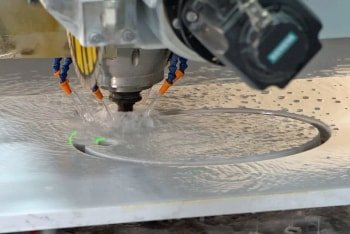
Waterjet cutting an opening in a quartz piece, from the live “Water Jet” photograph on Aspire Stone’s workshop page. The published file is a small thumbnail.
How should the cut itself be controlled?
Four shop conditions matter more than any unpublished setting.
The slab must sit flat and stable, with the cut line supported on both sides. Vibration, a rocking slab, or an unsupported offcut increases chipping and can start a crack, especially near inside corners.
Water should reach the point of contact throughout the cut. Starved or intermittent water lets the rim overheat. If recycled water is used, it should be treated and maintained; dirty water reduces cooling and can damage tooling. The UK Health and Safety Executive also notes that mist from water suppression can carry crystalline silica and must itself be controlled, for example with suitable local exhaust ventilation.
A sharp, true blade and a steady feed within the tool maker’s range produce a cleaner edge than forcing the machine. This article does not publish revolutions per minute or feed rates. Those values belong to the machine and blade manufacturers and to trained operators. If the cut sounds or looks wrong—burning, heavy chipping, wandering—stop and check the blade, water, and support before continuing.
A good saw cut may still need a little clean-up, but it should be straight, cool, and free of deep chips. Leave enough material for the planned edge profile.
The wider sequence after the cut is covered in how to fabricate quartz countertops. Edge finishing is covered in how to polish quartz edges.
How should silica dust and slurry be controlled?
Many conventional engineered-quartz products are high in crystalline silica, but formulas vary. The OSHA and NIOSH hazard alert states that crystalline silica can comprise up to 95% of engineered stone, that some products contain less than 50% in a polymer resin matrix, and that some other formulations are much lower. A shop cannot see the silica percentage in the dust, and a “low-silica” slab does not remove the need for dust and mist controls.
In the United States, OSHA’s general-industry standard, 29 CFR 1910.1053, sets a permissible exposure limit of 50 μg/m³ of respirable crystalline silica, calculated as an 8-hour time-weighted average, and an action level of 25 μg/m³ as an 8-hour TWA. Those figures are U.S. legal limits, not a worldwide standard.
The OSHA and NIOSH alert emphasises avoiding dry cutting, dry grinding, dry sweeping, and compressed-air cleaning; preferring remote or enclosed machines with water sprays where the work allows; keeping water on the tool at the point of contact, combined with local exhaust ventilation when needed; and cleaning with wet methods or a suitable vacuum.
In Great Britain, HSE’s COSHH essentials sheet ST3A, for cutting and polishing engineered stone with powered handheld rotary tools, includes on-tool water suppression, control of silica-containing mist, powered air-purifying respirators with an assigned protection factor of at least 20 for the processing, cleaning, and maintenance tasks described, and health surveillance where regular exposure may cause silicosis or COPD. That is UK guidance under COSHH. Shops elsewhere must follow their own regulations.
Slurry is part of the same hazard once it dries. Collect and dispose of it by the local method, and do not let dried slurry become a secondary dust source. For a fuller discussion of shop controls, see silica dust safety in fabrication.
How should cut-outs, corners, and internal radii be cut?
Sink, hob, and socket cut-outs are where many cracks begin. A sharp inside corner concentrates load from handling, transport, cabinet movement, or heat.
Widely used professional practice, illustrated in Caesarstone’s guide, is to drill or core a radius at each corner before connecting the sides; avoid overcutting past the rounded corner and avoid “cross-cutting” corners; follow the fixture manufacturer’s current template; and keep a sensible margin of material between a cut-out and a finished edge or seam, with support under narrow remaining strips.
Caesarstone’s published figures, which apply to its own products and should not be treated as a universal code, include a minimum 10 mm (⅜ in) cut-out corner radius, a minimum 50 mm (2 in) distance between a cut-out and an edge or seam, and additional support if that distance is less than 150 mm (6 in). Other manufacturers publish different minimums. Always use the current guide for the slab in front of you, together with the sink or appliance drawing.
Inside corners of L-shaped tops carry a similar risk. A radiused inside corner is stronger than a sharp 90° notch. Some manufacturers recommend a joint at a change of direction so the piece is easier to handle and less likely to crack in transport.
A circular sink opening cut by waterjet, from the live “Water Jet” workshop photograph.
What cutting defects are common, and what often causes them?
The table below is a workshop aid, not a diagnosis. The same symptom can have more than one cause.
| Defect | Often related to | What to check |
|---|---|---|
| Edge chipping or a broken arris | Worn or unsuitable blade; insufficient water; poor support; forcing the feed; a square or overcut corner | Blade condition, water at the cut, bed support, corner method |
| Hairline cracks from a cut-out or inside corner | Square corners, overcutting, narrow margins, unsupported offcuts, rough handling after the cut | Radii, remaining material, lifting method, transport packing |
| Inaccurate dimensions | Template or drawing error; unsquared slab perimeter; blade wander; no allowance for edge polish | Measure against the template; confirm saw setup by the equipment maker’s method |
| Burn marks, discoloration, or a glazed cut face | Dry or under-cooled cutting; dull tooling; excessive dwell | Water delivery, blade sharpness; pause and dress or change the tool |
| Pieces that no longer colour-match at a seam | Different batches; joining non-adjacent areas; pattern running in opposite directions | Dry-lay before cutting; keep adjoining ends from the same region of the slab where the design requires it |
A fuller troubleshooting view, including problems that appear only after polishing or installation, is in common quartz fabrication problems.
Pre-cut and post-cut inspection checklist
| Stage | Check |
|---|---|
| Before cutting | Slab identity, batch, and colour match confirmed for seamed pieces; face, back, and edges inspected; defects recorded |
| Before cutting | Template or drawing agreed: sizes, seams, edge polish, sink and hob centres, grain direction |
| Before cutting | Slab fully supported; lifting method planned; cut-out waste will not drop unsupported |
| Before cutting | Water, guards, and dust or mist controls working; operators trained and wearing the required protection |
| During cutting | Water stays on the cut; blade remains true; no forced feed; corners radiused before side cuts are completed |
| After cutting | Finished sizes checked against the drawing; cut-out margins, radii, and visible edges inspected for chips and cracks |
| After cutting | Pieces labelled, protected, and moved without twisting narrow sections; slurry and the work area cleaned by a wet or dustless method |
FAQ
What blade is used to cut quartz?
Professional shops use water-cooled diamond cutting disks chosen for engineered quartz and for the machine and thickness involved, plus diamond contour blades and core bits for curves and holes. There is no single blade model that suits every saw. Follow the tool and slab manufacturers’ guidance, and replace or dress a blade that is chipping or wandering.
Can quartz be cut with a wet saw?
Yes. A wet saw, bridge saw, CNC, or waterjet with continuous water at the cut is the normal professional method. Wet cutting cools the material and helps control dust. Dry cutting is discouraged by occupational-health agencies and by manufacturer guides because it raises respirable dust and can damage the slab.
How do you prevent chipping?
Keep the slab fully supported, use a sharp diamond blade with a steady feed, and keep water on the cut. Radius cut-out corners with a core bit rather than cutting a square inside corner, and do not overcut the radius. Leave enough material for the planned edge profile. Polishing can tidy a small arris, but it will not hide a deep chip or a crack started at a corner.
How should silica dust be controlled?
Follow the rules that apply in the shop’s country. Official U.S. guidance from OSHA and NIOSH emphasises wet methods, local exhaust ventilation, no dry sweeping or compressed-air cleaning, and exposure assessment against the U.S. permissible exposure limit and action level. UK HSE guidance for handheld rotary work on engineered stone also requires water suppression, mist control, and suitable respiratory protection. A lower-silica material can reduce the silica content of the dust, but it does not make dry or uncontrolled cutting acceptable.
Does a low-silica or silica-free slab change the cutting method?
It can change the composition of the dust, which is one reason some buyers specify those products. It does not remove the need to read the product’s safety data, use wet tooling, and apply the dust and mist controls required locally.
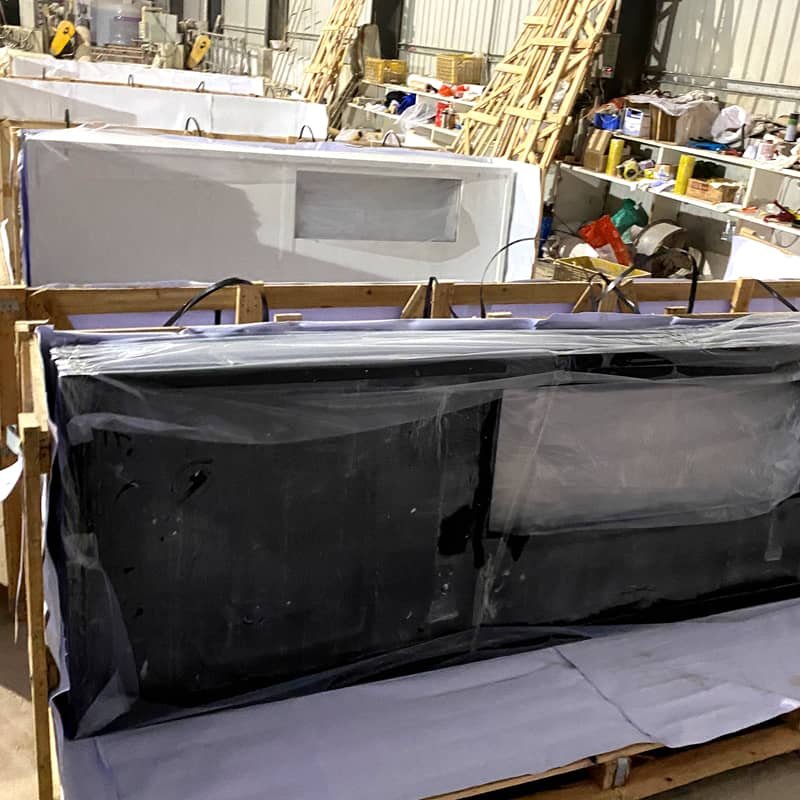
Cut-to-size quartz pieces packed in timber crates at the Aspire Stone workshop.
Need slabs cut to your drawings?
Aspire Stone manufactures quartz slabs in Foshan and also operates a published cut-to-size workshop of about 4,000 sq.m, equipped with infrared cutting machines, water jets, and edge polishing machines, and staffed by 50 skilled workers. Those figures are workshop figures from the live cut-to-size page, not a whole-factory headcount. The same page lists cutting, polishing, sink-hole cutting, lamination, and mitered edges, with pieces cleaned, sealed, labelled, and packed for delivery.
If you want pieces prepared from confirmed dimensions, contact Aspire Stone with drawings, thickness, edge details, and the slab series. Site measurement and final installation still belong to the local fabricator or installer, who must also apply the safety rules in force at the workshop and on site.


 WhatsApp
 EMAIL