




Jumbo and Super Jumbo Quartz Slabs: Published Sizes, Handling and Uses
Jumbo and super jumbo are market names for oversized engineered-quartz slabs, not a standard size. Manufacturers publish different dimensions under the same labels. Aspire Stone’s Super Jumbo page describes Super Jumbo as 138×78", and refers to regular slabs as around 120×56" and jumbo as around 128×63". Those figures are that page’s published examples. Larger sheets can reduce seams on islands and commercial tops, but they need careful handling and transport.
What is a jumbo or super jumbo quartz slab?
In the trade, “jumbo” usually means a slab that is longer or wider than a factory’s regular sheet, and “super jumbo” usually means a still larger format. There is no single governing standard that fixes those names to one length and width. A buyer who writes “jumbo” on a purchase order without a measured size is leaving the most important specification blank.
Aspire Stone’s Super Jumbo quartz slabs page—the live URL uses that spelling and should not be “corrected”—was checked on 23 November 2026. It describes Super Jumbo as a larger format than standard jumbo slabs, “described on this page as 138×78".” The same page says: “Regular quartz slabs were commonly around 120×56", jumbo around 128×63", and Super Jumbo at 138×78" is now available.” It presents the larger sheet as intended for kitchen islands, feature walls, and commercial surfaces that need fewer seams. Converted approximately to millimetres, those published inch figures are about 3048×1422 mm, 3251×1600 mm, and 3505×1981 mm. The series page itself does not list individual colours or a thickness.
Other Aspire Stone pages use related but not identical figures. The Carrara and Veined series page lists slabs at 3200×1600 mm (126×63"), in 20 mm or 30 mm. Several Calacatta, printed, and other product listings checked the same day use that same 3200×1600 mm published size. The bookmatching News article states that “super jumbo size” is available in 20 mm and 30 mm. Those statements should be read as the wording on those pages, not as a complete Super Jumbo stock list. Colour availability in the 138×78" format should be confirmed with the factory, because the Super Jumbo page does not currently show a model grid.
The About page, also checked that day, says Aspire Stone produces regular, jumbo, and super-jumbo quartz slabs and supplies cut-to-size pieces. For a broader discussion of everyday sizes, thicknesses, and finishes, see quartz slab sizes, thicknesses, and finishes.
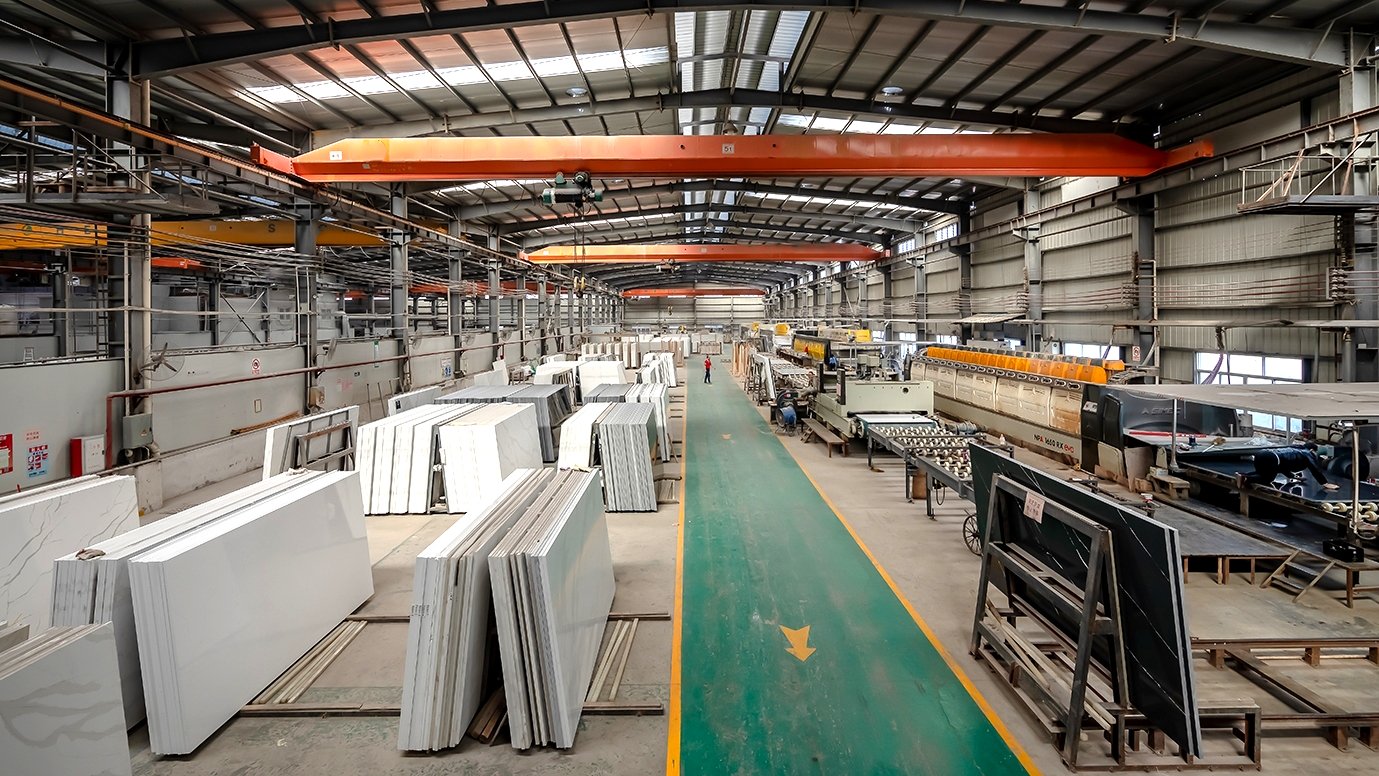
Large-format quartz slabs stored in the Aspire Stone factory hall. The photograph does not label a standard, jumbo, or Super Jumbo size.
How much do published jumbo sizes vary between manufacturers?
Comparing a few official manufacturer pages is enough to show that the labels move around. The figures below are examples published by those companies, verified on 23 November 2026. They are not a standard, and they are not Aspire Stone’s sizes.
| Published source | What that source calls the size | Published dimensions |
|---|---|---|
| Aspire Stone Super Jumbo page | Regular, jumbo, and Super Jumbo, as described on that page | Commonly around 120×56" (regular), around 128×63" (jumbo), and 138×78" (Super Jumbo) |
| Caesarstone US, Design & Specification | Jumbo, for some ICON, quartz, and mineral surfaces | 128" ±1.5% × 64.5" ±1.5% (327 cm ±1.5% × 164 cm ±1.5%) |
| Caesarstone US, BLDR Line | Jumbo and Super Jumbo, as listed for that collection | Jumbo 128" ±1% × 64.5" ±1% (57.33 sq ft); Super Jumbo 137" ±1% × 79" ±1% (75.16 sq ft) |
| Cosentino / Silestone US slab-size sheet | Two slab formats, not labelled “super jumbo” on that sheet | 137 cm (54") × 305 cm (120"), and 160 cm (63") × 325 cm (128"), in 1.2, 2.0, and 3.0 cm thicknesses |
Two observations follow. First, several producers cluster around a “jumbo” near 128" long and about 63–64.5" wide, but the exact numbers and tolerances differ. Second, “super jumbo” is even less settled: Aspire Stone’s page publishes 138×78", while Caesarstone’s BLDR Line publishes 137×79" for its Super Jumbo. Those formats are close in area and not identical. A specification should quote the supplier, the product line, the nominal size, and the tolerance, not the nickname alone.
Do jumbo slabs reduce seams, and where are they used?
The main benefit is layout flexibility. A larger sheet can cover a long island, a peninsula, or a wide reception top with fewer joints, or with no joint at all, if the finished dimensions, cut-outs, and grain direction still fit inside the usable slab. Aspire Stone’s Super Jumbo page names kitchen islands, feature walls, and commercial surfaces that need fewer seams as the intended uses.
Fewer seams is a potential benefit, not an automatic result. An island with a large sink, an overhang, or a waterfall can still need a joint, or it can force a less attractive cut from the pattern. The fabricator should nest the pieces on the actual slab size before anyone promises a seamless top. Island planning is covered further in kitchen islands in quartz, and take-off practice in how to measure and calculate quartz worktops.
Large-format slabs can also reduce the number of sheets required in a container or a project package, but only if the pieces nest well. A Super Jumbo sheet that yields poorly can waste more material than two well-planned smaller slabs. Yield should be calculated, not assumed.
How should jumbo and super jumbo slabs be handled, stored, and transported?
The first planning figure is weight. Aspire Stone’s Super Jumbo page does not publish a slab weight. A useful scale, not a factory figure, comes from other published data. ISFA 3-01 (2013) sets a minimum density for quartz surfacing of 2,200 kg/m³ (ASTM C97-09). Caesarstone’s US specification page publishes 43–48 kg/m² for 2 cm slabs and 66–70 kg/m² for 3 cm slabs, with jumbo 3 cm sheets in its own smaller jumbo format listed at 362–382 kg.
Using Caesarstone’s published mass per square metre only as an estimating aid, a 138×78" sheet has an area of about 6.94 m². That would suggest a very approximate range of about 300–330 kg at 2 cm and about 460–490 kg at 3 cm. Those numbers are calculations, not Aspire Stone weigh-tickets, and they should not be used for lifting plans until the factory confirms thickness, density, and packed weight for the actual order. A crate, A-frame, and packing will add more mass.
Handling at that scale needs equipment and space, not only more people. Typical workshop practice for large quartz sheets includes A-frames or vertical storage, vacuum lifters or gantries, and forklifts rated for the packed load, with enough aisle width and door height to turn the sheet without striking it. A 78" (about 1,981 mm) width is also a transport constraint: truck bodies, container doors, and warehouse racks must be checked against the packed width and length, not only against the nominal slab size. The risk of breakage rises when a heavy, thin sheet is flexed, set down unevenly, or moved with inadequate support.
This article does not invent a container loading plan or a piece count per container. Those figures depend on packing method, thickness, and whether mixed sizes are loaded. They should be calculated for the shipment, as discussed in container load calculation.
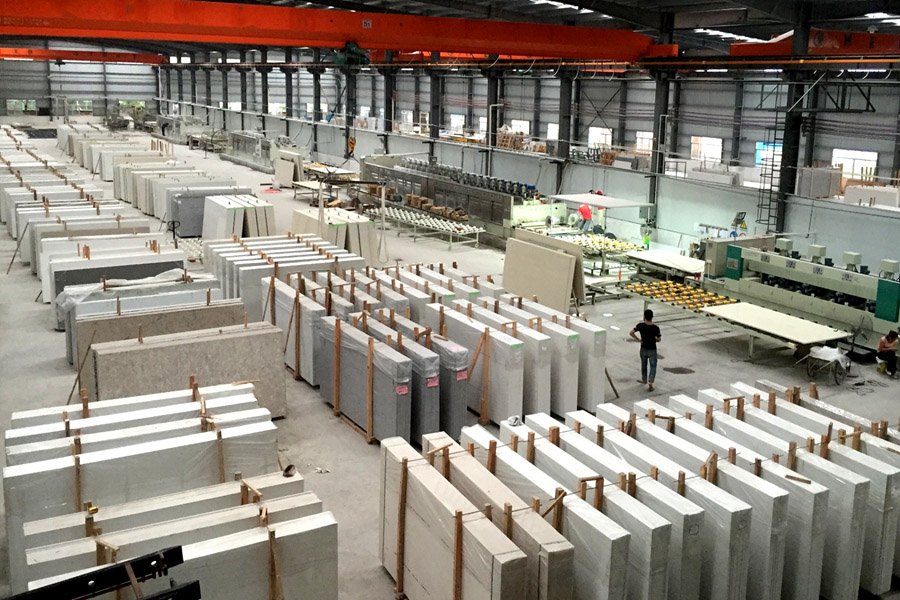
Large quartz slabs standing in factory storage at Aspire Stone in Foshan.
What should fabricators plan before cutting a large-format slab?
- Confirm the actual usable length and width, not only the nominal size, and allow for edge trimming.
- Confirm thickness. The Super Jumbo series page does not state it; other Aspire Stone pages mention 20 mm and 30 mm in connection with large or standard formats, but the order should still name the thickness.
- Draw the island, joints, sink, hob, and overhangs on the real slab size, including vein direction.
- Check table capacity, hoist capacity, and the route from storage to the saw.
- Agree how a bookmatched or vein-matched pair will be cut if two large sheets are meant to meet.
- Plan packed dimensions and lifting points with the transporter before the slabs leave the factory.
What should be written on a jumbo or super jumbo order?
| Specify | Why |
|---|---|
| Nominal size and units | Write 138×78", or the metric equivalent you have agreed, rather than only “Super Jumbo.” |
| Tolerance, if the supplier publishes one | Other manufacturers publish percentage tolerances; if Aspire Stone has a stated tolerance, it should be on the order. If not, ask. |
| Thickness and finish | Do not assume 20 mm or 30 mm, or a polished finish, if it is not written down. |
| Model name and code | The Super Jumbo page does not currently list colours. The colour must be named separately and confirmed as available in that format. |
| Quantity, packing, and packed weight | Needed for lifting, transport, and any container plan. |
| Cutting drawings, if cut-to-size is required | Aspire Stone also supplies cut-to-size. Large finished pieces still need the same handling checks as whole slabs. |
FAQ
What is a jumbo quartz slab?
It is a trade name for an oversized engineered-quartz sheet, larger than a factory’s regular size. The exact length and width depend on the supplier. Aspire Stone’s Super Jumbo page refers to jumbo as commonly around 128×63", as an example described on that page, not as an industry rule.
What is the largest quartz slab size?
There is no single official maximum. Manufacturers publish different top sizes. On Aspire Stone’s Super Jumbo page, the largest format described is 138×78". Other producers publish other figures; Caesarstone’s BLDR Line, for example, lists a Super Jumbo of 137×79" ±1%. Ask the supplier for the current maximum of the named colour, not for a generic “largest size.”
Do jumbo slabs reduce seams?
They can, when the finished top, including cut-outs and overhangs, fits within the usable slab. They do not guarantee a seamless result. Nest the pieces on the actual sheet size before promising a joint-free island or commercial top.
How are jumbo slabs transported?
They are typically packed on A-frames or in reinforced crates and moved with equipment rated for the packed weight and size. Width and length must be checked against the vehicle or container opening. Packed weight should come from the factory; estimates in this article are only a planning scale and are not Aspire Stone shipping weights.
Are all colours available in Super Jumbo?
That is not shown on Aspire Stone’s Super Jumbo page, which currently describes the format but does not list individual models. Availability by colour should be confirmed with the factory before a project is drawn around 138×78" sheets.
Confirm the measured size, not only the name
If you are planning a large island or a commercial top, start with the finished dimensions, then ask whether a regular, jumbo, or Super Jumbo sheet will cover them. Review Aspire Stone’s Super Jumbo page for the format described there, and confirm the actual size, thickness, colour, and packed weight with the factory before the drawings are locked.


 WhatsApp
 EMAIL