




Workplace Controls for Silica Dust in Stone Fabrication
Stone fabrication can release respirable crystalline silica when slabs that contain crystalline silica are cut, ground, drilled, edged, or polished, and when settled dust is disturbed. Official workplace guidance uses a hierarchy of controls: elimination or substitution, engineering controls, administrative controls, and then personal protective equipment. Those measures can reduce exposure. They do not fully eliminate risk, and a written programme does not guarantee safety.
Which tasks can generate respirable crystalline silica dust?
The 2026 OSHA/NIOSH Hazard Alert (OSHA 3768 / NIOSH 2026-101) identifies high-exposure work in countertop manufacturing, finishing, and installation. Powered hand tools—saws, grinders, and high-speed polishers—can produce some of the highest exposures, in the shop and on the job site. Nearby workers and people who do maintenance or housekeeping can also be exposed. In plants that manufacture engineered stone, the same alert notes exposure when silica powder and bulk raw materials are handled and when dust collectors are maintained.
Dry cutting, dry grinding, dry sweeping, and compressed-air blow-down are repeatedly identified as practices that put dust into the air. Wet methods reduce airborne dust, but they are not a complete solution. The UK Health and Safety Executive (HSE) notes that the mist generated by water suppression contains crystalline silica and has to be controlled. Dried slurry can also become a later source of dust if it is left on floors, tools, or clothing.
The amount of crystalline silica in the slab affects how much RCS a task can generate, but it does not tell you the airborne concentration on a given day. Exposure also depends on the tool, the duration, the controls in use, and housekeeping. The health background is in understanding silica in engineered stone. Practical cutting and fabrication sequences are in how to cut quartz slabs and how to fabricate quartz countertops; those articles do not replace a workplace risk assessment.
How should shops apply the hierarchy of controls?
Official guidance, including the 2026 Hazard Alert and HSE’s engineered-stone advice, uses the same order of preference.
| Level | What it means in a stone shop | Limit of the measure |
|---|---|---|
| Elimination or substitution | Where lawful and genuinely lower risk, use materials with little or no crystalline silica, after verifying the content rather than relying on a trade name | A lower content does not make the task dust-free, and the substitute must not introduce a greater or unevaluated hazard |
| Engineering controls | Wet methods at the point of contact; local exhaust ventilation (LEV), booths, or enclosures; remote-controlled or enclosed tools with water where practical; combined water and LEV where one control is not enough | Poorly maintained water systems, uncontrolled mist, or weak airflow can leave exposures high |
| Administrative controls | Training, task isolation, access limits, scheduled maintenance, exposure assessment, and work practices such as standing upstream of a capture hood | Procedures only work if they are supervised and kept current |
| Personal protective equipment | Respiratory protection and other PPE required by local law, as a supplement when higher controls do not reduce exposure enough, or during short tasks where engineering controls are not yet in place | PPE is the last line, not the first. Ordinary disposable masks are not a respiratory-protection programme |
OSHA’s general industry silica standard requires employers to use engineering and work-practice controls to reduce and maintain exposure at or below the permissible exposure limit, unless they can demonstrate that such controls are not feasible, and to supplement them with respirators where those controls are not sufficient. That duty is US law. Other countries write the same idea in their own statutes. In every case, the shop should not treat a brochure, a “low-silica” name, or a single piece of equipment as a complete programme.
Is wet cutting enough, and what ventilation is needed?
Wet cutting is not enough on its own. It is an important engineering control, and official sources advise avoiding dry operations, but water has to reach the point of contact, be supplied in adequate volume, and be maintained. HSE’s COSHH essentials sheet ST3A, which addresses cutting and polishing engineered stone with powered hand-held rotary tools in Great Britain, advises on-tool water suppression, control of the resulting mist—for example by working in a partially enclosed, externally vented local exhaust booth designed to extract wet mist—and mechanical ventilation to prevent mist build-up. If water is recirculated, ST3A also requires a programme to prevent bacterial growth, including legionella, and to avoid a build-up of silica in the water.
The 2026 Hazard Alert likewise recommends isolating high-exposure tasks, installing LEV to capture dust near its origin, combining water and LEV where necessary, and enhancing general ventilation of indoor spaces. System design should provide enough airflow to capture dust without defeating the water used to suppress it. There is no single hood design or air-change figure that this article can offer as universally sufficient. Ventilation has to be designed, commissioned, and maintained for the space and the tasks, with advice from a competent person.
Equipment wears quickly in abrasive, silica-containing dust. Official guidance emphasises planned maintenance, checks before work starts, and prompt repair. A control that is switched off, clogged, or short of water is not a control.
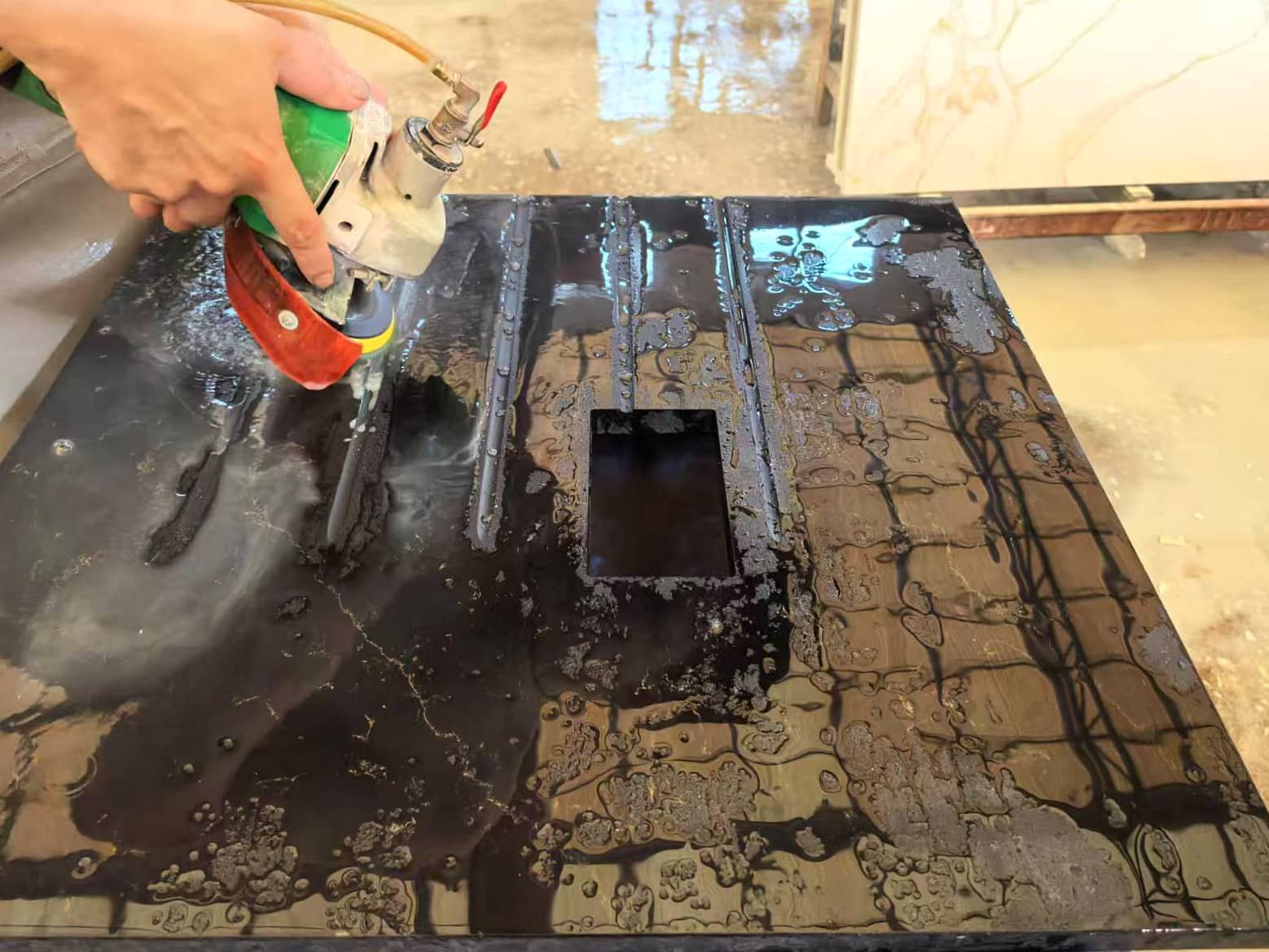
Wet polishing on a quartz top in the Aspire Stone workshop. This photograph is not a claim that wet cutting or polishing eliminates silica-dust risk, or that the workshop meets a named safety standard.
What about exposure assessment, training, housekeeping, and waste?
Where the law requires it, employers must assess worker exposure. In the United States, 29 CFR 1910.1053 still sets a PEL of 50 µg/m3 and an action level of 25 µg/m3, each as an 8-hour time-weighted average (verified 23 November 2026), and it requires exposure assessment at or above the action level, a written exposure control plan, and medical surveillance for employees occupationally exposed at or above the action level for 30 or more days per year. In Great Britain, HSE states that the workplace exposure limit for RCS is 0.1 mg/m3 as an 8-hour TWA, under COSHH, and that health surveillance must be provided to workers who are regularly exposed to RCS dust and there is a reasonable likelihood that silicosis may develop. Those figures are jurisdiction-specific. They are not a global limit and they are not a product ban. Country product rules are summarised in engineered stone regulations.
Training should cover the health hazard, the controls in use, how to check that those controls are working, and what to do if something fails. HSE and OSHA both stress training in a form workers can understand, and supervision so that procedures are actually followed. Keeping records of that training helps demonstrate what was provided; it does not, by itself, prove that exposure was controlled.
Housekeeping is part of exposure control. Official US and GB sources advise against dry sweeping and against compressed air for cleaning clothing, surfaces, or machinery. Prefer wet cleaning or vacuum equipment specified for hazardous dust (HSE’s ST3A refers to at least Class M vacuum equipment in that GB guidance). Clean regularly, including after slurry has been produced, so that dried residue is not later disturbed. Do not send silica-contaminated work clothing home for laundering; ST3A advises a contract laundry or equivalent, with a warning that the dust contains silica.
Waste and slurry need a planned route: collection, storage that prevents drying and redispersion, and disposal that meets local environmental and work-health rules. In Australia, Safe Work Australia’s 2025 review found that clearer guidance on engineered-stone and silica waste was still needed, and the September 2026 implementation plan recorded that work as ongoing. Shops should follow the current local rule rather than inventing a single international method.
How should respirator use and medical surveillance be handled?
This article does not recommend a specific respirator as universally sufficient. Selection, fit, and when a respirator is required are questions for the law that covers the workplace and for competent advice.
In the United States, where respirators are required by the silica standard, the employer must have a respiratory-protection programme that meets 29 CFR 1910.134, including proper selection, fit testing, medical evaluation, and training. The 2026 Hazard Alert states that if respirators are provided, at least a NIOSH Approved N95 respirator should be used, and that a half-face respirator is not protective enough if the RCS level is more than ten times the OSHA PEL. That is US guidance tied to US limits. It is not a global specification.
In Great Britain, ST3A advises powered air-purifying respirators, or equivalent positive-pressure equipment, with an assigned protection factor of at least 20 when processing, cleaning, or maintaining machinery in the task that sheet covers. HSE also states that following the guidance is not compulsory unless specifically stated. That sheet should not be copied into another country as if it were a universal rule.
Tight-fitting respirators generally require a clean shave at the seal and face-fit testing. Loose-fitting powered units are different and still have to be selected and maintained correctly. Respirators must be stored clean, away from dust, and they are not a substitute for wet methods and ventilation. Medical surveillance, where required, should be arranged with a competent occupational-health professional under local rules. It is a backstop for detecting health effects, not a licence to run an uncontrolled process.
What belongs on a workplace audit checklist?
| Audit question | What “in place” looks like |
|---|---|
| Have silica-generating tasks been identified, in the shop and on site? | A current task list that includes cutting, grinding, polishing, drilling, cleanup, and maintenance, not only the saw |
| Is dry work prevented where wet or other engineering controls can be used? | Written rules, working water at the tool, and no routine dry cutting, dry sweeping, or compressed-air blow-down |
| Is mist and dust captured, not only wetted? | LEV or an equivalent capture system that is designed for the task, switched on, and maintained |
| Are controls inspected and maintained? | A schedule, pre-use checks, filter and water-quality records, and prompt repair |
| Has exposure been assessed where the law requires it? | Monitoring or other assessment methods accepted by the local regulator, with results compared to the local limit |
| Are workers trained and supervised? | Training records, language that workers understand, and supervision that corrects unsafe improvisation |
| Is housekeeping and waste handled so that dust is not redispersed? | Wet or suitable vacuum cleaning, controlled slurry, no home laundry of contaminated clothing |
| If respirators are used, is there a real programme? | Selection under local rules, fit testing where required, cleaning, storage, and medical clearance where required |
| Is medical surveillance provided where required? | Access at no cost to the worker, at the intervals the local rule requires, with a competent provider |
Official starting points include OSHA 29 CFR 1910.1053 and 1926.1153, the 2026 OSHA/NIOSH Hazard Alert, HSE’s silicosis and engineered-stone pages, COSHH essentials ST3A, and, in Australia, Safe Work Australia’s silica materials and the local WHS regulator. This article does not claim that any Aspire Stone workshop has been audited against those sources. For document questions on a specific material, use the Aspire Stone contact page, then apply the destination country’s own workplace rules.
FAQ
How do stone fabricators control silica dust?
By following the hierarchy of controls required or recommended by the local regulator: consider lower-silica materials where they are lawful and verified, use wet methods and local exhaust ventilation, add work practices and training, keep the workplace clean without dry sweeping or compressed air, and use a proper respiratory-protection programme where the law requires it. No single tool or policy is sufficient on its own.
Is wet cutting enough to control silica?
No. Wet cutting is an important control, but official guidance also addresses the silica-containing mist that water can create, the need for capture ventilation, maintenance, housekeeping, and, in some cases, respirators. Wet cutting does not fully eliminate risk.
What ventilation is needed?
Ventilation should capture dust and mist near the source and prevent it from spreading to other workers. HSE’s ST3A describes, for a specific GB task, a partially enclosed, externally vented LEV booth designed to extract wet mist, plus mechanical ventilation to prevent build-up. The right design depends on the space, the tools, and local rules, and it should be set with competent advice. There is no universal airflow figure in this article.
What training should workers receive?
Training should explain the health hazard, how and when to use the controls, how to check that those controls are working, and what to do if they fail. It should be provided in a language and form workers understand, and it should be reinforced by supervision. Training records help show what was delivered; they do not replace working controls.
Can ordinary masks replace a respirator programme?
No. Where respirators are required, official rules generally call for proper selection, training, and, for tight-fitting types, fit testing, under a workplace programme. Ordinary masks are not a substitute, and no single respirator is recommended here as universally sufficient.
Does a low-silica slab remove the need for these controls?
No. A lower crystalline-silica content may change the amount of RCS a task can generate, but residual crystalline silica, other dusts, and workplace duties can still apply. Controls should be set by a risk assessment and by local law.


 WhatsApp
 EMAIL