




Bulk Quartz Slab Supply for Multi-Unit Residential Schemes
Buying quartz slabs in bulk for a multi-unit development is a planning problem as much as a purchasing one. The usual risks are colour drift between production batches, incomplete colour holds, poorly staged deliveries, and packing that does not match the install sequence. This article explains how to structure a bulk order so those issues are controlled, without treating capacity, minimum order, or lead time as fixed published figures.
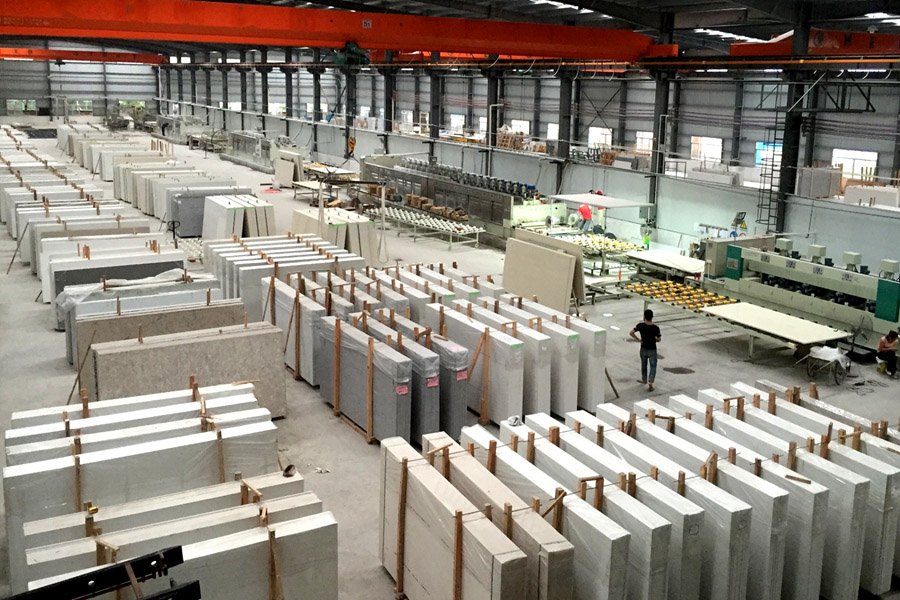
Engineered quartz slabs standing in storage at the Foshan factory.
The guidance is for developers, main contractors, importers, and wholesalers who need a repeatable supply of slabs, or of repeated cut pieces, across many units. It sits alongside how to specify quartz surfaces for large residential projects, which covers the specification process itself. Aspire Stone’s About page, fetched 23 November 2026 (Asia/Shanghai), still describes a Foshan factory of more than 25,000 sq.m with 3 quartz pressing lines and in-house production on Italian Simec equipment, and it lists cut-to-size supply for multi-unit projects. Those are published factory and capability statements, not a monthly capacity, a minimum order, or a named development.
What planning challenges come with large-volume slab supply?
A bulk order is not simply a small order multiplied. The difficulties that matter most in practice are:
- Batch consistency. Each production cycle can carry a different batch identity. Rooms, kitchens, or floors that will be seen together should be planned from the same batch wherever a visible match is required.
- Colour holds. A reserved colour or batch only helps if the hold quantity, the expiry, and what happens when the hold lapses are written down.
- Model standardisation. Too many colours or special island layouts multiply batch breaks, remnants, and the chance of a near-match substitution.
- Staging and access. If the site cannot take the full quantity at once, the packing and shipping plan has to follow the construction sequence.
- Identification. Slabs or cut pieces that arrive unlabelled by building, floor, unit type, or room are easy to mix on a busy site.
- Replacement stock. A later repair from a new batch is often a visible mismatch. Attic stock has to be part of the first plan.
None of these is solved by a square-metre price alone. Factors that influence wholesale cost, without inventing a figure here, are discussed in what affects the wholesale price of quartz slabs.
Why do model standardisation, batch consistency, and reserve stock matter?
Standardise first, then buy. A development that uses one or two approved models for typical kitchens and vanities is easier to batch, inspect, and repair than a scheme that allows a different colour in every building. Special islands, bookmatched features, or late design changes should be isolated in the schedule so they do not break the main batch.
Caesarstone’s August 2023 Fabrication & Installation Guide, used here as one manufacturer example, states that each production cycle carries a different batch number, that the number appears on the slab label and is also stamped on the back, and that jobs needing several slabs should use slabs from the same batch. Even then, the guide tells fabricators to carry out a visual colour match before cutting, preferably in lighting similar to the jobsite. Caesarstone also notes that a small sample is not a complete indicator of a full slab. Those points are good practice for any brand: reserve a batch, inspect adjacent slabs, and sign a retain sample or mock-up as the standard of work.
Reserve stock, sometimes called attic stock, should be taken from that same batch and stored so it can be found later. Agree the quantity in writing. This article does not publish a standard spare percentage.
If the development is handed over in phases, decide which rooms must match the first batch and where a controlled batch break is acceptable — for example between separate buildings that will not be seen together.
How should forecasting, production slots, and phased orders be handled?
Forecast from the unit mix and from a nested take-off, not from a rough area allowance. The measurement method is set out in the sister article on calculating slabs; waste control on large packages is covered in how to reduce material waste in large quartz countertop projects. Once typical units are nested on the real slab format, multiply by the number of units in each phase and add the agreed reserve.
Production slots and shipping windows should then be aligned with the construction programme. Ask the supplier to state, in the quotation:
- When the reserved batch will be produced or allocated, and how long the colour hold lasts.
- How a phased release will be scheduled, and what notice is needed to change a release date.
- What happens if the project is delayed after the batch has been produced.
- Whether later phases will be supplied from the same batch or from a new one.
Lead time is a function of colour, volume, whether the slabs are already allocated, how the order is phased, and the shipping method. It should be confirmed in writing for the live order. This article does not publish a standard factory lead time, a minimum order quantity, or a monthly capacity, because those figures have to come from a current confirmation, not from a newsletter.
Container planning, including how slab format and packing affect a load, is covered in how to calculate a quartz slab container load.
What belongs in the quality plan and the nonconformance process?
A bulk order needs a quality plan that is agreed before production, not a visual check only at the dock. Typical contents are:
- A signed sample, and a mock-up of each typical unit where the design is veined or repeated many times.
- A batch-identity rule and a requirement that labels or back stamps remain traceable.
- Inspection of full slabs or of first-off cut pieces against the signed standard, under agreed lighting.
- A defect list: what will be accepted as normal variation, and what will be rejected (for example cracks, pits, obvious gloss variation, or a colour that fails the visual match).
- Caesarstone’s own inspection notes, used only as an example of the kind of limits a manufacturer may publish, include a thickness tolerance and warp limits on that company’s slabs. Do not treat those numbers as Aspire Stone’s workshop tolerances. Ask the supplier for the inspection criteria that will apply to the live order.
- A nonconformance process: how a rejected slab or piece is recorded, whether it may be recut for a smaller piece, how a replacement is batched, and who pays for what.
Aspire Stone’s homepage, fetched the same day, says slabs are produced in-house on its Foshan pressing lines, with attention to colour consistency, surface finish, and export packing. That is the published wording. It is not a substitute for a project-specific inspection plan.
How should packing, labelling, and site delivery be organised?
Packing is part of bulk supply, not a last-minute crate note. Before the first shipment leaves, agree:
- Whether the order is raw slabs, cut-to-size pieces, or a mix.
- The packing method (for example A-frames or closed crates) and how it suits the destination handling equipment.
- A labelling code that names building, floor, unit type or unit number, and room, at the level the site actually needs.
- A packing list that can be checked against the schedule without opening every bundle.
- Who is responsible for offloading, storage on A-frames or in a dry area, and the order in which bundles are opened.
- How damaged pieces will be photographed, reported, and replaced from the reserve or from the same batch.
If pieces are cut to size, the published packing sequence on Aspire Stone’s cut-to-size page is that every countertop and vanity top is “cleaned, sealed, labeled, and packed for delivery.” That is the factory’s published packing wording. It should not be read as advice to apply a topical sealer to the finished face. Confirm what each step means when the order is placed.

Packed pieces in timber crates, from the live “Well packing” workshop photograph.
Bulk order RFQ checklist
| Request | What to send or ask for |
|---|---|
| Project brief | Location, phases, unit mix, and whether supply is slabs, cut-to-size, or both. |
| Product identity | Exact model codes, finishes, and published thicknesses, plus signed sample references. |
| Quantities | Nested take-off by unit type and phase, plus agreed attic stock, not only a total area. |
| Batch and hold | Same-batch rule, colour-hold quantity and expiry, and how a hold lapse will be handled. |
| Quality plan | Mock-up, inspection lighting, acceptance and rejection criteria, and nonconformance process. |
| Drawings | Typical-unit drawings or shop drawings, and current sink templates if pieces will be pre-cut. |
| Packing and labels | Packing method, labelling code, packing list format, and access or handling limits. |
| Logistics | Phased release dates, destination, and any container or site staging constraints. |
| Commercial terms | Price, minimum order, lead time, payment, and delay or cancellation terms — all to be confirmed in writing. Leave those figures off the specification body until they are confirmed. |
| Destination rules | Engineered-stone and silica requirements for the project location, checked before the order is placed. |
Australia appears on Aspire Stone’s site as a published market. That is not a market-access claim under Australia’s engineered-stone ban. Check the rule that applies to the destination before the RFQ is issued.
FAQ
How do I buy quartz slabs in bulk?
Issue an RFQ that includes the unit mix, a nested take-off, exact product codes, a batch-matching and hold request, a quality plan, packing and labelling notes, and the delivery sequence. A quantity and a colour name alone are not enough to run a multi-unit order.
How do suppliers manage large orders?
In a well-run order, the supplier allocates or produces a reserved batch, works to an agreed quality plan, releases shipments in phases, and labels bundles so the site can stage them. Ask for that sequence in the quotation rather than assuming it.
How can colour consistency be maintained?
Use slabs from the same production batch for rooms that will be seen together, inspect adjacent slabs visually under representative lighting, keep a signed retain sample or mock-up, and hold attic stock from that batch. If the project is phased, agree where a batch break is acceptable.
What is the lead time for bulk quartz orders?
It depends on the colour, the volume, whether a batch is already allocated, how the order is phased, and the shipping method. Lead time should be confirmed in writing for the live order. No standard factory lead time, minimum order, or monthly capacity is published in this article.
Should a bulk order be shipped all at once?
Only if the site can store and protect the full quantity, and if one batch can cover the rooms that must match. Many developments are better served by phased releases that follow the construction sequence, with packing lists and labels that match those releases.
What should be held as reserve stock?
A quantity, agreed in writing, of the same models and the same batch as the installed work, stored so it can be identified later. The figure is a project decision. Buying a replacement from a later batch is often a visible compromise.
Ready to issue a bulk slab RFQ?
If you have a unit mix, a take-off, or a finish schedule for a multi-unit development, send the RFQ checklist through Aspire Stone’s contact page. Ask for a written confirmation of batch allocation, packing, and programme. Those commercial figures should come back on the quotation, not from this article.


 WhatsApp
 EMAIL