




Is Quartz Stone a Good Material for Modern Interior Design?
Engineered quartz can be a strong choice for many modern interiors: factories can produce a wide range of colors and patterns with consistent repeats, and the finished surface is dense and easy to clean in everyday use. It is not right for every project. Heat, UV, visible seams and chips still need to be designed around, and the material should be compared with natural stone and porcelain for each brief.
What design advantages does engineered quartz offer?
The main design advantage is control. Color, pattern and finish are created in the factory, so a marble-look, a soft monochrome or a solid color can be specified with a closer match from slab to slab than most quarried stones allow. That repeatability is useful in modern kitchens, apartments and hospitality interiors, where several tops may need to read as one family of surfaces.
The range is also wide. Aspire Stone’s live product categories include Calacatta, Carrara and veined, solid color, sparkling, printed, exotic, low-silica or silica-free, and super-jumbo series. A designer can therefore look for a quiet white, a bold vein or a consistent block color without changing material category. Calacatta quartz is a typical route when a modern scheme wants a marble look with a more coordinated pattern. Printed designs, described on Aspire Stone’s printed-quartz pages as high-resolution thermal-transfer images, can also keep a pattern consistent from sheet to sheet.
Large formats support the same aesthetic. A jumbo or super-jumbo sheet can carry a long island or a tall waterfall with fewer joints, which suits the clean lines of many contemporary kitchens. Finish is part of the design as well: a polished face gives sharpness and reflection, while a honed or matte face is quieter. Not every color is made in every finish, so the finish should be confirmed with the sample, not assumed.
None of this means every slab in a color will be identical. Shade lots can still vary, and busy veins will never tile as perfectly as a solid color. The advantage is relative consistency, not a promise of zero variation.
For color selection in kitchens, see best quartz colors for modern kitchens. For combining the worktop with furniture and floors, see how to match quartz with cabinets and flooring.
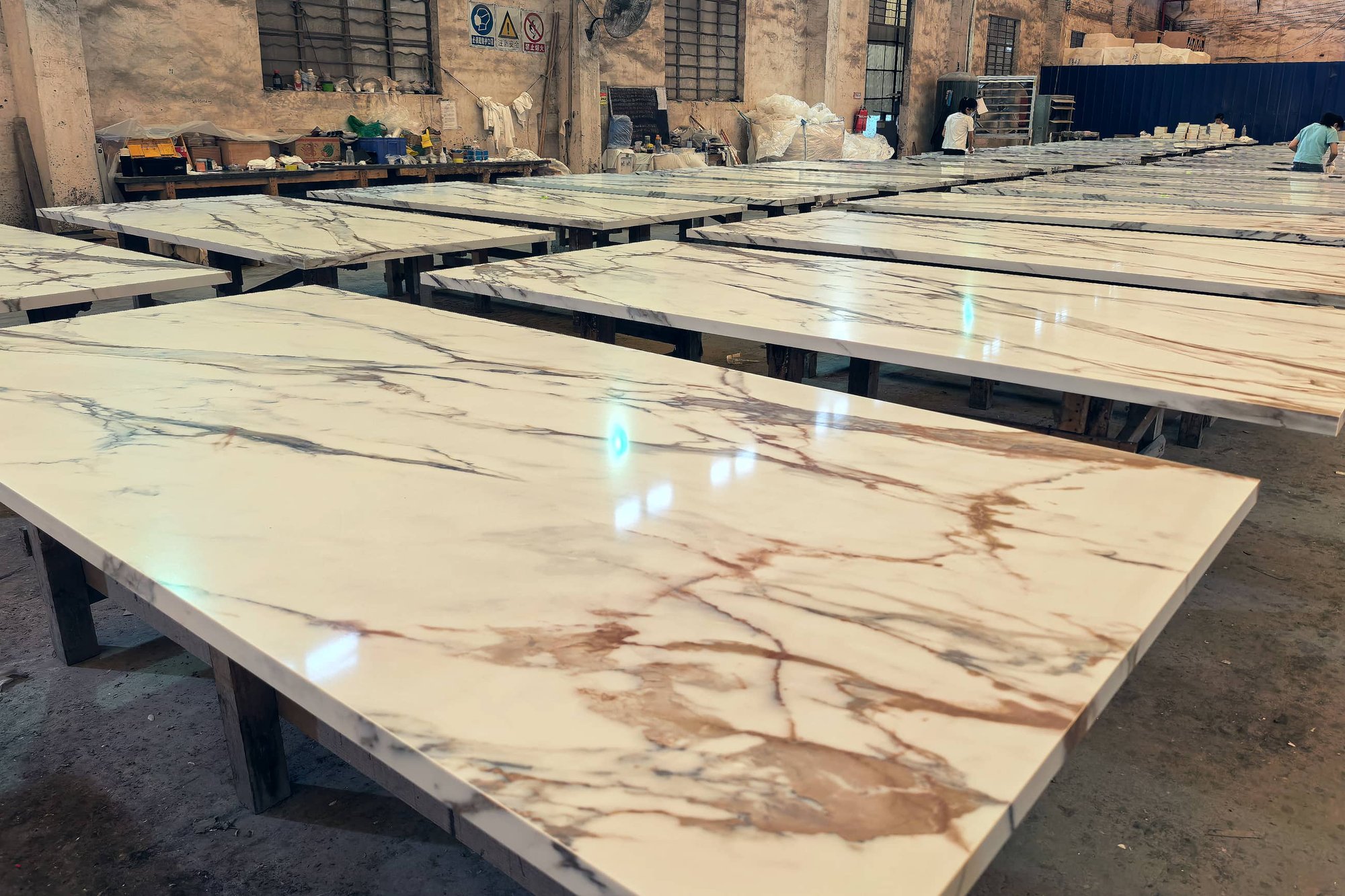
Engineered quartz slabs of a marble-look design, laid out in the workshop for interior worktops.
How does quartz perform in everyday use and cleaning?
In daily interior use, the practical benefit most often cited by manufacturers is a dense, low-absorption face that can be cleaned with mild soap and water. Caesarstone describes its quartz surfaces as nonporous and says routine care is simple, while still warning users to wipe spills, use trivets, and avoid harsh chemicals. Cosentino’s Silestone care manual calls the surface low-porous, recommends water and mild soap, and tells users not to apply repellents, sealants or polish.
That combination is why many buyers are told that engineered quartz does not require sealing. The statement should be kept in that qualified form. Low absorption is not the same as stain-proof, and a care guide is not a claim that the surface can be ignored. Dark or honed finishes can show marks, limescale or residue more clearly. Abrasive pads, high-pH cleaners, paint strippers and similar products are widely discouraged.
The material is also not maintenance-free in the absolute sense. Use Natural Stone, the Natural Stone Institute’s educational campaign, has pointed out that engineered quartz is sometimes thought to be maintenance-free, but that it can still stain, chip, scratch or be damaged by excessive heat. Cambria likewise says no stone is chip-proof or scratch-proof, and that seams are visible.
Used with ordinary care — a cutting board, a trivet, a soft cloth and prompt cleaning of spills — quartz is a low-effort interior worktop for many kitchens and bathrooms. That is a strong everyday argument. It is not a reason to specify the material where heat, sunlight or abuse will be severe.
What are the limitations of quartz in interiors?
The first limitation is heat. Conventional resin-bound quartz can be damaged by a sudden temperature change or by a hot pan, griddle, slow cooker or roaster left on the surface. Cosentino warns that thermal shock can damage the worktop. Caesarstone and Cambria both require trivets or hot pads. This is a design and user-habit issue: the kitchen can still look modern, but the specification should assume that heat protection is part of daily use.
The second is UV. The polymer binder can discolor, and in some cases warp, under unfiltered sunlight. Cosentino says Silestone should not be placed outdoors or anywhere exposed to direct UV rays. Vicostone and PentalQuartz give similar warnings, including for some interior locations with prolonged direct sun. A glass wall, a sunlit breakfast bar or an outdoor kitchen is therefore not an automatic fit.
The third is that the surface is a slab assembly, not a seamless sculpted volume. Joints will be seen. Pattern and shade can change across a seam. Edges and cut-outs are more vulnerable to chips than the middle of the sheet. Repair is possible in some cases, but a damaged corner or a burned resin spot is not as straightforward to make invisible as a marketing phrase might suggest.
A fourth limit is formulation and regulation. Ordinary engineered quartz contains crystalline silica in the mineral aggregate, and destination rules for engineered stone can affect whether a product can be specified at all. Low-silica or silica-free surfaces are a separate product decision, not a design finish, and they should be verified rather than assumed from a series name.
These limits do not make quartz a poor interior material. They define the projects in which it is a good one. The wider applications of quartz slabs are mostly indoor work surfaces, not exterior or high-heat uses.
How does quartz compare with natural stone and porcelain for design flexibility?
Against natural stone, quartz usually offers a more predictable pattern, a factory-controlled thickness and, in many care guides, no routine sealing. Natural marble, granite or quartzite can provide a geological uniqueness that some interiors want, and some of those stones can be used outdoors, but they also bring their own care and variation issues. Marble-look quartz is a design substitute, not a piece of marble. The right comparison is the look you want plus the maintenance you will actually do.
Against porcelain or sintered slabs, the comparison is different. Porcelain is often chosen where heat or UV exposure is more demanding, because those ceramic surfaces are fired rather than resin-bound. Quartz generally feels closer to stone in visual depth and in familiar kitchen fabrication practice, and it is widely available in marble-look and solid colors for interior worktops. Porcelain has its own thickness, edge, handling and fabrication requirements. The choice should be made on the exposure and the workshop capability, not on a single “modern” label. A dedicated quartz vs porcelain comparison is the place to go deeper.
In short, quartz is often the more flexible interior design surface when the project needs coordinated color, repeatable slabs and straightforward daily cleaning. Natural stone may win where unique movement or exterior use is essential. Porcelain may win where unfiltered sun or higher heat is part of the brief.
How should you decide if quartz is right for a project?
A simple framework keeps the decision honest.
| Question | If the answer is yes | If the answer is no, or uncertain |
|---|---|---|
| Is the surface indoors, and mostly away from unfiltered sun? | Quartz is in its usual setting | Consider porcelain, natural stone, or a product warranted for UV / exterior use |
| Can users live with trivets, cutting boards and visible seams? | Everyday kitchen and vanity use is a typical fit | Reassess edge design, layout, or material expectations |
| Is a coordinated, repeatable pattern more important than unique geological movement? | Quartz’s factory design range is a strength | Natural stone may be the better aesthetic |
| Will the project accept ordinary mild cleaning, without treating the top as indestructible? | Quartz can be a low-effort worktop | No surface will meet a “proof against everything” brief |
| Do budget, lead time and fabrication capability line up with a slab material? | Compare actual sizes, finishes and cut-to-size options | A different format or material may be simpler |
The balanced view is that engineered quartz is a good material for many modern interiors, especially kitchens and bathrooms that want a cleanable, coordinated work surface. It is not automatically the best material for every kitchen, and it is a poor choice where the brief needs outdoor use, high heat or a seamless, damage-proof surface.
For a definition of the material itself, see what quartz stone is. If you are shortlisting designs, start with Aspire Stone’s categories or Calacatta series, and request samples or a specification review for the rooms you are designing.
FAQ
What are the advantages of engineered quartz?
The usual advantages are a wide, factory-controlled range of colors and patterns, relatively consistent repeats from slab to slab, a dense surface that is typically easy to clean with mild soap and water, and, in many manufacturer care guides, no routine sealing. Large formats can also reduce the number of seams on long modern worktops.
What are the disadvantages of quartz countertops?
Quartz is not heat-proof, scratch-proof or stain-proof. Seams are visible. Edges can chip. The resin binder is sensitive to unfiltered UV, so conventional products are generally not recommended outdoors. Shade lots can still vary, and harsh cleaners can damage the face.
Does quartz require sealing?
Many manufacturers say engineered quartz does not need sealing because the finished face is non-porous or low-absorption. Cosentino explicitly tells users not to apply sealants or polish to Silestone. Confirm the care instructions for the exact product, and remember that “no sealing” is not the same as “no cleaning” or “no staining.”
Is quartz suitable for every kitchen?
No. It is a strong candidate for many indoor, modern kitchens that can use trivets, accept visible seams and stay within ordinary cleaning habits. Kitchens with unfiltered sun, outdoor cooking, or an expectation that the worktop will take direct heat or heavy abuse may need a different material or a more cautious design.


 WhatsApp
 EMAIL